



3 in 1 CNC Busbar Machine Capacity Planning for Switchgear Workshops
A switchgear workshop can appear busy without being truly capacity-limited. Copper bars may be waiting beside the punching station, bent parts may accumulate before assembly, and operators may spend more time moving material between processes than processing it. In this situation, buying the largest available machine is not automatically the right answer. The better choice is a 3 in 1 CNC busbar machine sized around the workshop’s actual bottleneck, material range, part mix, and required delivery rhythm.
For most purchasing decisions, capacity planning should begin with the heaviest realistic production week rather than an annual average. Estimate the number of busbar parts that must be cut, punched, and bent during that period, then compare that demand with usable machine time after setup, tool changes, inspection, loading, unloading, and planned maintenance. A machine that looks sufficient on paper can become restrictive when frequent short batches or complex hole patterns are included.
Start with the production flow, not the machine specification
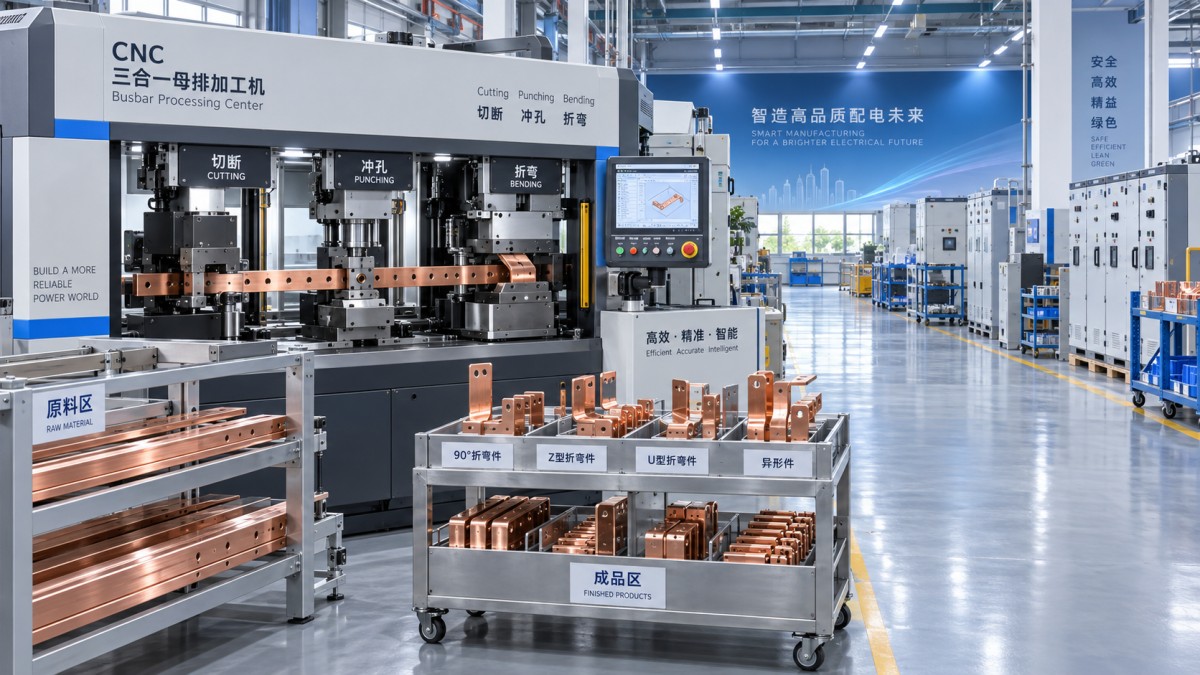
A three-function machine can reduce handling between cutting, punching, and bending, but its practical output still depends on how work enters and leaves the station. Review the path of a typical busbar from stock rack to finished, labeled component. Identify where material waits, where operators re-measure dimensions, and where parts are returned for correction. These observations often reveal whether the issue is machine capacity, programming, tooling availability, or material preparation.
In a workshop producing repeated panel designs, the machine may run long batches with few changeovers. Capacity is then largely determined by processing speed, material thickness, and the number of parts per shift. A workshop serving many customized switchgear orders faces a different condition: frequent switching between widths, hole patterns, bend angles, and part revisions can consume a meaningful share of the day. For that operation, programming convenience, fast setup, and organized tooling may matter as much as nominal cycle speed.
Before comparing models, separate the workload into three groups:
- High-volume standard parts: repeated links, connectors, mounting bars, and common panel busbars.
- Variable engineered parts: components with different hole layouts, offsets, or bend sequences.
- Occasional heavy or oversized work: parts that may define the required tonnage, throat depth, or bending range even though they are not produced every day.
The machine should handle the first two groups efficiently and accommodate the third group without forcing an impractical workaround. Do not base selection solely on the most frequent small part if larger conductors are essential to the workshop’s product range.
Convert demand into usable machine hours
A reliable planning calculation does not need invented precision. It needs realistic assumptions. Begin by listing expected weekly or monthly quantities by part family. For each family, note the number of cuts, holes, slots, embossing operations where applicable, and bends required per piece. Then estimate the average processing time together with non-cutting time: material positioning, program selection, tool change, quality checks, scrap removal, and finished-part handling.
Use available production time rather than calendar time. A nominal shift may include breaks, meetings, material delays, first-piece approval, and routine cleaning. Reserve some open time for urgent replacement parts, rework, or changing priorities. When a capacity plan assumes every scheduled minute is productive, even a small disruption can push deliveries behind schedule.
A useful purchasing question is not “How many pieces per hour can it make?” but “How many finished, accepted busbar parts can the workshop release per shift under normal scheduling conditions?” The second question includes the realities that determine whether equipment actually relieves pressure on assembly.
Match machine range to the busbar specification
Capacity is more than output rate. The processing range must cover the workshop’s maximum and routine conductor dimensions. Check the permitted busbar width and thickness for cutting, punching, and bending individually. A machine may accept a material size in one station but have different limits for another operation. Bending capacity should also be assessed against the required bend orientation, minimum inside radius, leg length, and clearance around already-punched features.
Copper and aluminum should not be treated as interchangeable simply because dimensions are similar. Material behavior affects bending force, surface marking risk, burr control, and springback. Purchasers should provide representative drawings and material details during evaluation, particularly where aluminum sections, plated surfaces, or tight electrical-clearance requirements are involved.
Punching requirements deserve the same attention. Count not only round holes but also oblong holes, special slots, and repeated mounting patterns. Tooling gaps can create a hidden constraint: an operator may need to reposition material, make several separate hits, or substitute an unsuitable tool shape. That adds time and can complicate dimensional control. Where replacement or additional tooling is part of the plan, a compatible Punch Die can be considered for the required busbar mold supply, provided its dimensions and application match the machine and intended hole pattern.
Find the real bottleneck before adding capacity
When output falls behind, the processing machine is often blamed first. Yet the constraint may be upstream material staging or downstream assembly release. Look at the queue in front of each activity over several normal production days. A growing queue before punching may indicate insufficient processing time or too many tool changes. A queue after bending may point instead to inspection delays, unclear part identification, or a lack of organized storage for completed components.
There are also cases where one function causes most of the delay. For example, cutting may be quick while complex bending consumes time because every part needs manual orientation checks. Or the punch station may be occupied by small urgent jobs that interrupt planned batches. A 3-in-1 arrangement is valuable when it fits the overall flow, but it is still important to understand whether one shared platform will become a scheduling constraint as volume rises.
Ask the following operational questions during evaluation:
- Can cutting, punching, and bending activities be scheduled in the order required by current jobs?
- How often will operators change dies, bending tools, or program setups during a typical week?
- Are material racks and finished-part locations close enough to avoid repeated lifting and searching?
- Will one machine be expected to support both production orders and urgent service parts?
- Does the planned layout leave access for loading long busbars, maintenance, and safe removal of offcuts?
Plan around repeatability, not only peak speed
Switchgear busbars must fit their intended assemblies without repeated adjustment. A high nominal processing rate has limited value if hole positions drift, bend angles require correction, or cut edges need excessive finishing. During technical review, focus on how the machine controls positioning, how programs are stored and recalled, and how operators verify first pieces after a changeover. Repeatability becomes especially important when several panels use matching busbar sets or when parts are prepared ahead of assembly.
Tool condition is part of this calculation. Worn punch tooling can increase burrs, affect hole quality, and create avoidable rework. Keep frequently used dies identified by size and application, and maintain a simple replacement record. A low-cost die is not necessarily low-cost in operation if its service life, fit, or finish creates repeated interruptions. The stated price of a Punch Die is $66, but purchasing should still confirm compatibility and the correct tool specification before treating it as a production spare.
Decide how much growth margin is justified
Some reserve capacity is sensible because switchgear orders rarely arrive in perfectly even volumes. However, excessive oversizing can tie up budget, floor space, electrical capacity, and operator attention without solving the workshop’s real problem. A practical margin should reflect expected changes in order quantity, conductor size, and job complexity, not a vague assumption that more capacity is always safer.
Choose the larger processing range when upcoming work is likely to include thicker or wider busbars, more demanding bending geometry, or a meaningful increase in part volume. Choose a configuration focused on fast setup and reliable program handling when demand is mixed, customized, and time-sensitive. Where production demand is stable but delivery dates are tight, invest equal effort in material flow, tool organization, and inspection routines; these factors often determine whether the machine’s rated capacity is actually available.
The strongest capacity plan leaves the workshop with enough processing time for planned orders, enough flexibility for normal variation, and clear limits for work that exceeds the selected machine’s range. That gives purchasing teams a basis for comparing equipment on operational fit rather than headline specifications alone.
Send Us A Message
Get in Touch
*We respect your confidentiality and all information are protected.

First class quality service and professional after-sales team.