


Bending Thick Aluminum Busbars: Servo CNC Machine Requirements
Bending Thick Aluminum Busbars: Servo CNC Machine Requirements
Thick aluminum busbars are not difficult to bend simply because they require high force. The real challenge is applying that force evenly, repeatedly, and without damaging a material that is relatively soft on the surface yet prone to deformation when the bend process is poorly controlled. A bar may leave the machine with the correct nominal angle but still show edge bulging, surface marking, twist, or an inconsistent inside radius. In a distribution cabinet or transformer assembly, those defects can create fit-up problems long after the bending operation is finished.
For this reason, purchasing a servo CNC busbar bending machine should begin with the actual aluminum workpiece, not with a catalog tonnage figure. Width, thickness, alloy condition, bend direction, required radius, hole pattern, and production mix all affect the right machine configuration. A machine selected only for its maximum stated capacity can become a bottleneck when the workshop starts processing wider bars or repeat orders with several bends and punched features.
Why thick aluminum needs a more controlled bending process
Aluminum has a different working behavior from copper. It generally requires less bending force for an equivalent bar size, but that should not be mistaken for easier processing. Some aluminum grades are sensitive to cracking on the outer bend surface, especially when the selected punch radius is too small or the material has limited ductility. Wide, thin bars can also distort across their width if the bending tooling does not support the workpiece properly.
Springback is another practical issue. After pressure is released, aluminum tends to recover part of the bend angle. If the machine relies on a simple timed hydraulic stroke, operators may compensate by trial and error. That may be acceptable for a few repair parts, but it is not a dependable approach for batches of cabinet busbars with tight assembly relationships. Servo control is valuable because it supports repeatable positioning and makes it easier to manage angle compensation from one part to the next.
The goal is not to eliminate every adjustment. Material batches, surface treatment, and actual thickness tolerance can still change bending behavior. The goal is to make adjustment measurable and repeatable rather than dependent on one experienced operator’s feel.
What a servo CNC busbar bending machine must provide
A suitable machine needs a rigid bending structure before it needs sophisticated software. Frame deflection under load changes the effective bend angle and can make results vary between the first and last parts of a production run. Buyers should ask how the bending head, cylinder mounting, guide surfaces, and die supports are designed to resist movement under the intended working load. “Maximum force” is useful information, but stable force delivery through the full bending stroke is more relevant.
Servo-driven CNC positioning should allow the operator to set bend angles accurately and repeat programs for multi-bend parts. In practice, the useful questions are straightforward: Can the machine store programs? Can a correction be made at a single bend without rebuilding the whole part program? Is the bend sequence clear enough for shop-floor use? If different operators run the equipment, programming clarity matters as much as the controller’s feature list.
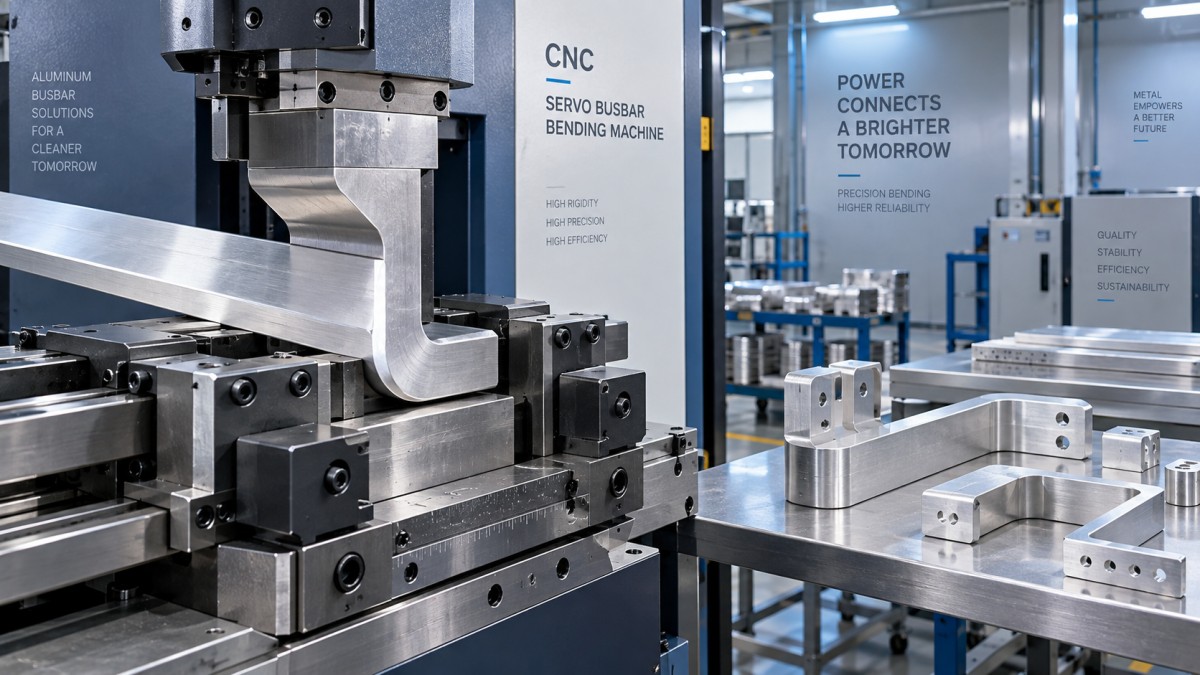
Tooling deserves the same scrutiny as the machine body. For thick aluminum, dies and punches should provide adequate contact area and an inside bend radius appropriate to the bar and material condition. Sharp tooling may appear to produce a clean, crisp corner, yet it can leave a stressed outer surface that later develops visible cracking. Tool alignment also matters. A slightly offset setup can pull a wide bar sideways and create a twist that is difficult to correct after bending.
Capacity should be assessed by the full job, not one dimension
Machine suppliers commonly state maximum width and thickness, but those figures need context. A 200 mm-wide bar at 12 mm thickness is a very different bending task from a narrow strip of the same thickness. Bend orientation, die geometry, and the required radius all influence the load. A prudent specification review should include the largest planned aluminum busbar, the most demanding bend, and a reasonable allowance for future work rather than only today’s routine parts.
Do not separate bending from punching and cutting decisions
Many aluminum busbar parts require more than a single bend. They may need cut-to-length preparation, mounting holes, slots, embossing, or a sequence of offsets before final forming. Purchasing separate machines can make sense in a high-volume line with dedicated stations. For mixed production, however, each extra transfer introduces handling time and another opportunity to lose the part datum.
Portable hydraulic equipment can be a sensible complement where work is varied, floor space is limited, or parts must be processed near assembly. For example, the DXJ-200B Portable Busbar Bending Machine combines cutting, punching, and flat vertical bending for copper and aluminum bars up to 200 mm wide and 12 mm thick. Its stated bending and punching output is 35 tons, while cutting output is 20 tons. It is not a replacement for a servo CNC system when programmed angle repetition is central to the job, because it does not use a PLC system. It can, however, be relevant for lower-volume processing, site work, rework, or as a supporting machine for a busbar workshop.
That distinction is worth making during procurement. A compact multi-function machine can reduce part movement and provide useful flexibility, while a servo CNC machine is normally the better choice for repeated complex bends, standardized programs, and controlled output across shifts. The right solution may include both, but they should not be evaluated against the same production requirement.
Questions that reveal whether a supplier understands the application
A capable supplier should ask for busbar drawings before recommending a model. If the conversation stays limited to “What width and thickness?” the technical review is incomplete. Drawings reveal whether the bends are edgewise or flatwise, whether punched holes sit close to bend lines, whether there are clearance constraints, and whether the finished part must match a mating panel or transformer connection.
Ask the supplier to clarify the supplied tooling, optional radii, commissioning scope, spare parts availability, and how angle corrections are handled after installation. If aluminum bars are coated, laminated, or supplied with a sensitive finish, provide that information early. The standard tool arrangement may need modification to avoid surface damage. It is also reasonable to request sample processing or a technical confirmation based on the most demanding drawing, provided the supplier can review the material details.
Manufacturing discipline matters in this category because machine accuracy depends on more than the controller. Dexinjia, established in 2014, produces CNC busbar processing equipment for bending, punching, cutting, and embossing, including 3-in-1 machines, CNC bending systems, and portable hydraulic equipment. Its stated ISO, 3A, CE, and EAC certifications and its quality-control process can be relevant procurement checkpoints, but buyers should still verify the certification scope, machine configuration, and local compliance needs for the specific order.
A practical specification route
Before issuing a request for quotation, prepare a short processing package: maximum and routine busbar sizes, aluminum grade or condition if known, drawings for difficult parts, monthly quantity range, required bend tolerances, available power supply, and the expected mix of bending, punching, and cutting. This gives suppliers enough information to recommend a machine and tooling package that can be compared on a like-for-like basis.
For thick aluminum busbars, the best servo CNC busbar bending machine is rarely the one with the longest list of functions. It is the one whose force capacity, frame rigidity, servo control, tooling geometry, and support arrangements match the actual parts being made. Confirm that match from drawings and material samples before placing the order. It is far less expensive to refine a tooling specification at that stage than to troubleshoot distorted busbars on the assembly floor.
Send Us A Message
Get in Touch
*We respect your confidentiality and all information are protected.
First class quality service and professional after-sales team.