


Busbar Cutting Machine Selection by Material, Width, and Thickness
A busbar cutting machine should be selected from the workpiece outward, not from the machine catalogue inward. The decisive inputs are the conductor material, finished width, thickness, required edge condition, and production pattern. A machine that has enough nominal tonnage but an unsuitable throat, blade arrangement, or workholding system can still create burrs, distortion, poor repeatability, and unnecessary secondary finishing.
For most electrical panel, switchgear, transformer, and power-distribution work, copper and aluminum busbars are supplied in relatively standard rectangular sections. That does not make cutting requirements standard. A 120 mm × 10 mm copper bar and a 120 mm × 10 mm aluminum bar occupy the same envelope, but they do not impose the same load on the cutting system or behave identically at the cut edge. Selection should therefore begin with the full material-and-section range expected over the equipment’s working life, rather than with the dimensions of the most common current order.
Material determines cutting force, edge behavior, and tooling expectations
Copper is the more demanding material in many busbar cutting applications because of its higher strength and its tendency to work-harden under deformation. It requires a rigid cutting structure, correctly matched blade clearance, and stable clamping. If the cutting force is marginal, the visible outcome may be a rough edge, excessive burr, local rollover at the upper edge, or a slight twist in narrower sections. These defects matter because busbar ends are frequently used in bolted, plated, insulated, or closely spaced electrical assemblies.
Aluminum generally needs less cutting force than copper at the same width and thickness, but it should not be treated as a low-risk substitute in machine selection. Aluminum is more prone to surface marking and can form burrs or dragged material if blades are dull, clearance is excessive, or the workpiece is not adequately supported. Its oxide layer and softer surface also make downstream contact preparation important. A cut that looks acceptable visually may still require deburring or surface treatment before a reliable electrical joint is assembled.
A supplier’s stated “copper and aluminum capacity” is only a starting point. The purchasing review should establish whether that capacity applies to the same maximum section for both materials, whether it is based on a single cut or sustained duty, and whether the machine uses the same blade set and clearance arrangement for each material. Some cutting systems accommodate a range of sections effectively only when blade geometry or settings are adjusted. That is not necessarily a weakness, but it must be reflected in setup time, operator instructions, and spare-tool planning.
Width is not just a capacity number
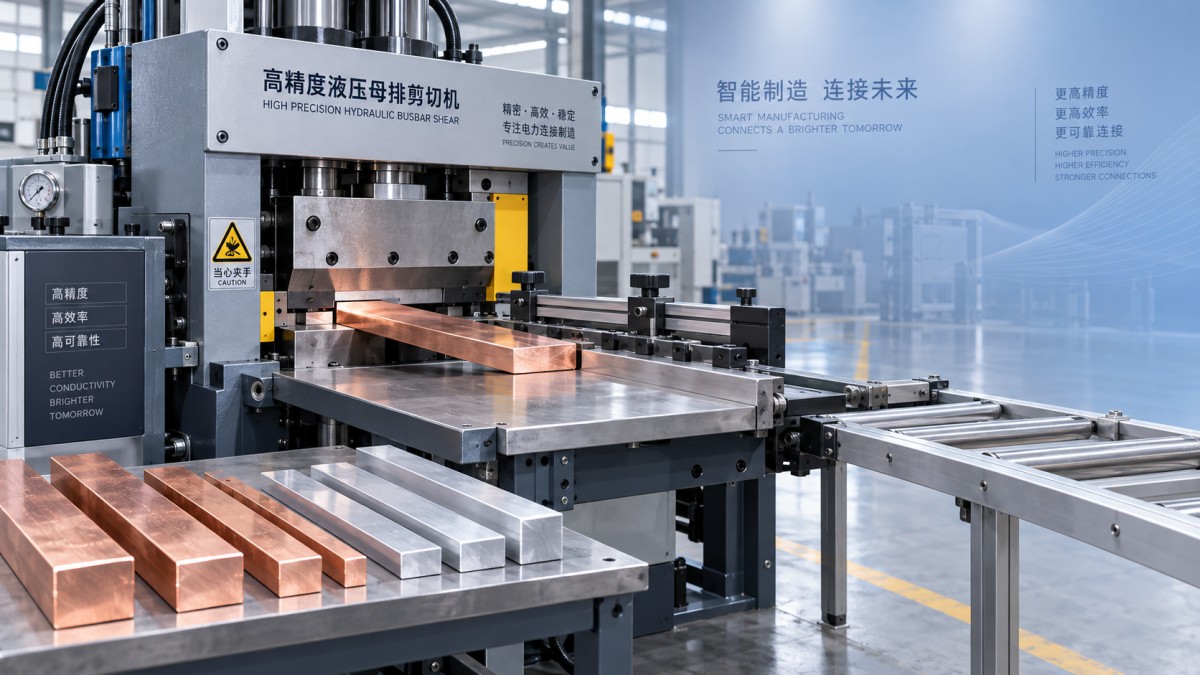
Maximum busbar width affects more than whether the material physically fits under the cutting head. Wide flat bars need support on both sides of the cut line so that their own weight does not cause sagging or a tilted cut. This is especially relevant when processing long stock lengths or when operators cut near an unsupported end. A machine with a nominal 200 mm width capacity may not deliver the same cut quality across that full width unless the infeed table, back gauge, side guide, and outfeed support are designed for it.
The practical question is therefore: what widths will be cut repeatedly, at what lengths, and with what length tolerance? For short, repetitive parts, an accurate mechanical stop or programmable back gauge can have a greater impact on output consistency than extra unused width capacity. For mixed jobs, guides must be easy to reset without introducing squareness errors. A poorly referenced guide can turn a capable shear into a source of angled cuts that become obvious only during assembly.
Width also affects the required clearance around the tooling. Buyers should verify the usable width rather than rely on an external machine dimension or a broad catalogue category. Items such as protective guards, clamps, stroke path, and the position of the gauge can limit the real processable width. If busbars include pre-punched holes, embossed identification marks, or formed ends before cutting, confirm that these features can pass through the machine without interference.
Thickness is where nominal capacity often becomes misleading
Thickness has a strong influence on shear force. In simplified terms, cutting load rises with the cross-sectional area being sheared, so a moderate increase in thickness can move a job from routine operation to the upper end of a machine’s capability. The relevant section is width multiplied by thickness, but material condition, blade condition, and the shear angle also affect the actual load and cut result.
For that reason, a machine rated for a maximum thickness should not automatically be specified for continuous production at maximum width and maximum thickness. A stated limit may describe the largest permissible section under controlled conditions, rather than the ideal operating point for frequent production. If the order mix includes regular cutting near the capacity boundary, it is prudent to request the supplier’s rated combination of width, thickness, and material, along with the machine’s intended duty cycle.
Thickness variation within a batch is another procurement issue. Rolled bar stock may be supplied to tolerance, and the actual section can differ from the nominal dimension. A cutting machine with very little margin may produce inconsistent edges when material approaches the upper tolerance. Capacity should be assessed against the highest credible material dimension, not simply the number printed on the purchase order.
Thin busbars have a different problem: they may deflect, bow, or show pronounced rollover if clamping is weak or the blade gap is inappropriate. The right equipment must cover the complete operating window. A high-force machine is not automatically better for thin material if it lacks controlled hold-down pressure and suitable tooling geometry.
Cut quality must be defined before comparing machine prices
“Clean cut” is too vague for a technical purchase specification. The acceptable edge condition depends on what happens after shearing. A busbar that will be punched, bent, and enclosed may tolerate a different finish from a conductor that will be directly connected to a terminal pad or supplied as a visible finished component.
The specification should state the acceptable limits for burr direction and height, end-face squareness, length tolerance, and deformation near the cut. It should also define whether manual deburring is permitted. This point has direct cost implications. A lower-priced machine that creates a repeatable but unacceptable burr transfers cost to labor, handling, inspection, and potentially assembly rework. Conversely, requiring an exceptionally fine edge where a simple deburr is sufficient can lead to unnecessary capital expenditure.
Cutting sequence matters as well. Cutting before punching and bending is common because it simplifies handling and part identification, but certain layouts may require holes or marks before final length is established. When choosing a standalone busbar cutting machine or a station within a combined processing line, check whether the locating datum remains consistent through every operation. Accurate individual stations do not guarantee accurate finished parts if each operation references a different edge or stop.
Machine architecture should match the production pattern
Portable hydraulic tools can be suitable where work is performed at installation sites, quantities are limited, or busbar sizes vary frequently. Their constraints are usually handling effort, manual positioning, and lower automation. They should be evaluated for portability without overlooking the need for a stable work surface, safe material support, and repeatable length measurement.
Fixed hydraulic shears and integrated busbar processing machines are more appropriate where repeatability and throughput are central. Their value comes not only from faster strokes, but from better guiding, controlled clamping, repeatable stops, and the possibility of coordinating cutting with punching and bending. The appropriate configuration depends on whether output is dominated by repeated production batches or highly varied, low-volume electrical assemblies.
Do not compare cycle time in isolation. A realistic productivity review includes loading long bars, measuring and setting stops, making trial cuts after a size change, removing parts safely, and managing offcuts. In a high-mix environment, setup simplicity and gauge repeatability can outweigh a faster theoretical cutting stroke.
Flatness of incoming stock can affect cutting accuracy
A cutting unit cannot fully compensate for busbar that arrives with coil-set, longitudinal bow, or uneven flatness. Curved stock may sit inconsistently against the guide and stop, causing length variation or a non-square relationship between the cut and the bar edges. It can also complicate later punching and bending, where stable positioning is essential.
Where straightness is a recurring issue, pre-processing should be considered as part of the equipment decision rather than as a separate inconvenience. For copper and aluminum bars up to 160 mm wide and 12 mm thick, a roller leveling unit such as the DXJ-160 Copper Busbar Straightening & Leveling Machine can be placed ahead of punching, shearing, and bending operations. Its role is not to add cutting capacity; it is to improve the consistency of the material entering those processes. That distinction is important when evaluating a line’s overall output quality.
What should be verified in a supplier quotation
A usable quotation should identify the maximum copper and aluminum section separately, the cutting method, usable width, thickness range, length-stop arrangement, tooling included, electrical requirements, and the expected consumables. It should also clarify whether installation, commissioning, operator training, and remote or local service are included.
Blade life should be discussed in operational terms, not accepted as a broad promise. Ask how blades are inspected, whether they can be rotated or reground, how replacement clearance is set, and whether replacement parts are available with documented lead times. For overseas procurement, these details can be more consequential than a small difference in initial machine price.
Certification must be relevant to the destination market and the supplied configuration. CE marking, for example, is not a generic proof that any machine can be placed into any application without review; the delivered machine, guarding, electrical system, documentation, and intended market requirements all need to align. Request the applicable documents early, particularly where import clearance, internal safety approval, or customer audits are involved.
The best selection is rarely the model with the highest headline tonnage. It is the machine whose verified material range, usable working envelope, cutting quality, support arrangement, and serviceability match the actual busbar schedule. Defining those conditions before requesting quotations turns a busbar cutting machine purchase from a comparison of catalogue limits into a controlled production decision.
Send Us A Message
Get in Touch
*We respect your confidentiality and all information are protected.
First class quality service and professional after-sales team.