



Calculating the ROI of Servo CNC Busbar Bending for Switchgear Plants
Calculating the ROI of Servo CNC Busbar Bending for Switchgear Plants
For switchgear plants, investing in a servo CNC busbar bending machine is not only a production upgrade—it is a measurable business decision. By reducing manual labor, improving bending accuracy, minimizing material waste, and accelerating throughput, the right machine can deliver a strong return on investment. The important point is that ROI should not be judged by the machine’s purchase price alone. In busbar fabrication, the real cost often sits in rework, fitting delays, operator dependence, damaged copper, and jobs that remain unfinished when the assembly line is waiting.
A practical ROI calculation starts with the way a plant actually produces switchgear. A workshop making repeat batches of distribution panels has a different cost profile from a plant handling low-volume, engineer-to-order medium-voltage assemblies. Both may benefit from automation, but the payback mechanism is not identical. High-volume plants usually recover investment through cycle-time reduction; mixed-production plants often gain more from repeatable quality, easier program recall, and fewer costly corrections during final assembly.
Start with the Cost of the Existing Bending Process
Before estimating savings, document the current process honestly. Many plants compare a new CNC system only with the wage of one bending operator. That is too narrow. Manual or semi-manual bending commonly involves measuring, marking, setting stops, checking angles, moving parts between stations, and correcting pieces that do not fit the intended enclosure or connection point. Those minutes are easy to overlook because they are spread across fabrication, inspection, and assembly.
The baseline should include direct labor, supervision, overtime, scrap value, rework time, tooling changeover, and the cost of production interruption. Copper and aluminum are not forgiving materials from a purchasing perspective: an incorrect bend near a punched hole may leave a piece unsuitable for the original drawing, even if it can be retained for a smaller future job. Plants should record this as recoverable residual material, not assume it has full value.
One useful method is to sample several representative orders over two to four weeks. Track the number of busbar pieces, total bends, operator minutes, rejected parts, and time spent waiting for correction. Include both simple 90-degree bends and more difficult profiles that require accurate spacing and orientation. The result is far more reliable than using a single “average minutes per part” figure.
The ROI Formula Is Simple; the Inputs Are Not
The standard calculation is straightforward:
Annual ROI (%) = (Annual financial benefit − Annual operating cost) ÷ Total investment × 100
For capital planning, many managers also use payback period:
Payback period (years) = Total investment ÷ Net annual financial benefit
The total investment should cover more than the equipment quotation. Add shipping, import-related costs where applicable, installation, electrical preparation, operator training, initial tooling, and a realistic allowance for commissioning time. If the machine requires changes to material flow or safety arrangements, those costs belong in the project as well. Leaving them out makes the proposal look better on paper but weaker when finance reviews the final numbers.
Annual financial benefit generally comes from four places: labor capacity released for other work, reduced scrap and rework, increased productive output, and fewer assembly disruptions. Not every saved minute becomes a cash saving. If an operator remains employed and production volume is unchanged, the gain may be capacity rather than payroll reduction. That still has value, particularly when overtime is common or when hiring skilled fabricators is difficult, but it should be described accurately in the investment case.
Where Servo CNC Bending Changes the Economics
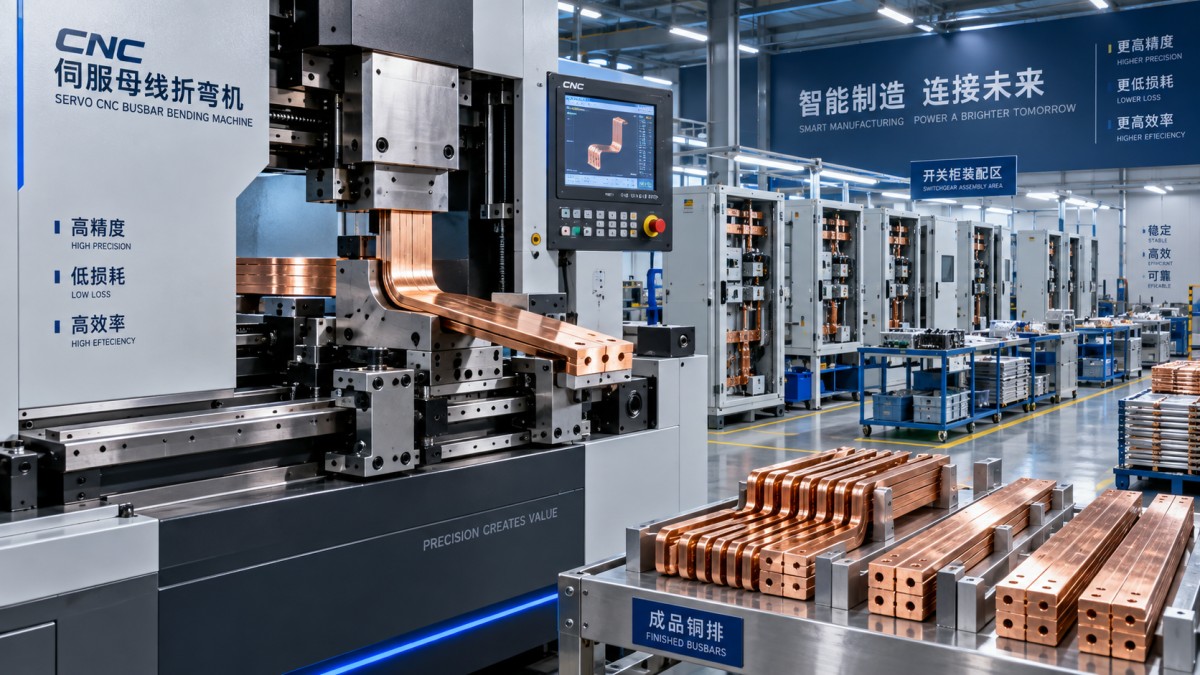
A servo CNC busbar bending machine earns its place when programming and repeatability replace repeated manual setup. Instead of relying on an operator to interpret every angle, offset, and bend sequence from a drawing, the plant can store proven programs and reproduce them across future orders. This matters when switchgear designs recur with small variations, when several shifts use the same drawings, or when experienced operators are not always available.
Accuracy has a direct cost effect. A busbar that is only slightly outside the intended angle can create contact pressure issues, misalignment at insulators, interference with panel partitions, or extra shimming during assembly. The fabrication department may see a minor adjustment; the assembly team sees a delay with a cabinet occupying valuable floor space. The strongest ROI models assign at least an internal cost to these interruptions rather than treating them as unavoidable workshop noise.
Throughput should also be evaluated at the bottleneck, not just at the bending station. If punching, cutting, and bending are handled as separate queues, a faster bending machine alone may not materially improve completed-panel output. In some plants, a combined busbar processing arrangement is more economical because it reduces part handling between operations. In others, dedicated equipment is justified because volume is high enough to keep each station busy. There is no universal answer; the production mix decides it.
Match Capability to the Work You Actually Run
A common procurement mistake is selecting a machine according to maximum capacity alone. A plant may occasionally process a large copper bar but spend most of its year bending smaller, repetitive conductors. The better question is whether the machine handles the normal work range efficiently, with suitable tooling and a control system operators can use consistently.
For example, the DXJ-80CN Copper Busbar Machine range includes configurations intended for busbars up to 300 mm wide and 20 mm thick, with an 800 KN rating. The DXJ-803CN configuration combines punching, cutting, and bending through independent hydraulic stations, while its Siemens PLC bending control supports direct angle input and program memory. Its stated bending accuracy is ±0.5°, a specification worth considering where consistent fit-up is a recurring issue. These figures are useful only if they match the plant’s material dimensions, bend types, and daily workload; buying excess capability that is rarely used can lengthen payback.
Tool durability deserves similar attention. Punches and bending dies are consumables in economic terms, even when they last a long time. Buyers should ask what grades are used, which common hole and bend tools are included, how quickly replacements can be supplied, and whether local or remote technical support can help diagnose setup problems. A low initial price loses its appeal if a worn or damaged tool keeps a production line idle.
Build Three ROI Scenarios, Not One Optimistic Forecast
A sensible capital request uses conservative, expected, and high-utilization scenarios. The conservative scenario should assume current order volume, modest labor savings, and no immediate reduction in headcount. The expected scenario can include realistic scrap reduction and overtime avoidance based on measured production records. The high-utilization scenario may reflect planned capacity growth, but it should not be the only justification for the purchase.
Look Beyond the Machine Specification Sheet
The machine itself is only one part of the investment. Ask the supplier how programs are created and backed up, whether the interface supports the languages used on the shop floor, what remote support covers, and how spare parts are managed in your region. For plants that process both copper and aluminum, confirm the tooling and process recommendations for each material rather than assuming identical settings will deliver identical results.
Dexinjia, founded in 2014, manufactures CNC busbar processing equipment including 3-in-1 machines, CNC bending systems, and portable hydraulic equipment. The company states that it applies quality control throughout production and holds ISO, 3A, CE, and EAC certifications. For a buyer, the relevant next step is still practical verification: review the exact model configuration, scope of supply, warranty terms, electrical compatibility, and service response arrangements before turning those claims into procurement assumptions.
The best investment decision usually comes from a short trial calculation built around real drawings and recent production records. If the projected payback depends entirely on dramatic labor cuts or an unproven increase in orders, pause. If it remains credible after including training, tooling, conservative utilization, and a realistic maintenance allowance, then a servo CNC busbar bending machine is not simply a new asset on the floor—it is a controlled way to reduce the hidden cost of busbar fabrication.
Send Us A Message
Get in Touch
*We respect your confidentiality and all information are protected.

First class quality service and professional after-sales team.