



Can a 3 in 1 CNC Busbar Machine Cut Setup Time for Custom Panels?
Can a 3 in 1 CNC Busbar Machine Cut Setup Time for Custom Panels?
For custom panel manufacturers, setup time is rarely lost in one dramatic delay. It disappears in small, repeated interruptions: moving copper bar from a cutting station to a punch press, confirming orientation before bending, changing tools, checking dimensions after each operation, and correcting a hole position that shifted during handling. On a standard enclosure job, those minutes may be manageable. On a mixed batch of made-to-order switchboards, distribution cabinets, or power control panels, they quickly become the constraint that limits output.
A 3 in 1 CNC busbar machine can reduce that friction by bringing cutting, punching, and bending into one coordinated process. The practical benefit is not simply that three functions sit in one machine frame. The real gain comes from reducing the number of times an operator must re-reference the workpiece, transfer material, and decide whether the next feature still matches the drawing. For businesses handling frequent design changes and low-to-medium production volumes, that difference can matter more than headline cycle speed.
Where Setup Time Actually Goes in Custom Busbar Work
Custom panels create a very different production environment from repetitive busbar runs. Dimensions vary, terminal locations move, holes may be added for a specific breaker or meter arrangement, and bend geometry can change with cabinet layout. The workshop is not just processing metal; it is translating electrical design intent into a physical conductor that has to fit correctly on the first installation attempt.
In a separated workflow, each process introduces another setup point. An operator may cut stock to length, carry it to punching, establish the datum again, then move it to a bender and align the same part one more time. Even when each machine is capable and well maintained, variation can creep in through handling and reference selection. This is especially noticeable on narrow bars, long copper pieces, and components with several bends close to punched holes.
The issue is not that standalone equipment has no place. It often makes sense in a plant dedicated to high-volume, stable part families. But when the production schedule contains a changing mix of copper and aluminum busbars, an integrated CNC approach can remove several handoffs that do not add value to the finished panel.
How an Integrated Machine Changes the Workflow
With a properly configured 3 in 1 CNC busbar machine, the operator can prepare a program and process multiple features from a common reference. Cutting establishes the required blank length, punching creates connection and mounting holes, and bending follows the programmed geometry. Rather than treating every stage as a separate job, the team can treat the busbar as one controlled part sequence.
That changes setup in several useful ways:
- Fewer physical transfers reduce waiting, handling marks, and the chance of mixing similar parts.
- A common datum makes it easier to keep hole patterns and bend positions related to the same edge or end reference.
- Programmed sequences are easier to repeat when a panel order is revised or a replacement bar is needed later.
- Operators spend less time resetting stops and measuring the same feature across separate stations.
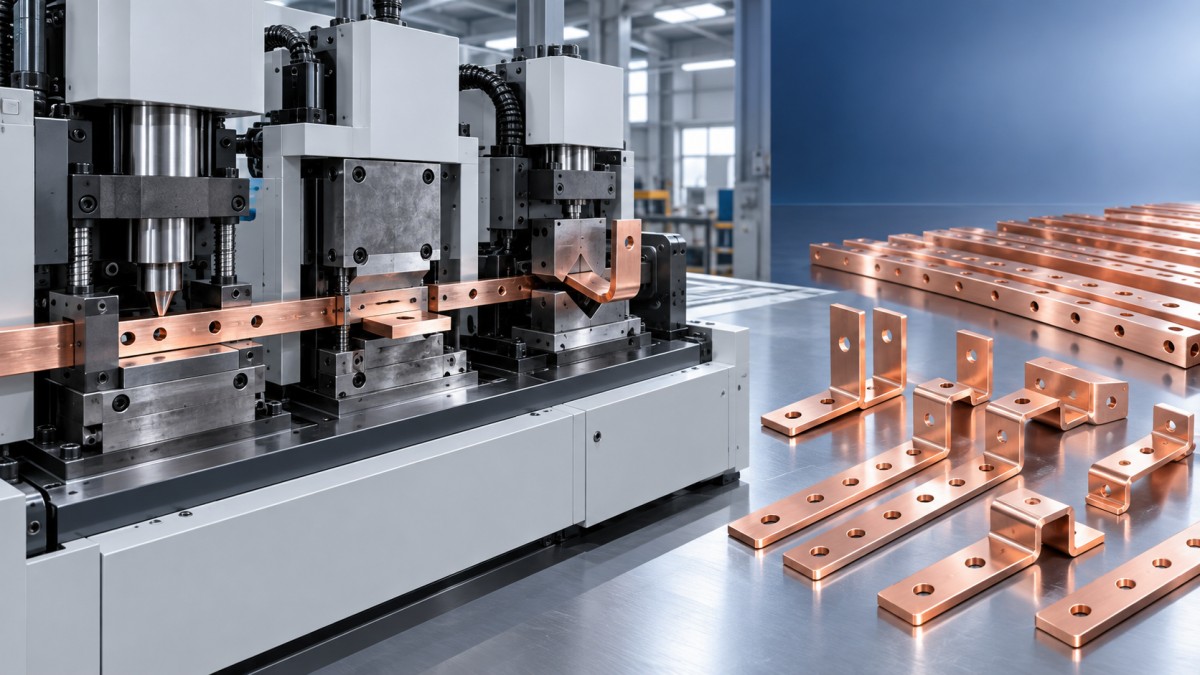
There is an important qualification: integration does not automatically eliminate setup. A CNC system still requires correct material data, an accurate part drawing, suitable tooling, and disciplined program verification. What it removes is much of the unnecessary setup created by a fragmented process. That distinction is worth keeping in mind when evaluating expected returns.
Accuracy Is Often the Bigger Operational Benefit
Many decision-makers initially focus on parts per hour. In custom panel work, however, avoiding one incorrect busbar can be more valuable than gaining a few seconds on a routine operation. A mislocated hole or an incorrect bend angle may not be discovered until assembly, when installation teams are already waiting and the replacement process becomes urgent.
An integrated sequence helps control cumulative error because the part is not repeatedly repositioned between independent machines. It also supports more consistent operator practice. Instead of relying on individual judgment at every station, the workflow can be built around approved drawings, verified programs, material-specific settings, and first-piece inspection.
Copper and aluminum should not be treated as interchangeable in this respect. Their behavior during bending, surface condition, thickness, and bar width all influence the result. A program that works well for one material or section should be reviewed before it is applied to another. In practice, experienced teams keep records of proven settings and still inspect the first finished part when geometry, material source, or tooling changes.
Tooling Determines Whether the Machine Delivers Its Promise
The machine itself is only one part of the setup-time equation. Punches, dies, bending molds, and their condition determine how smoothly a job moves from drawing to finished bar. A shop that repeatedly pauses to search for the right die, adapt an unsuitable tool, or deal with worn edges will not see the full benefit of CNC integration.
This is particularly relevant for non-standard bends. Tight clearances inside modern panels can require special profiles, offsets, or bending arrangements that standard tooling does not comfortably support. For busbar mold supply requirements involving uncommon forming shapes, a dedicated option such as Other-Special-Dies-bending may be more appropriate than forcing the part through a general-purpose die. The correct choice depends on the conductor dimensions, bend radius, required geometry, and the risk of surface damage or deformation.
Before purchasing an integrated machine, ask the supplier to clarify which standard tools are included, how custom dies are specified, how changeovers are handled, and what technical support is available when a drawing contains an unusual feature. Those questions are more useful than comparing machine functions on a brochure alone.
When a 3 in 1 CNC Busbar Machine Makes Commercial Sense
The strongest fit is usually a panel builder facing frequent engineering variation, short delivery windows, and recurring rework caused by manual setup or multiple transfers. It can also be a sensible choice for a growing operation that wants to standardize busbar fabrication before adding more labor or more isolated workstations.
It may be less compelling where every job uses only one operation, where busbars are outsourced in small quantities, or where exceptionally high volumes of one stable part justify dedicated automated lines. The right decision is therefore not “integrated versus traditional” in the abstract. It is a question of where time is currently being lost: programming, material movement, tool changes, inspection, or rework.
A useful internal review is to follow one custom busbar order from released drawing to final assembly. Record how often the bar is touched, where it waits, when measurements are repeated, and why first pieces are rejected. The bottleneck is often more visible after that exercise.
Choosing a Practical CNC Busbar Partner
Machine reliability matters because custom panel schedules leave little room for unexpected downtime. Since 2014, Dexinjia (DXJ™) has focused on CNC busbar processing equipment for copper and aluminum bending, punching, cutting, and embossing. Its range includes 3-in-1 machines, CNC bending equipment, and portable hydraulic busbar processing solutions. The company states that it uses precision molds, high-quality materials, and pure copper motors, while providing standard and customized solutions along with technical and after-sales support.
DXJ equipment is offered with ISO, 3A, CE, and EAC certifications, but purchasers should still confirm the exact documentation and configuration applicable to the machine, destination market, and intended use. Certification is one part of procurement; service response, spare-parts planning, training, tooling availability, and the ability to process the actual busbar drawings are just as important.
A 3 in 1 CNC busbar machine can genuinely cut setup time for custom panels, but only when it is introduced as a controlled production system rather than a standalone purchase. Start with the part families that create the most handling and rework. Validate tooling against real drawings. Train operators to protect the reference system from material loading through final inspection. That is where the time savings become repeatable instead of theoretical.
Send Us A Message
Get in Touch
*We respect your confidentiality and all information are protected.

First class quality service and professional after-sales team.