



Estimating Labor Savings from a 3 in 1 CNC Busbar Machine Investment
A labor-saving case for a 3 in 1 CNC busbar machine should be built from the work it removes, not from a headline claim about automation. The relevant comparison is the full process required to turn copper or aluminum bar stock into an approved part: measuring, marking, moving material between stations, punching, cutting, bending, checking, and correcting errors. If those steps are currently divided among manual tools or separate machines, an integrated system can reduce direct touch time substantially. If the existing process is already well-balanced and highly automated, the labor case may be much narrower.
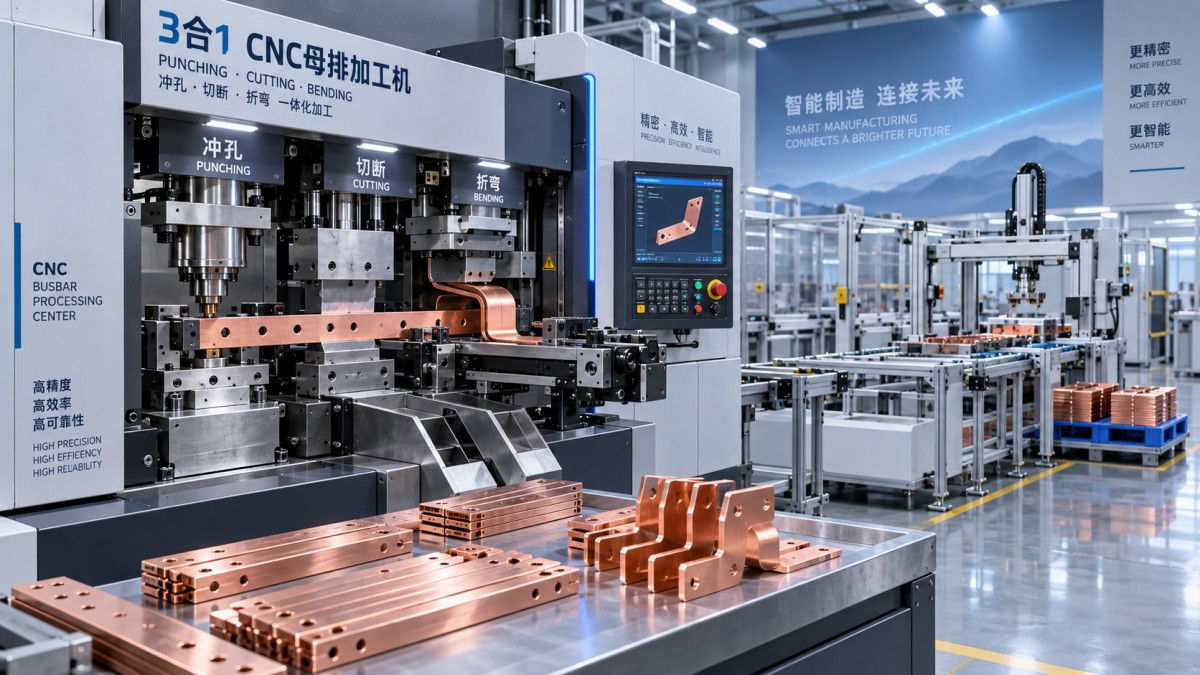
For most buyers, the investment makes sense when busbar work involves frequent changeovers, repeatable part families, or enough volume that handling and setup consume more time than the actual forming operation. A 3 in 1 CNC busbar machine can consolidate punching, cutting, and bending into a more controlled workflow, but its labor value depends on part mix, material flow, programming discipline, and how many people are genuinely reassigned after installation.
Start with labor content per finished part
Do not begin the estimate with machine cycle time alone. A fast cycle at one station does little for payroll if an operator still spends several minutes carrying bars, finding the next drawing, measuring hole positions, or waiting for another process to become available.
Map the current route for a representative group of parts. The best sample is usually not one simple, high-volume bar. Include the parts that consume meaningful shop time: multiple holes, different bend orientations, tight dimensional requirements, and short production runs that require frequent setup.
For each part family, record the labor minutes used for:
- Reading drawings, measuring, marking, and material identification.
- Loading, positioning, clamping, and transferring work between operations.
- Punching, cutting, bending, and tool changes.
- In-process inspection and correction work.
- Sorting, labeling, and moving completed parts to the next operation.
Separate labor minutes from elapsed minutes. A worker may be occupied for only part of a machine cycle, while a part may still wait in a queue for a long period. Labor savings affect the staffing case; elapsed-time reduction affects throughput, delivery reliability, and work-in-process. Both matter, but combining them into one number often overstates the financial return.
A practical baseline uses the following calculation:
Annual direct labor cost for a part family = annual output x labor minutes per part / 60 x fully burdened hourly labor cost.
The fully burdened rate should reflect more than wage rate. Depending on the company’s accounting method, it may include payroll taxes, benefits, overtime premiums, shift differentials, and the cost of supervision or temporary labor used to cover bottlenecks. The rate must be consistent on both sides of the comparison.
Where an integrated machine can remove labor
The largest labor reduction often comes from fewer handoffs. In a fragmented process, a busbar may be measured at one bench, punched at another, cut separately, then moved to a bending station. Every transfer creates handling time and another chance to mix parts, reverse orientation, or use an outdated instruction.
Programming a coordinated sequence can reduce repeated measurement and manual layout work, especially for parts with multiple holes and bends. The operator still loads material, confirms the program, monitors processing, and performs inspection, but the same person does not need to recreate each location manually. For repeat orders, stored programs can also reduce setup time, provided revision control is reliable.
Tooling deserves a place in the estimate. Punching capacity is not just a machine specification; it is a production constraint shaped by die condition, hole geometry, material thickness, and the time required to change tools. A worn or poorly matched die can create burrs, deformation, and rework that erode the expected labor savings. When replacement tooling is budgeted, buyers should compare availability, compatibility, and lead time along with purchase price. For example, a listed Punch Die price may be useful for estimating a spare-tool allowance, but it should not be treated as the total cost of maintaining a punch operation.
Build a conservative future-state estimate
For the proposed workflow, estimate operator minutes for loading, program selection, setup, tool changes, inspection, unloading, and routine material movement. Then add realistic allowances for first-piece checks, minor stoppages, and the time needed to handle exceptions. A labor model that assumes continuous unattended production will rarely match a busbar shop with varied part numbers.
The annual labor saving can then be expressed as the difference between current and future direct labor cost. Use several scenarios rather than a single best-case forecast. A base case might assume normal utilization and current staffing patterns. A lower case can allow for slower adoption, more frequent changeovers, and retained inspection requirements. A higher case should only be used when there is a credible plan to fill released capacity with additional work or reduce overtime, temporary labor, or planned hiring.
Labor capacity is not automatically payroll reduction
This distinction matters in an investment approval. If two operators become capable of producing the same output as three, the company has gained capacity. It has not necessarily reduced labor expense by one full position. The financial result depends on whether overtime declines, an open role is not replaced, contract labor is reduced, or employees are reassigned to work that otherwise would have required additional hiring.
Decision-makers should ask a direct operational question: what will the freed hours be used for? If the answer is to relieve a chronic fabrication bottleneck, protect delivery dates, or bring outsourced busbar work in-house, the value may be real even without immediate headcount reduction. If the shop has excess capacity and no planned staffing change, report the benefit as available labor capacity rather than a cash saving.
There is also a learning curve. A CNC system shifts some work from manual layout toward program preparation, fixture discipline, and file control. The estimate should include training time, initial program development, and responsibility for maintaining approved revisions. Shops that ignore these tasks can see early output slowed by programming uncertainty or preventable setup mistakes.
Test whether the machine fits the demand pattern
A 3 in 1 CNC busbar machine is usually easier to justify when the same operation set is repeated across a meaningful share of production. It may be less compelling when most work consists of one-off parts, highly variable material dimensions, or operations that remain dependent on manual finishing outside the machine.
Before selecting a configuration, compare the actual demand mix against the machine’s usable processing envelope: busbar width and thickness, copper and aluminum requirements, hole and bend geometry, tolerances, and expected order sizes. Also examine the material loading arrangement. A machine that reduces processing time but requires awkward manual feeding may deliver less labor reduction than the proposal suggests.
Ask suppliers to demonstrate representative drawings rather than generic sample parts. The trial should show the full sequence, including program setup, tool changes, first-piece inspection, and handling of the longest or heaviest material likely to be run. That exercise exposes whether the expected savings come from the machine itself or from assumptions about auxiliary work that has not been addressed.
A defensible investment case therefore has two outputs: a conservative annual labor-capacity calculation and a separate plan for converting that capacity into lower cost, higher output, or more dependable delivery. When those two figures align with the actual part mix, the labor-saving value of an integrated busbar machine becomes far clearer than any nominal cycle-time comparison.
Send Us A Message
Get in Touch
*We respect your confidentiality and all information are protected.

First class quality service and professional after-sales team.