



How Accurate Busbar Cutting Supports Faster Electrical Panel Assembly
In a panel shop, delays rarely begin at the final wiring stage. They often start much earlier—with a copper or aluminum bar that is a few millimeters too long, a cut edge that needs extra dressing, or a hole pattern that no longer aligns after bending. Each issue may seem minor on its own. Across a production run, however, those small corrections slow fitting, interrupt workstations, and create uncertainty for the assembly team.
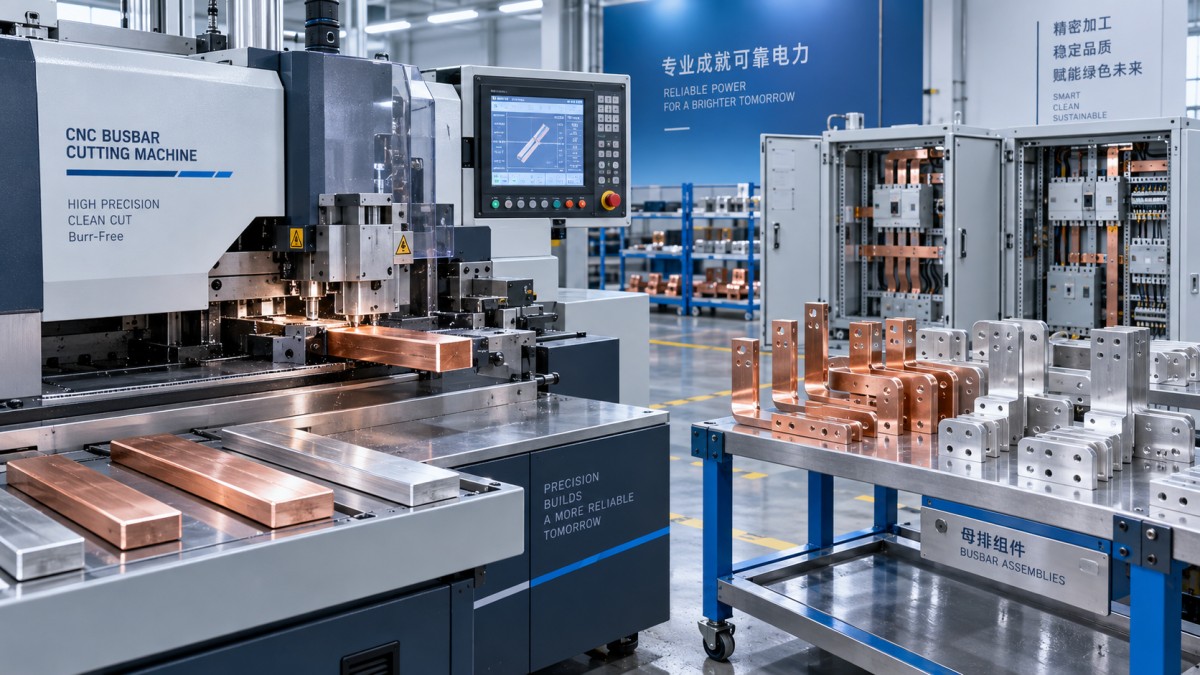
That is why accurate busbar cutting has a direct effect on electrical panel assembly speed. A well-selected busbar cutting machine produces parts that arrive at the next operation at the correct length, with clean edges and repeatable geometry. Instead of treating cutting as a simple preparation step, manufacturers can use it as the foundation for a more predictable busbar fabrication and panel-building workflow.
Assembly speed is decided before the busbar reaches the panel
Busbars are not standalone components. Their dimensions affect every downstream operation: punching, bending, insulation fitting, phase spacing, support placement, and final installation in the enclosure. When a bar is cut inaccurately, the consequences move through the line.
A short cut can leave insufficient contact area at a terminal. An overlength bar may interfere with clearances or force technicians to trim it manually. A rough or distorted edge can complicate handling and require deburring before the part can be installed. In more complex switchgear, even a small dimensional deviation may prevent a pre-punched or pre-bent component from seating correctly.
For decision-makers, the important point is not merely whether a cut is technically possible. It is whether the cut supports a stable process. Consistent cut length allows production teams to prepare bending programs, punching positions, and assembly instructions with confidence. The less time technicians spend measuring, adjusting, and reworking, the more time remains for value-adding work.
Where inaccurate cutting creates hidden costs
Material scrap is the most visible cost of poor cutting accuracy, especially when copper prices are under pressure. Yet the more persistent losses are often hidden in labor time and production disruption. A fabricator may recut one piece quickly, but the assembly station may already be waiting for that replacement. If the part requires a revised bend or new holes, the delay expands further.
Common symptoms include:
- Operators measuring every part again before bending or installation.
- Manual trimming of bars to compensate for length variation.
- Hole positions drifting from the intended terminal or support location.
- Extra deburring work caused by poor cut quality.
- Different shift teams producing components with inconsistent fit.
- Assembly staff holding unfinished panels while waiting for corrected busbars.
These problems do not always appear in a monthly scrap report. They show up as longer lead times, overtime near shipment dates, and an assembly department that seems busy without reaching planned throughput. Improving the cut stage can therefore be one of the most practical ways to protect the rhythm of the whole panel shop.
A cutting process designed for the full fabrication sequence
The best approach is to plan cutting around the complete busbar route, rather than evaluating the cutting station in isolation. Start with the finished component drawing: required overall length, bend positions, punched holes, edge-clearance requirements, material width, thickness, and the direction in which the part will be handled during assembly.
From there, establish a repeatable sequence. For many applications, cutting takes place before punching and bending so that the material datum remains consistent from operation to operation. The chosen reference edge and stop position should be clear to every operator. If the process changes between copper and aluminum, that change should be documented rather than left to individual judgment.
A capable busbar cutting machine should support this discipline through a rigid cutting structure, reliable positioning, suitable tooling, and controls that make repeat work straightforward. Precision is not only a matter of the blade or die; it also depends on how consistently the material is located, how the operator verifies the first piece, and how easily the machine maintains repeatability through a full batch.
Clean edges matter more than they appear to
Cut quality influences both productivity and workmanship. A clean, square edge reduces the need for secondary finishing and helps busbars sit properly against terminal pads, connectors, and supports. It also makes inspection easier. When an edge is visibly distorted or heavily burred, the team must spend time deciding whether the part can still be used safely and neatly.
For aluminum busbars, attention to edge condition is especially useful because the material can behave differently from copper during processing. Tooling selection, clearance, machine condition, and proper handling all affect the result. A process that works acceptably for one material should not automatically be assumed to deliver the same finish for another.
Matching equipment to production reality
There is no single machine configuration that suits every panel manufacturer. A compact workshop producing varied, low-volume control panels may value flexible setup and a small footprint. A producer of repeatable switchgear assemblies may place greater emphasis on programmed accuracy, faster changeovers, and coordinated bending and punching operations.
When evaluating equipment, purchasing and operations teams should look beyond the headline capacity. Useful questions include:
- What copper and aluminum widths and thicknesses are processed most often?
- How many part changes occur in a typical shift?
- Does the workflow require cutting only, or integrated punching and bending?
- How are dimensions transferred from drawings to the machine operator?
- Can the tooling support the hole shapes and patterns used in current panels?
- What service, spare parts, training, and technical support are available after installation?
For shops handling multiple operations in one area, a 3-in-1 busbar machine can reduce unnecessary material movement between separate stations. Where throughput and complex repeat work are priorities, CNC busbar processing equipment may offer stronger process control. Portable hydraulic equipment can be useful for field work or applications where fixed machinery is impractical, although the expected volume and required consistency should guide the choice.
Tooling deserves equal attention. Punching accuracy depends on a properly matched die, maintained clearance, and dependable alignment with the busbar reference. For replacement or application-specific tooling, a Punch Die can be considered as part of the wider mold supply requirement, rather than as an afterthought once production is already underway.
From a first-off check to repeatable panel fitting
Even advanced equipment benefits from a practical quality routine. Before launching a batch, operators should inspect the first-off component against the drawing: overall length, cut squareness, edge condition, hole-to-edge distance where applicable, and the relationship between the cut reference and later bend lines. This short check is far less costly than discovering a systematic error after dozens of parts have reached assembly.
It also helps to separate machine accuracy from process accuracy. A machine may be capable of precise work, but results can still vary if material dimensions differ, measuring tools are not calibrated, stop surfaces are contaminated, or programs are entered inconsistently. Clear work instructions and controlled inspection points turn machine capability into reliable production output.
Many businesses benefit from labeling busbars by panel or assembly group immediately after processing. This simple step reduces the risk of mixing similar-looking parts and allows assembly teams to receive complete kits. When cut, punched, and bent components arrive together and fit the intended design, panel assembly becomes calmer, faster, and easier to schedule.
Why the investment case is broader than cycle time
A faster cutting stroke alone does not guarantee a faster factory. The stronger business case comes from fewer interruptions: less hand finishing, fewer remakes, more consistent assembly fit, improved material utilization, and reduced dependence on individual operator experience. These gains can be particularly meaningful when skilled fabricators are difficult to recruit or when project deadlines leave little room for correction.
Dexinjia (DXJ™), founded in 2014, manufactures CNC busbar processing machines for copper and aluminum cutting, punching, bending, and embossing. Its range includes 3-in-1 machines, CNC bending equipment, and portable hydraulic processing solutions. For buyers comparing options, machine construction, precision molds, motor quality, certification requirements, and access to technical support should all be assessed alongside the production task itself. A durable machine is valuable, but a machine that fits the actual workflow is more likely to deliver measurable operational improvement.
Accurate busbar cutting ultimately gives panel assembly teams something they need every day: trust in the part arriving at their station. When dimensions are consistent and edges are ready for use, assembly moves from correction to completion. That shift supports shorter lead times, cleaner panel builds, and a production system that is better prepared to scale with demand.
Send Us A Message
Get in Touch
*We respect your confidentiality and all information are protected.

First class quality service and professional after-sales team.