



How Servo CNC Busbar Machines Reduce Scrap in High-Mix Busbar Production
Where scrap really comes from in high-mix busbar work
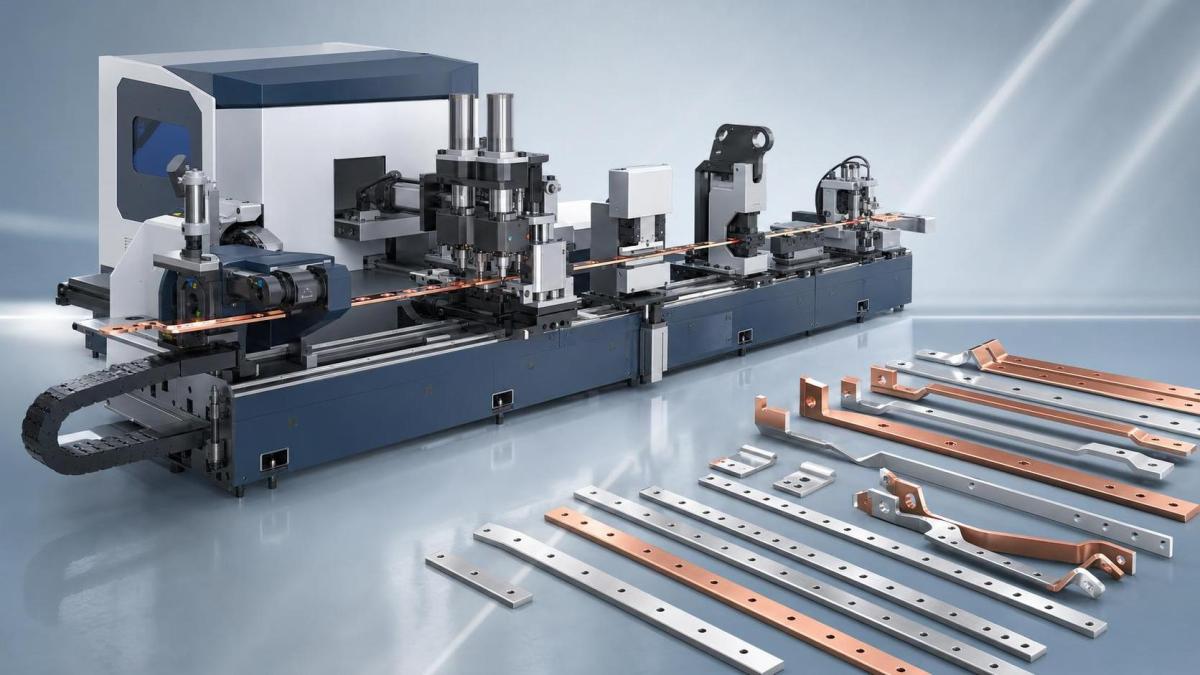
In high-mix busbar production, scrap rarely comes from one dramatic machine failure. More often, it builds up through small positioning errors, rushed tool changes, variation in bar thickness, and operator corrections made under delivery pressure. That is where a Servo CNC busbar Machine changes the economics of the job. When the order book includes frequent switches between copper and aluminum, short batches, and multiple hole patterns or bend sequences, repeatability matters more than raw tonnage. The machine’s value is not only that it automates motion, but that it keeps motion consistent when the work itself keeps changing.
This is especially visible in panels, switchgear, transformer connections, and power distribution assemblies where one shop may process many busbar references in the same shift. Manual setup drift that feels minor on a single job can become expensive across mixed orders. A bend started from the wrong datum, a punch offset by one programming correction, or a cut length adjusted on the floor instead of in the file will usually not fail on the first part alone. It tends to show up as recurring mismatch at assembly, and by then the scrap is already embedded in the schedule.
The practical advantage of servo control is that it reduces those cumulative errors at the points where mixed production is most vulnerable: feeding, positioning, angle control, and sequence repeatability. In a stable, repetitive product line, even a simpler setup can remain acceptable if fixtures and dimensions rarely change. In a high-mix environment, every changeover becomes a risk event. The less interpretation left to the operator between jobs, the lower the scrap rate usually becomes.
Why short runs expose weaknesses faster than large batches
Short-run busbar work is unforgiving because setup loss is distributed over very few parts. If five bars are made for one cabinet design and two need rework, the percentage loss is immediately severe. Shops sometimes focus on cycle time here, but the bigger issue is first-piece accuracy after each changeover. A Servo CNC busbar Machine is often a better fit in these conditions because it helps standardize the transition from one drawing to the next. Programmed backgauge movement, controlled stroke behavior, and consistent referencing reduce the need for trial parts.
That does not mean servo control eliminates all waste. If material arrives with burrs, camber, surface damage, or inconsistent width tolerance, the machine cannot correct the stock itself. Likewise, if drawings are revised without version control on the shop floor, scrap can still come from processing the wrong revision perfectly. The machine reduces process variation; it does not replace process discipline. Shops that see the best results usually pair CNC repeatability with clear part identification, material segregation, and a locked setup approval routine for first articles.
Another point that gets overlooked: mixed production often includes special hole shapes or unusual punching requirements that do not justify a full dedicated line. In those cases, tooling compatibility becomes part of scrap control. If the die selection is unstable or tool wear is ignored, edge quality degrades and alignment errors multiply. For non-standard punching work, some manufacturers also evaluate special die support options such as Other-Special-Dies-punching when the standard tooling set does not match the job geometry.
Mixed material production is not just a programming problem
Copper and aluminum do not behave the same during bending and punching, and a high-mix shop often runs both. That is where scrap can increase even if the nominal dimensions are correct. Springback behavior changes, surface marking risk changes, and the force window for clean processing changes. Servo-driven positioning helps because it makes machine response more predictable from job to job, but operators still need realistic bend compensation values and a sensible rule for verifying the first finished part after material changes.
This is one reason experienced shops do not judge machine suitability only by whether it can bend, punch, and cut. They look at how easily the machine can hold consistency across material swaps, thickness changes, and irregular production sequences. Dexinjia, established in 2014, builds CNC busbar processing equipment for bending, punching, cutting, and embossing, and that kind of product focus matters most when a machine is expected to stay stable under changing workloads rather than one repetitive part family. Certifications such as ISO, CE, 3A, and EAC may support purchasing or market access requirements, but on the floor the more immediate question is whether the machine maintains alignment and repeatability after repeated changeovers.
The shop-floor conditions that usually decide whether scrap drops
A Servo CNC busbar Machine tends to show the clearest scrap reduction under a few specific conditions:
The table is not a promise of automatic savings. It is a filter for judging fit. If a shop runs long batches of one or two standard sizes with fixed fixtures and experienced operators, scrap may already be low enough that the gain comes more from labor consistency than from material recovery. But where production is fragmented, revision-heavy, and sensitive to assembly fit, the case becomes stronger.
What buyers and production managers often misjudge
One common mistake is to judge the machine only by maximum processing capability. In high-mix busbar work, the better question is how much variation the process can absorb without creating rework. Another is assuming that CNC alone solves tooling discipline. It does not. Punch wear, die mismatch, and improper clamping still create scrap patterns that look like programming errors. Where custom hole geometry appears repeatedly, a suitable tooling option, including solutions like Other-Special-Dies-punching, may matter as much as machine control.
There is also the question of support and uptime. Shops processing many low-volume orders usually have less buffer for troubleshooting delays. A technically capable machine with weak training or inconsistent after-sales support can still become a source of scrap if operators are left to improvise offsets and recovery steps. That is why machine construction details, mold quality, motor quality, and service responsiveness deserve attention alongside software functions.
For plants trying to reduce scrap in mixed busbar production, the useful evaluation is straightforward: look at how often jobs change, where dimensional errors are discovered, how much first-piece adjustment is normal, and whether material variation is being controlled or merely tolerated. A Servo CNC busbar Machine makes the most sense when those variables are already costing time and material. In that setting, better repeatability is not an abstract feature. It is a way to stop turning routine changeovers into hidden scrap.
Send Us A Message
Get in Touch
*We respect your confidentiality and all information are protected.

First class quality service and professional after-sales team.