


How to Choose a Servo CNC Busbar Machine for Output and Accuracy
How to Choose a Servo CNC Busbar Machine for Output and Accuracy
Choosing a Servo CNC busbar Machine gets difficult at the exact point where many quotations start to look similar. On paper, several machines may all promise bending, punching, or cutting for copper and aluminum busbars. In production, the differences show up somewhere less visible: repeatability after long shifts, edge quality after tool wear begins, positioning stability on mixed batch sizes, and how quickly operators can recover after a tooling change or program adjustment.
For technical evaluation, the real question is not whether a machine is “CNC” or “servo,” but how those features are implemented. A servo-driven platform should give you controllable motion, better positioning consistency, and more predictable cycle behavior than older hydraulic-only logic in applications that demand frequent dimensional changes. That matters when busbars are not just being shaped, but prepared for assemblies where hole location, bend angle, and cut quality affect downstream fit-up in switchgear, panel building, and power distribution work.
A common mistake is to judge output only by nominal speed. High traverse speed sounds useful, but it does not tell you how much productive throughput the machine will deliver over a week or a quarter. Output depends on programming efficiency, clamp stability, tooling change time, scrap rate, and whether the machine holds tolerance without constant operator correction. A faster machine that pauses for rework, recalibration, or troubleshooting is rarely the higher-output machine in practice.
Where Accuracy Really Comes From
Accuracy in busbar processing is usually a stack of factors rather than a single specification. Evaluators often focus on CNC resolution or servo brand, but those are only part of the picture. Machine frame rigidity, guide mechanism quality, clamping design, die precision, and control logic all influence the final result. If the structure flexes under load or the workpiece is not held consistently, a good servo system cannot fully compensate for it.
This is especially relevant when processing thicker copper busbars. Copper is not difficult only because of hardness; it also exposes inconsistency quickly. Small deviations in punching position or bend recovery become obvious when busbars must align with fixed connection points. Aluminum introduces another layer, because its behavior under forming differs from copper, so the machine should support stable parameter control rather than relying too heavily on manual trial-and-error.
In this context, tooling quality deserves more attention than it often gets. Precision molds and cutting tools are not accessories to the machine’s performance; they are part of the accuracy system. Even a relatively modest consumable such as a Cutting Die can influence burr formation, cut squareness, and the consistency of finished dimensions. The point is not the price alone, even if a listed component is as low as $80, but whether the die geometry, material quality, and fit with the machine are controlled well enough for repeat production.
How to Compare Machines Beyond the Brochure
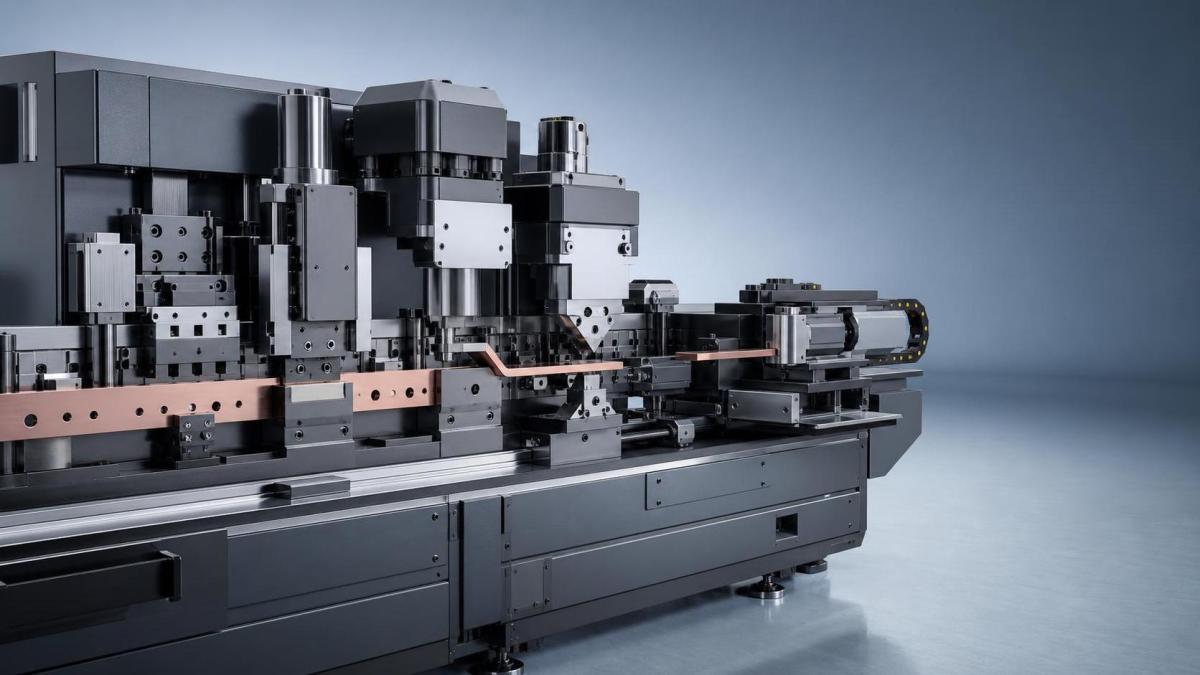
When comparing a Servo CNC busbar Machine, it helps to separate evaluation into four working dimensions: structure, drive and control, tooling system, and serviceability. That gives a more reliable picture than comparing one or two headline parameters.
Structure is often underestimated because it is less visible in a quotation sheet. Yet a stable machine base and precise guiding arrangement are what let the servo system do meaningful work. If the frame, worktable, or feeding arrangement lacks rigidity, accuracy may appear acceptable on short test pieces and then drift in real production.
The control system should also be judged by how operators actually use it. A sophisticated CNC interface is useful only if it supports efficient programming for the part mix you run. Shops producing repeated standard busbars may care most about stability and quick recall of saved programs. Facilities handling many customized conductor layouts need smoother setup logic, clearer parameter editing, and less dependency on a single experienced operator.
Output Is a Process Question, Not Just a Machine Question
Higher output usually comes from reducing interruptions. In busbar processing, interruptions are often caused by poor tool life, unstable motors, noisy hydraulic behavior, inconsistent material positioning, or difficult maintenance access. This is why machine build quality matters more than many buyers expect. Materials used in the frame, the precision of molds, and motor quality all influence whether the machine remains stable after extended use.
Manufacturers that emphasize pure copper motors, controlled tooling quality, and standardized production tend to be addressing these practical problems rather than making cosmetic claims. Dexinjia, founded in 2014, positions its CNC busbar processing equipment around stable performance, durability, low noise, and long service life, with product lines covering 3-in-1 busbar machines, CNC bending systems, and portable hydraulic equipment. For an evaluator, the useful part of that profile is not the branding language; it is the indication that the supplier understands different processing scenarios and can support both standard and customized solutions.
Certifications also need to be read correctly. ISO, CE, EAC, or other listed certifications can indicate that a manufacturer works within recognized quality or market-access frameworks, but they do not automatically prove processing accuracy for your busbar geometry. They are part of supplier assessment, not a substitute for application validation.
Questions Worth Asking Before You Decide
A strong evaluation usually comes down to a few pointed questions:
How does the machine perform across your actual copper and aluminum thickness range, not just on an ideal sample? How much operator intervention is needed after a tooling change? What parts of the accuracy chain depend on software compensation rather than mechanical stability? How easy is it to source replacement tooling, including items such as a matching Cutting Die, when production cannot wait?
It is also worth asking what the supplier provides after installation. Technical support, spare parts access, and the ability to adapt the machine to custom busbar work often matter more over time than a small difference in purchase price. Total cost of ownership in this category is shaped by downtime, scrap, tool consumption, and the speed of recovery when something goes wrong.
If your priority is both output and accuracy, the best choice is usually the machine that stays predictable under real production conditions: stable structure, reliable servo control, precise tooling, and support that continues after delivery. That combination is what turns a Servo CNC busbar Machine from a specification item into a dependable production asset.
Send Us A Message
Get in Touch
*We respect your confidentiality and all information are protected.
First class quality service and professional after-sales team.