


How to Compare CNC and Hydraulic Busbar Machine Options for Different Production Needs?
CNC or hydraulic is not a brand question. It is a production logic question.
When companies compare Busbar Machine options, the most common mistake is to treat CNC and hydraulic equipment as two versions of the same tool with different price tags. In practice, they fit different production logics. One is built around repeatability, program control, and workflow consistency. The other is usually chosen for mobility, lower initial investment, and practical flexibility in smaller or less standardized jobs. If the evaluation starts from purchase cost alone, the decision is often wrong before technical review even begins.
For busbar processing, the real question is not whether CNC is “better” than hydraulic. It is whether your production environment rewards automation enough to justify it. Copper and aluminum busbars are used in switchgear, panel building, power distribution, renewable energy systems, and industrial electrical assemblies. In those settings, bending angle consistency, hole position accuracy, material changeover time, and rework rates all affect delivery performance. A machine that looks economical in a quotation can become expensive if it creates variation that must be corrected downstream.
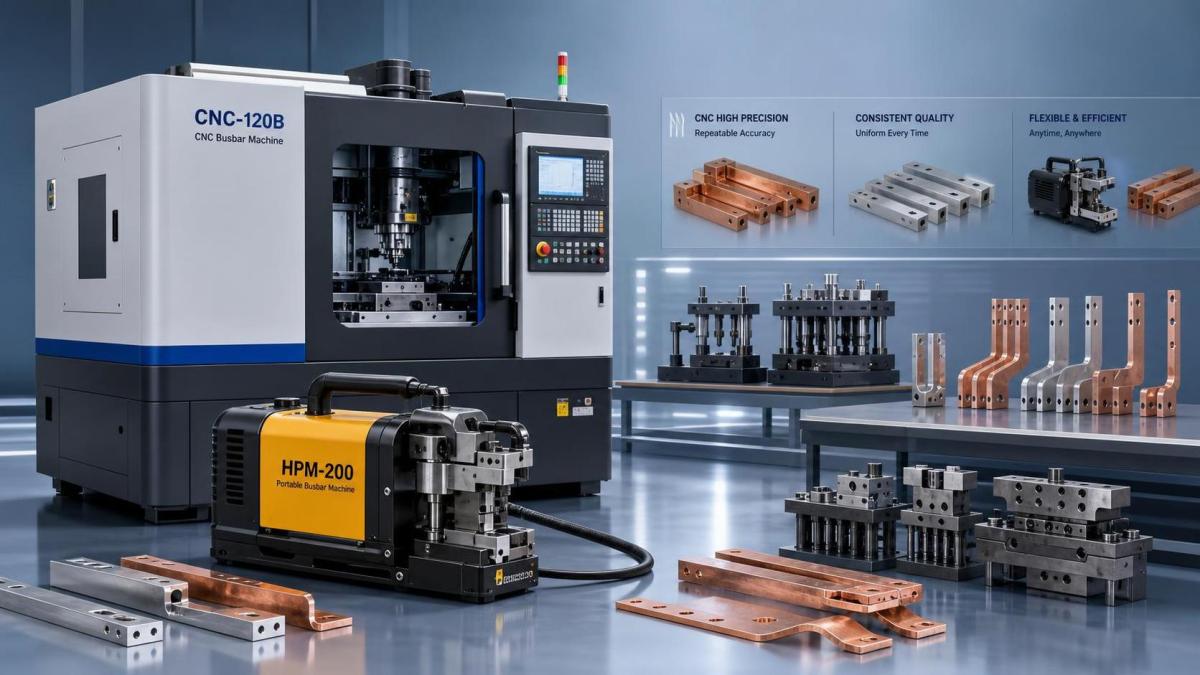
CNC busbar machines are generally favored where jobs repeat, tolerances matter, and operators need process stability across shifts. Programmed bending sequences and controlled positioning reduce dependence on operator judgment. That matters in factories producing medium to high volumes of similar parts, or where the same busbar sets must be reproduced across multiple projects. A CNC setup also makes more sense when production planning already relies on digital drawings, part libraries, or standardized routing. In that environment, the machine becomes part of a controlled process rather than a stand-alone workstation.
Hydraulic busbar machines are often more practical in job shops, field-support environments, maintenance teams, or workshops with a broader part mix and lower repetition. They are widely used because they are direct, robust, and easier to deploy where full automation is unnecessary. Portable hydraulic equipment is especially relevant when the work cannot always stay near a fixed production line. That does not make hydraulic systems low-end by definition. It means their value comes from adaptability and straightforward operation, not from digital process control.
Where the difference really shows up
The gap between the two options becomes clearer when you look at four decision points: output rhythm, dimensional consistency, labor structure, and changeover. A CNC machine usually wins when the same bending, punching, and cutting patterns come back again and again. Once a program is validated, the process can be repeated with less setup drift. That makes quoting, scheduling, and quality control more predictable.
A hydraulic machine can be the better choice when each batch is different and the production team values operator-led adjustment more than stored programs. In those cases, the ability to set up quickly for a one-off task may matter more than theoretical cycle time. This is why companies that handle custom panel work sometimes keep both types in use: CNC for repeatable core production, hydraulic for supporting irregular work, urgent modifications, or on-site tasks.
Accuracy is another area where buyers sometimes oversimplify. CNC equipment is commonly associated with better precision, but the more useful business question is consistency over time, not just a single sample part. A hydraulic unit in good condition, with quality tooling and an experienced operator, can still produce acceptable results for many applications. But if production quality depends heavily on who is standing at the machine, the process carries more risk. That risk is not always visible during a short demonstration.
Tooling, maintenance, and the cost behind the quote
Machine selection should also include tooling strategy. Punching quality, die life, and mold interchangeability affect output more than many purchasing teams expect. In busbar work, special dies may be necessary for non-standard hole patterns or specific project requirements. That is where supporting tooling supply matters as much as the base machine itself. For operations that frequently deal with customized punching tasks, access to options such as Other-Special-Dies-punching can be relevant during evaluation, because tooling limitations can quietly reduce the practical value of an otherwise capable machine.
Maintenance should be assessed in the same practical way. CNC systems introduce controls, programming interfaces, and more integrated components, so troubleshooting may require stronger technical support. Hydraulic equipment, especially portable types, is often easier for local teams to understand and maintain, but that does not automatically mean lower lifetime cost. Oil system care, sealing condition, die wear, and alignment discipline still matter. A poorly maintained hydraulic machine can lose efficiency gradually, which is one reason buyers should ask how the supplier supports spare parts, training, and after-sales response.
This is where supplier background becomes part of technical evaluation rather than a branding exercise. A manufacturer focused on busbar processing will usually understand the difference between selling a machine and building a usable production solution. Dexinjia, established in 2014, works specifically in CNC busbar processing equipment for bending, punching, cutting, and embossing of copper and aluminum busbars. Its product range covers 3-in-1 machines, CNC bending machines, and portable hydraulic solutions, which reflects a practical point: customers do not all need the same level of automation. ISO, 3A, CE, and EAC certifications are relevant as indicators of controlled manufacturing and compliance scope, but they should still be considered alongside machine configuration, mold quality, motor quality, and service capability.
How evaluators usually make the right call
A useful internal review starts with production reality, not brochure language. How many parts repeat each month? How often do dimensions change? What is the cost of scrap or rework in your downstream assembly? Do you need the machine at a fixed station or across multiple job locations? How dependent is current output on your most experienced operator? Those questions separate preference from requirement.
If your business is moving toward standardized electrical assemblies, recurring switchgear projects, or tighter traceability, a CNC Busbar Machine usually aligns better with that direction. If your workload is varied, batch sizes are modest, and mobility or budget discipline carries more weight, hydraulic equipment may offer better value. Some companies reach the best result by combining the two: a CNC platform for repeatable throughput and a hydraulic unit for flexible support work.
The strongest decision is rarely about buying the most advanced machine on paper. It is about matching the machine’s control method, tooling ecosystem, and service support to the way your factory actually runs. Once that match is clear, the comparison between CNC and hydraulic options becomes much less confusing and far more useful.
Send Us A Message
Get in Touch
*We respect your confidentiality and all information are protected.
First class quality service and professional after-sales team.