


How to Select a Busbar Punching and Shearing Machine for Panel Shops
A panel shop rarely feels the cost of a poor equipment decision on the day the purchase order is signed. The problem appears later: operators waiting for changeovers, holes drifting from their intended position, burrs requiring hand finishing, or a machine that cannot keep pace when a switchboard project moves from prototype work to volume production.
That is why selecting a busbar punching and shearing machine should be treated as a production-planning decision rather than a simple comparison of tonnage and price. For procurement teams, the right machine must fit the busbar sizes used today, leave room for practical growth, and remain serviceable when deadlines are tight. This guide focuses on the questions that matter most when buying equipment for copper and aluminum busbar processing.
Start with the work actually reaching the shop floor
Before reviewing catalogs, collect production data from the people who prepare drawings, operate machines, and assemble panels. A machine may look suitable on a specification sheet but become restrictive if it does not match the shop’s real mix of bar widths, thicknesses, hole patterns, and batch sizes.
Build a short profile of your normal workload:
- Common copper and aluminum busbar thicknesses and widths
- Maximum bar size, not only the average size
- Round-hole, oblong-hole, and special-shape punching requirements
- Typical cut lengths and dimensional tolerances
- Daily or weekly output volume
- Frequency of drawing revisions and small-batch jobs
This exercise often reveals the real buying priority. A shop producing repeated standard components may benefit most from faster cycle times and predictable tooling. A panel builder handling customized electrical cabinets may value flexible positioning, quick die changes, and easy setup more highly than maximum output speed.
Capacity is more than a maximum thickness rating
The stated punching force and shearing capacity are essential, but they should not be read in isolation. Punching a thick, wide copper bar places a different demand on a machine than cutting a narrower aluminum strip. Material hardness, hole diameter, edge distance, and the number of holes in a sequence all influence practical performance.
Ask suppliers to confirm capacity against your own material list. Ideally, provide sample drawings or representative busbar dimensions and request a written evaluation. This reduces the risk of buying a machine that handles the advertised maximum only under unusually favorable conditions.
Also consider working clearance. Can long bars be supported safely? Is there enough throat depth or table access for the hole locations found in your designs? An apparently capable machine can still create awkward handling if operators must repeatedly rotate or reposition heavy busbars by hand.
Compare punching quality, not just the number of stations
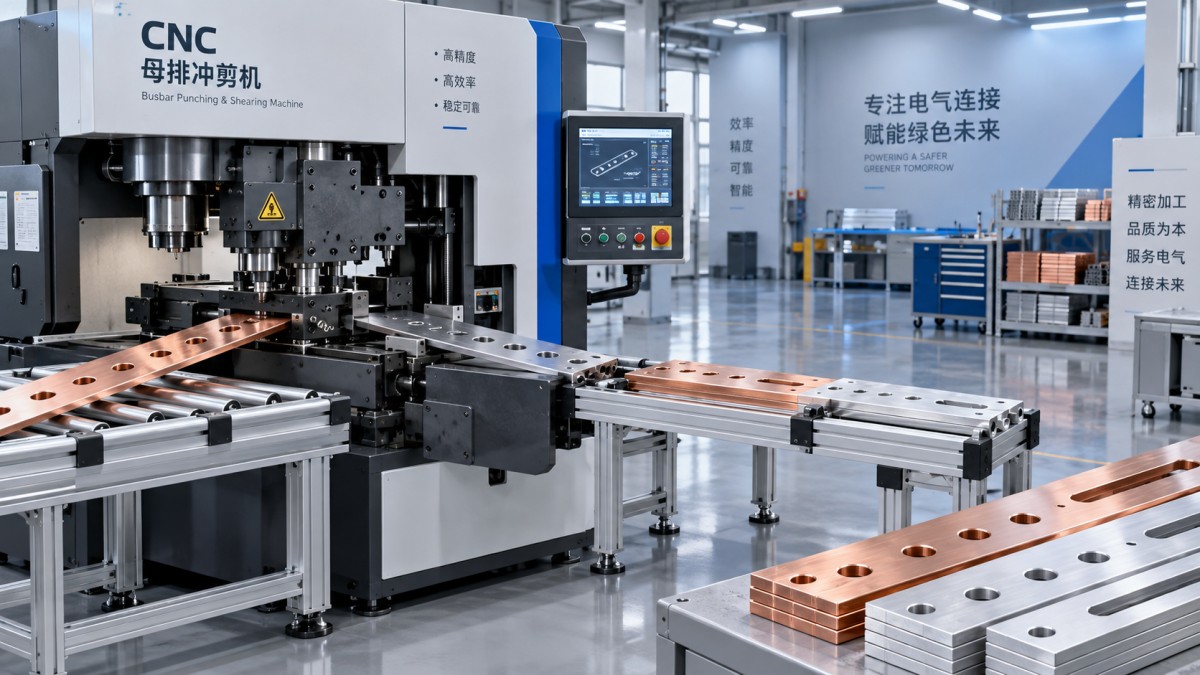
For electrical panel work, hole quality affects both appearance and assembly. Clean holes reduce deburring work and help maintain reliable fit-up for bolts, connectors, and mounting hardware. Poorly matched dies can leave excessive burrs, deformation, or inconsistent hole dimensions—small defects that become expensive when repeated across hundreds of parts.
Evaluate the die system as part of the busbar punching and shearing machine, not as an accessory to be considered later. Useful questions include:
- Which standard punch and die sizes are included?
- How quickly can operators change tooling?
- Are custom shapes available for project-specific busbar designs?
- How are punches, dies, and guide components identified and stored?
- Can replacement tooling be supplied without long delays?
A lower-cost machine can lose its advantage quickly if its tooling is difficult to source or if frequent changes require lengthy adjustments. For shops that maintain their own tool inventory, individual replacement items such as a Punch Die can also be relevant when planning consumables and spare-part budgets. The listed reference price of $66 may be useful for initial budgeting, but buyers should still verify the exact size, material compatibility, and configuration required.
Choose the right level of automation for your order mix
Manual and semi-automatic machines remain practical for many panel shops, especially where product variety is high and production quantities are modest. They can offer straightforward operation and are often easier to place within an existing workflow. However, manual measurement and positioning place more responsibility on the operator, which can affect consistency during long runs.
CNC busbar equipment makes more sense when repeatability, complex layouts, or recurring batches drive the workload. Programmed coordinates can reduce measuring time and help maintain positional accuracy across parts. The value is not simply “automation”; it is the ability to move from drawing to repeatable production with fewer opportunities for avoidable setup errors.
Procurement teams should avoid assuming that the highest automation level is automatically the best investment. Instead, calculate where labor time is currently being spent. If the bottleneck is hole layout and repeated positioning, CNC control may deliver clear gains. If the main constraint is material handling or downstream assembly, a different machine configuration—or a better handling arrangement—may produce a stronger return.
Shearing performance deserves its own assessment
Panel shops sometimes focus heavily on punching because it appears more complex, yet inaccurate cutting can create just as much disruption. A clean, square cut supports reliable assembly, while distorted or heavily burred edges add finishing time and can affect the final presentation of a busbar system.
Review how the machine controls length measurement and how it holds the workpiece during cutting. For frequent short parts, repeat stops and digital positioning can improve consistency. For longer runs, look at support arrangements and operator access. A shearing unit should be judged by the finish it produces on your typical bar stock, not only by the force stated in its brochure.
Ask how the machine will live in your shop
Equipment selection is also a question of daily usability. A machine that is difficult to load, clean, inspect, or maintain can gradually erode the savings promised during the sales process. Visit a demonstration if possible, or request detailed videos showing punching, shearing, tooling replacement, and routine maintenance.
Pay particular attention to the following:
- Safety: guards, emergency stops, clear operating zones, and procedures that reduce exposure to moving tools.
- Noise and stability: important factors in compact panel shops where several workstations operate nearby.
- Hydraulic and electrical access: maintenance points should be reachable without extensive disassembly.
- Operator controls: labels, programming interface, and training requirements should suit the skill level of the team.
- Footprint: account for material infeed, outfeed, service access, and storage for dies—not just the machine dimensions.
For buyers comparing suppliers, the machine’s construction and support model should carry real weight. Dexinjia (DXJ™), founded in 2014, supplies CNC busbar processing equipment for bending, punching, cutting, and embossing, including 3-in-1 machines, CNC bending machines, and portable hydraulic solutions. Its stated use of precision molds, pure copper motors, and quality-controlled production is relevant, but procurement should still match each model’s configuration to the intended application. ISO, 3A, CE, and EAC certifications may also be important where project documentation or regional compliance requirements apply.
Look beyond purchase price to operating cost
The cheapest quotation is not always the lowest-cost choice over several years. Include expected tooling consumption, power requirements, routine maintenance, training, spare parts, installation, and likely downtime in the comparison. If a supplier offers a very attractive machine price but cannot provide technical assistance or replacement components promptly, the exposure can be significant for a shop with committed delivery dates.
Request clarity on warranty scope, commissioning support, remote troubleshooting, documentation, and the process for ordering molds or wear parts. Customized busbar processing solutions can be particularly valuable when standard tooling does not suit a project’s connection-hole pattern or conductor geometry.
A practical final decision check
Before approval, score the shortlisted machines against the same criteria: verified material capacity, punch quality, cutting accuracy, changeover time, automation fit, safety, service access, tooling availability, supplier response, and total operating cost. Give each factor a weight based on your production reality rather than using a generic checklist.
The best busbar punching and shearing machine is the one that lets the panel shop produce its normal workload accurately, safely, and without creating new bottlenecks. When capacity, tooling, workflow, and support are evaluated together, procurement can make a decision that supports both current projects and the next stage of the shop’s growth.
Send Us A Message
Get in Touch
*We respect your confidentiality and all information are protected.
First class quality service and professional after-sales team.