



Manual vs. Automated Busbar Punching: When Does Automation Pay Off?
Manual vs. Automated Busbar Punching: When Does Automation Pay Off?
For decision-makers evaluating busbar production capacity, the central question is not whether automation is inherently better, but whether it solves a measurable operating constraint.
A busbar punching and shearing machine can bridge the gap between basic manual work and fully automated CNC production, but only when production demand supports it.
The right investment depends on volume, part complexity, labor availability, quality requirements, material handling, and the financial cost of production delays or rework.
Manual equipment remains commercially sensible for low-volume, variable work. Automation becomes compelling when repeated jobs create bottlenecks, quality variation, or rising labor dependency.
Start with the Production Problem, Not the Machine Specification
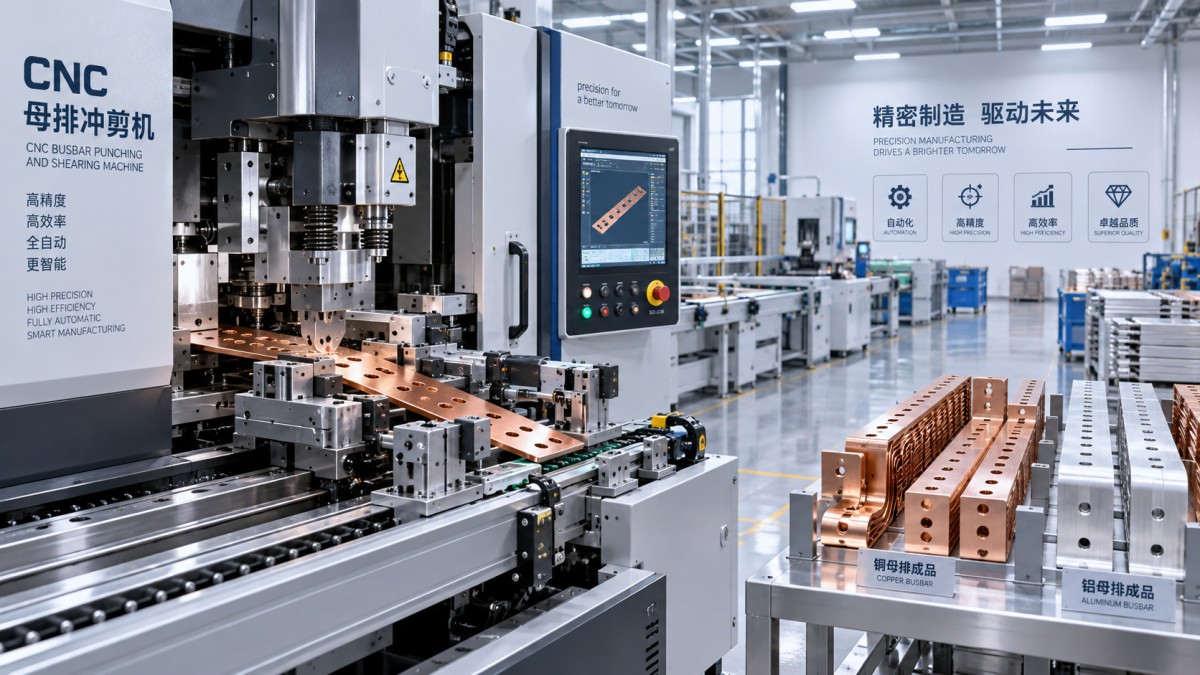
Buyers often compare tonnage, motor power, and tool stations first. Those details matter, but they do not reveal whether an automated system will generate a return.
The first assessment should identify where production time is actually lost. Common issues include marking errors, repeated measurements, slow tool changes, handling delays, and inspection rework.
Manual punching generally requires operators to measure locations, position material, select tools, actuate the machine, and verify every processed piece before moving onward.
That workflow can work well for prototypes, repair jobs, and limited batches. However, it becomes harder to control when production schedules require frequent repeatability across shifts.
Automated processing reduces manual positioning and calculation work by using programmed dimensions, coordinated tool paths, and repeatable material references for copper and aluminum busbars.
The business case is strongest when automation removes a proven bottleneck. It is weaker when low utilization means an expensive machine would spend most days idle.
When Manual Punching Still Makes Financial Sense
Manual or hydraulic punching equipment remains appropriate when annual output is limited, product designs change constantly, or work mainly involves straightforward holes and cuts.
Smaller electrical panel builders, maintenance contractors, and workshops producing custom assemblies may prioritize low acquisition cost and flexible operator control over cycle-time reduction.
For these businesses, the capital tied up in a CNC system may not be justified if skilled operators can complete the required workload without overtime.
Manual machines also offer a practical entry point when floor space, electrical infrastructure, programming capability, or maintenance resources are limited at the current stage.
However, decision-makers should calculate the full manual cost rather than comparing only purchase prices. Labor, scrap, setup time, fatigue, and delayed delivery all affect margins.
A low-cost machine is not necessarily low-cost production. If manual processing consumes experienced labor needed elsewhere, the apparent savings can disappear quickly.
Signals That Automation Is Ready to Pay Off
Automation usually becomes economically attractive when the same busbar patterns recur frequently enough to benefit from saved programs and standardized processing sequences.
Repeat orders are particularly important because programming costs are incurred once, while faster punching, shearing, and positioning benefits continue across every subsequent batch.
Another clear signal is sustained operator utilization. If trained workers spend much of each day measuring, aligning, punching, and checking busbars, capacity is constrained.
Frequent overtime is also a warning sign. Adding labor hours may temporarily protect delivery dates, but it raises cost and increases exposure to inconsistency.
Quality data provides another useful indicator. Repeated hole-position errors, burr-related rework, incorrect cut lengths, and scrapped copper indicate that process control needs improvement.
Automation is especially valuable where errors are expensive. Copper and aluminum costs make a small dimensional mistake more significant than a similar error on low-cost material.
Decision-makers should also consider lead-time pressure. Faster response can win orders when customers need switchgear, transformer connections, or distribution assemblies within short deadlines.
Compare Total Cost per Finished Busbar
A credible automation decision should use total cost per finished busbar rather than machine purchase price alone. This creates a clearer view of operational economics.
Calculate the current cost by including direct labor, setup labor, material waste, tooling consumption, energy, inspection, rework, maintenance, and the cost of missed delivery commitments.
Then estimate the automated process using realistic assumptions. Include programming time, loading and unloading, operator supervision, training, preventive maintenance, and financing costs.
The comparison should be based on actual part families rather than an ideal demonstration component. Complex layouts and frequently produced parts usually show greater savings.
For example, a busbar punching and shearing machine may shorten cycle time, but its financial value also comes from fewer layout mistakes and less dependent inspection.
Estimate annual savings by multiplying labor reduction, material savings, and additional productive capacity by expected yearly volume. Compare that figure with total ownership cost.
Payback periods vary widely, but the calculation should include avoided costs and revenue opportunities. More capacity has value only when sales demand can use it.
Choose the Right Level of Automation
Automation is not a single category. Companies can select portable hydraulic equipment, integrated three-in-one systems, semi-automatic stations, or fully CNC-controlled busbar processing lines.
A three-in-one machine can be a sensible upgrade for businesses that need coordinated punching, bending, and cutting without immediately investing in high-volume automation.
Fully CNC equipment is better suited to manufacturers with recurring production, multiple hole patterns, higher accuracy needs, and a requirement to reduce operator-dependent variation.
The best choice should match the production mix. Over-specifying a machine can create unnecessary capital cost, while under-specifying it can preserve the existing bottleneck.
Tooling availability deserves equal attention. Standard punches and dies support everyday work, while custom tooling may be required for unusual shapes, slots, or profiles.
Replacement tooling should be budgeted as part of production continuity. For example, a readily available Cutting Die priced at $80 may be a small expense compared with downtime caused by an unavailable wear part.
Assess Risks Before Committing Capital
Automation introduces implementation risks that should be managed early. The most common are insufficient operator training, poor production planning, incomplete maintenance routines, and unrealistic utilization forecasts.
A CNC machine will not automatically improve performance if material arrives inconsistently, drawings contain errors, or jobs are released without standardized production information.
Decision-makers should confirm that the supplier can support commissioning, training, spare parts, software guidance, and technical troubleshooting in the markets where equipment will operate.
Machine construction also affects lifetime economics. Precision molds, stable mechanical assemblies, reliable motors, and quality control reduce the risk that uptime savings are lost to repairs.
Certification and documented manufacturing standards are practical purchasing factors, especially for companies operating across borders or serving regulated electrical equipment customers.
Before purchase, request sample processing using representative copper and aluminum busbars. Check hole accuracy, cut quality, bending results, cycle time, noise level, and tooling changes.
Build a Practical Automation Decision Model
A useful decision model starts with three questions: What volume is processed today, what volume is expected within two years, and where is production capacity limited?
Next, separate jobs into recurring and one-off work. Recurring parts are the most likely candidates for programmed automation and measurable payback.
Measure the current process for several representative jobs. Record setup minutes, processing minutes, inspection time, rejected material, operator involvement, and total lead time.
Then model the future process conservatively. Do not assume unattended operation unless loading, unloading, material flow, and quality control procedures genuinely support it.
Finally, evaluate strategic value alongside direct savings. Shorter delivery times, improved consistency, reduced reliance on scarce skills, and scalable capacity may justify investment beyond simple payback.
Conclusion: Automate the Constraint That Limits Growth
Manual busbar punching remains the right choice for low-volume, highly variable work where capital preservation and flexibility outweigh cycle-time gains.
Automation pays off when recurring demand, labor pressure, quality losses, or delivery requirements expose manual processing as a continuing commercial constraint.
The strongest investment case is built from finished-part cost, realistic utilization, material savings, quality performance, and supplier support rather than headline machine specifications alone.
For growing busbar operations, the right busbar punching and shearing machine should improve throughput without creating excess capacity, unnecessary complexity, or unsupported maintenance risk.
Send Us A Message
Get in Touch
*We respect your confidentiality and all information are protected.

First class quality service and professional after-sales team.