



Servo CNC Busbar Bending Machines: Key Parameters for Copper Busbars
A servo CNC busbar bending machine should be selected from the actual copper busbar range and bend geometry, not from nominal tonnage alone. A machine that appears powerful enough can still produce inconsistent angles, surface marks, or unstable repeatability if its tooling, positioning system, and material support do not match the parts being made. For electrical panel and switchgear production, those small errors can create assembly delays across an entire batch.
Start with a clear part list: copper grade, width, thickness, flat or edgewise bending direction, minimum inside bend radius, number of bends per part, and required angle tolerance. This information is more useful than a general request for a “high-precision CNC bending machine” because it allows suppliers to match the machine’s working range and tooling arrangement to the job.
Match the Machine Capacity to the Hardest Real Part
Copper busbars are often processed in multiple sizes, but the purchase decision should be based on the most demanding part that will be produced regularly. This is usually the widest and thickest bar, the smallest required bend radius, or a component with bends close to an existing hole or edge.
Check the stated maximum width and thickness as a combined operating condition. A machine may accept a wide bar and a thick bar separately, while its allowable capacity is lower when both dimensions occur together. Also identify whether the quoted capacity applies to flatwise bending, edgewise bending, or both. These operations load the material and tooling differently.
Do not select capacity with no margin. Copper hardness, surface condition, and actual bend radius can change forming resistance. A modest working reserve helps the servo system maintain control and reduces stress on tools and mechanical components during routine production.
Servo Control Must Improve Repeatability, Not Just Add a Label
The value of a servo CNC busbar bending machine is its ability to control ram movement and part positioning consistently from one workpiece to the next. This is particularly useful where a production order contains repeated angles, several bend locations, or small dimensional allowances that affect final assembly.
Ask how the controller handles springback. Copper does not remain at the exact angle where the tool stops; it recovers slightly after pressure is released. The amount depends on material thickness, bend radius, and material condition. A practical CNC system allows the operator to enter bend compensation, save proven programs, and make controlled corrections without repeatedly resetting the entire job.
Program storage is important when the same panel designs return in batches. However, a large program library has limited value if operators cannot quickly identify the correct part, confirm the selected tool, and verify the first piece. The interface should support the shop’s normal workflow, including dimensional entry, angle adjustment, and clear alarms when a programmed movement exceeds machine limits.
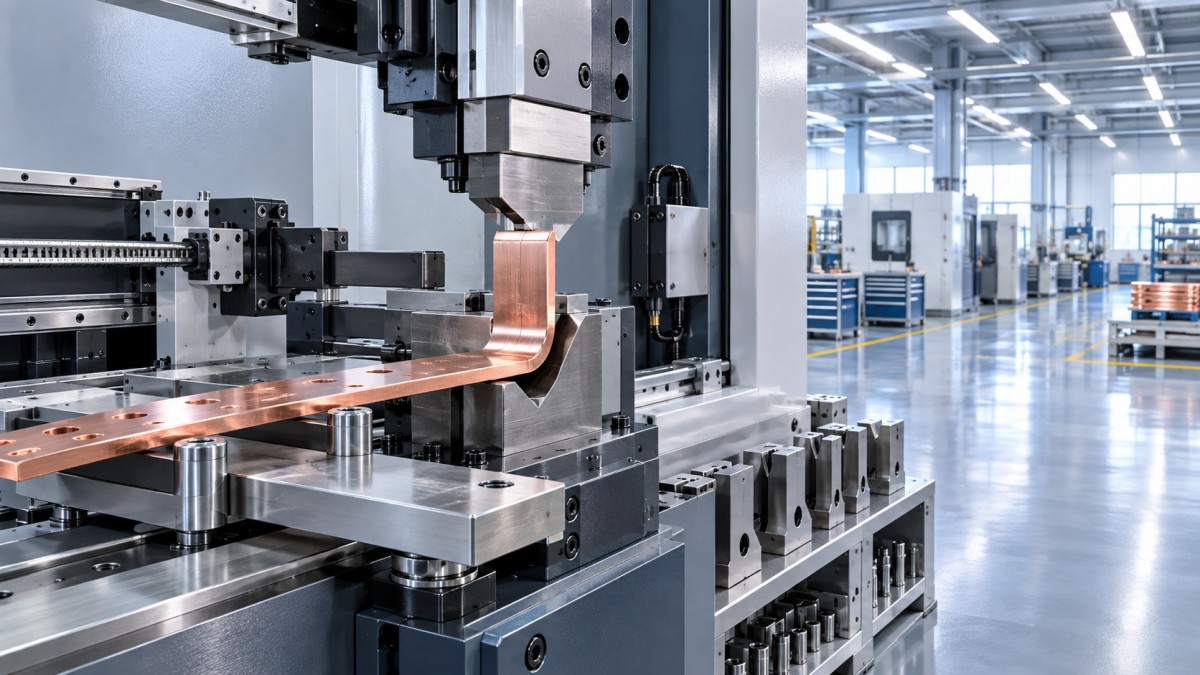
Tooling and Support Are Often the Difference Between a Good Bend and a Rework Job
Tooling should be evaluated alongside the machine, not treated as an accessory to be decided later. Punch radius, die opening, tool alignment, and contact surface all influence the appearance and dimensional stability of copper bends. Poorly matched tools can leave marks, distort the outside of the bend, or create a radius that does not fit the installation drawing.
For parts with short legs, offset bends, U-shapes, or bends near punched holes, request a sample review based on actual drawings. The issue is not simply whether the machine can create the angle. It must create the angle without tool interference, loss of positioning reference, or unacceptable deformation around the bend area.
Long or wide busbars also need adequate material support. If the bar is allowed to sag or rotate while being positioned, the CNC backgauge may be accurate while the actual bend location is not. Buyers should inspect the worktable, side supports, guide arrangement, and the operator’s ability to hold and reference larger pieces safely.
Consider Material Condition Before Blaming the Bender
Some bending problems begin upstream. Copper and aluminum bars may arrive with residual curvature, twist, or uneven flatness from handling, storage, or prior cutting. Feeding a curved bar into a precision bending process makes repeatable positioning more difficult and can affect the apparent angle after forming.
Where incoming stock regularly shows this condition, leveling should be considered part of the processing route. For bars up to 160 mm wide and 12 mm thick, the DXJ-160 Copper Busbar Straightening & Leveling Machine is intended to level copper and aluminum before punching, shearing, and bending. It is relevant for electrical control cabinet production where flatter material helps establish a stable reference before the busbar reaches the CNC bender.
This is not necessary for every operation. Shops using short, consistently flat pre-cut material may not need a dedicated leveling stage. It becomes more relevant when long bars are processed from coil-like storage conditions, when material straightness varies between deliveries, or when recurring position errors cannot be explained by tooling and programming.
Evaluate Cycle Time as a Complete Operation
A fast ram stroke does not automatically mean faster output. Total throughput includes loading, positioning, tool changes, bending, unloading, inspection, and correction of rejected parts. A machine with reliable backgauge movement and straightforward setup may deliver better usable output than a faster unit that requires frequent manual adjustment.
Ask suppliers to describe the full cycle for a representative part: how the bar is referenced, whether the operator turns it between bends, how the program calls for different tools, and how first-piece approval is performed. For a mixed, low-volume product range, quick setup and flexible tooling may be more valuable than maximum automatic speed. For repeat batches, stored programs, stable positioning, and predictable angle compensation carry more weight.
Reliability Depends on the Whole Supply Arrangement
Procurement should assess the machine as a supportable production asset. Confirm the power supply requirements, installation space, access for maintenance, availability of wearing parts, and the process for obtaining technical help. Tooling replacement, electrical troubleshooting, and controller support can matter more over time than a small difference in initial machine price.
Manufacturers that provide both bending equipment and related punching, cutting, and material-preparation equipment can also be useful when the goal is a coordinated busbar workflow. Dexinjia produces CNC busbar processing equipment for copper and aluminum applications and offers standard and customized processing solutions, which can simplify discussion when bending is only one stage of the required line.
Use a Sample-Part Review Before Issuing the Order
The most effective final check is to submit a small set of representative drawings rather than only a maximum material specification. Include the part with the thickest bar, the smallest bend radius, the shortest flange, the most complex sequence, and any bend close to a hole. Ask the supplier to identify the proposed tooling, bend sequence, reference method, and any geometry that requires special handling.
A well-chosen servo CNC busbar bending machine is one that produces the required parts repeatedly with manageable setup time and a clear support path. Capacity creates the starting point; tooling, positioning, material condition, and process fit determine whether the investment performs well on the shop floor.
Send Us A Message
Get in Touch
*We respect your confidentiality and all information are protected.

First class quality service and professional after-sales team.