



Servo CNC Busbar Machine Demand Trends in Power Distribution Projects
Servo CNC Busbar Machine Demand Trends in Power Distribution Projects
As power distribution projects demand faster delivery, higher precision, and lower operating costs, the Servo CNC busbar Machine is becoming a strategic investment for manufacturers and contractors. For business decision-makers, understanding this trend is essential to improving production efficiency, ensuring consistent busbar quality, and meeting the growing technical standards of modern electrical infrastructure.
What is changing most clearly is not simply equipment preference, but the production logic behind busbar fabrication. In many power distribution projects, the old model of separating bending, punching, cutting, and manual adjustment is under pressure. Delivery windows are tighter, panel builders are asked to handle more customized designs, and tolerance consistency matters more because rework now disrupts entire project schedules, not just a workshop task list. This is where demand for servo-driven CNC processing has gained practical weight.
The shift is closely tied to how electrical infrastructure is being built. Low-voltage and medium-voltage switchgear, transformer rooms, industrial distribution systems, renewable energy connection cabinets, and data center power systems all require busbar work that is accurate and repeatable. In these applications, minor dimensional deviation can create fitting problems during assembly, while surface damage or unstable bending angles can lead to waste of copper or aluminum, both of which remain cost-sensitive materials. Buyers are no longer looking only at machine purchase price; they are looking at the cost of scrap, downtime, operator dependence, and delayed installation.
A servo CNC busbar machine fits this demand because it changes how precision is maintained. Servo control gives better positional consistency than heavily manual processes, especially when multiple batches of similar parts must be produced over time. For project-based manufacturing, repeatability often matters more than peak speed on a brochure. A machine that can produce the same geometry across shifts and operators reduces one of the most common hidden costs in busbar workshops: variation that only becomes visible during final cabinet assembly.
There is also a labor-side signal behind the trend. In several manufacturing regions, experienced busbar operators are harder to replace than they were a decade ago. Training new staff on manual or semi-manual processes takes time, and the output quality can remain uneven for months. CNC adoption is partly a response to this skills gap. It does not remove the need for technicians, but it reduces reliance on individual craftsmanship for every critical bend or hole position. That matters to companies scaling output or opening new production lines where operator experience is still shallow.
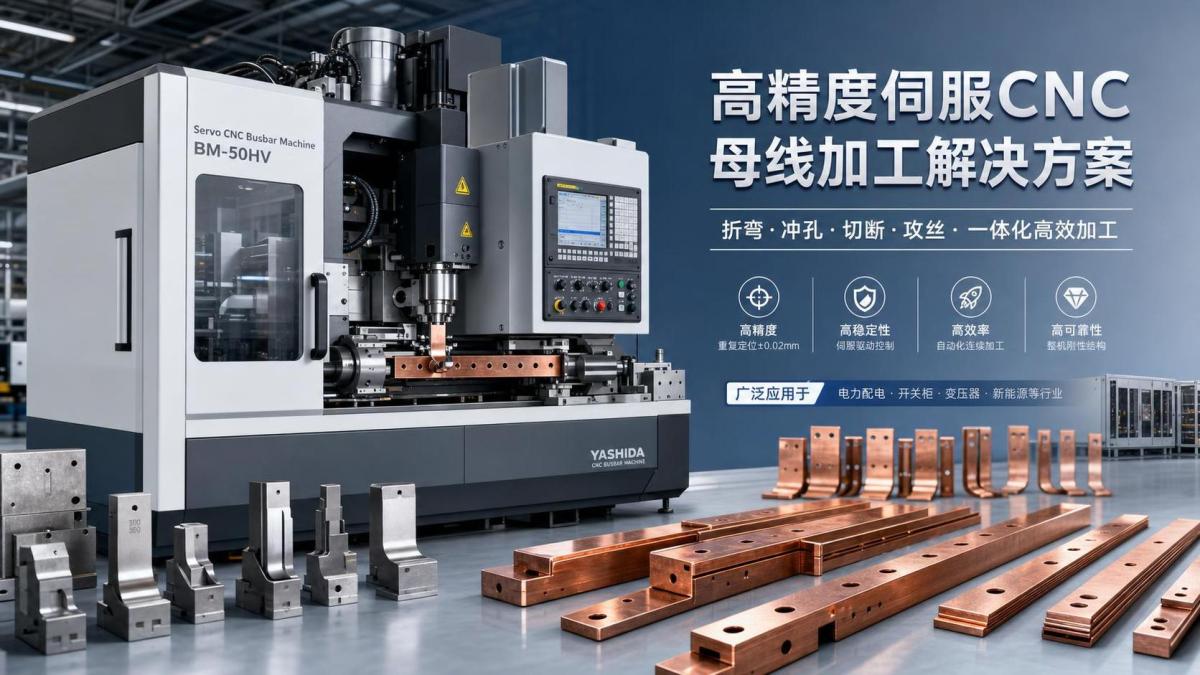
Another useful signal comes from procurement behavior. Buyers increasingly ask about compatibility with customized processing requirements rather than requesting only standard machine specifications. This reflects the fragmentation of end-use projects. Standardized switchboards still exist, but many orders now mix routine parts with non-standard busbar layouts. That pushes demand toward flexible CNC systems and modular tooling. In practice, tooling quality can shape the machine's real performance as much as the drive system does. For bending operations, mold stability, wear resistance, and dimensional consistency are often decisive, which is why components such as Bend-Die are drawing more attention in workshops that want tighter control over finished part accuracy.
Why Demand Is Strengthening Now
Several forces are converging. Grid upgrades continue in many markets, but the demand pattern is broader than utility investment alone. Industrial electrification, distributed energy systems, charging infrastructure, and data-intensive facilities all expand the number of projects using complex power distribution assemblies. Even where overall capital spending slows, project owners still expect shorter installation cycles and fewer on-site adjustments. That tends to move more precision work upstream into fabrication.
At the same time, cost pressure has become less forgiving. Copper and aluminum price volatility has made material utilization a management issue rather than a purchasing detail. When material costs swing, scrap tolerance drops. A more precise CNC process does not eliminate waste, but it can narrow the error band. For decision-makers, that is easier to justify than broad claims about automation. The return often comes from fewer remakes, more predictable throughput, and lower dependence on manual correction.
Compliance pressure also contributes, even if it does not point to one universal regulation. Manufacturers supplying projects across different countries increasingly work under certification, documentation, and quality-control expectations that favor traceable, repeatable production methods. A machine platform supported by stable process settings and durable components is easier to integrate into that environment than a workshop model built around operator habit.
What Buyers Are Actually Comparing
The market is not moving toward servo CNC equipment blindly. Buyers have become more selective, and that is an important part of the trend. In current evaluations, three questions come up repeatedly:
This is where established manufacturers with production discipline tend to stand out. Dexinjia, founded in 2014, operates in a segment where machine durability, precision molds, motor quality, and service response are not secondary details. In busbar processing, they directly affect output consistency. Certifications such as ISO, CE, 3A, and EAC may not close a deal by themselves, but they often act as trust filters when buyers are comparing suppliers for export-oriented or compliance-sensitive projects.
One more shift deserves attention: customers are increasingly open to mixed equipment strategies. Instead of relying on one large machine for every task, some workshops combine 3-in-1 busbar machines, dedicated CNC bending units, and portable hydraulic tools for site flexibility. That does not reduce interest in servo CNC models. It actually refines the buying decision. Companies want the CNC platform to handle the precision-critical and volume-sensitive work, while smaller tools absorb exceptions, installation adjustments, or lower-frequency tasks.
What to Watch Over the Next Buying Cycle
Demand for Servo CNC busbar Machine systems is likely to remain firm where project complexity is rising faster than workshop labor capacity. That does not mean every fabricator will upgrade at once. Smaller shops may continue with semi-automatic equipment until order mix changes enough to justify the move. The more immediate growth is likely in companies supplying switchgear, industrial power distribution, renewable energy integration, and export projects where consistency and documentation matter.
The strongest buying signal will probably not be headline market numbers. It will be whether fabricators start measuring machine value through process reliability and material control rather than nominal output alone. When that happens, attention naturally shifts to servo performance, tooling precision, and the quality of core components. Even seemingly small details, including the fit and finish of a Bend-Die, become part of a wider calculation about consistency, downtime, and long-run cost.
For decision-makers, the practical question is not whether CNC busbar processing is a trend in the abstract. It is whether current project demands are already exposing the limits of manual tolerance control, fragmented workflows, or unstable output. In companies where those signals are appearing, waiting too long usually costs more than the machine itself.
Send Us A Message
Get in Touch
*We respect your confidentiality and all information are protected.

First class quality service and professional after-sales team.