


Servo CNC Busbar Machine Price: What Drives Cost Beyond the Base Unit
Servo CNC Busbar Machine Price: What Drives Cost Beyond the Base Unit
When evaluating a Servo CNC busbar Machine, procurement teams quickly realize that the quoted base price is only part of the total investment. Factors such as automation level, material quality, tooling precision, certification, customization, and after-sales support can significantly influence final cost and long-term value. Understanding these price drivers helps buyers compare suppliers more accurately, control procurement risk, and choose equipment that delivers reliable performance and lower operating costs.
The mistake I see most often is simple: buyers compare two offers as if they were the same machine with different logos. In busbar processing, that is rarely true. One supplier may quote a lower base unit, but leave out tooling, software functions, installation, spare parts, or compliance documents your project actually needs. Another may price higher because the machine is built for stable copper and aluminum busbar work over years, not just for passing acceptance on day one.
If you are buying for a factory, switchgear workshop, panel builder, or infrastructure project, this is the checklist worth using before you treat any price as “competitive.”
Start with what the quotation actually includes
A Servo CNC busbar Machine quote should be read line by line. Not because procurement likes paperwork, but because missing scope is where budget trouble starts. Ask for a confirmed list covering machine body, servo system, CNC control, standard molds, software language, operator training, commissioning, packing standard, and warranty terms.
- Check whether bending, punching, cutting, and embossing are all included or split across options.
- Confirm if tooling for your busbar sizes is standard or charged separately.
- Ask whether the software supports your drawing import or program storage needs.
- Clarify freight terms, because a low EXW price can become expensive after logistics and import handling.
If the offer is vague, assume the final cost is not yet visible.
Servo system quality changes both price and operating risk
Two machines can look similar in photos and still behave very differently on the floor. The servo motor, drive, controller response, and positioning repeatability are major cost drivers. Buyers focused only on purchase price sometimes overlook this, then pay for it later through rework, unstable angle accuracy, or slower cycle times.
In busbar work, that matters because accumulated deviation shows up fast when you have repeated bends, hole position requirements, or a production run tied to installation deadlines. A cheaper configuration may be acceptable for light-duty work. It is a poor bargain if your shop runs frequent batches, mixed sizes, or tight delivery schedules.
Ask the supplier to explain the control architecture in practical terms: what supports positioning stability, how the machine handles repeat jobs, and what happens when operators switch between copper and aluminum busbar. You do not need marketing language here. You need a machine that stays predictable after months of use.
Frame rigidity, molds, and material choice are not cosmetic details
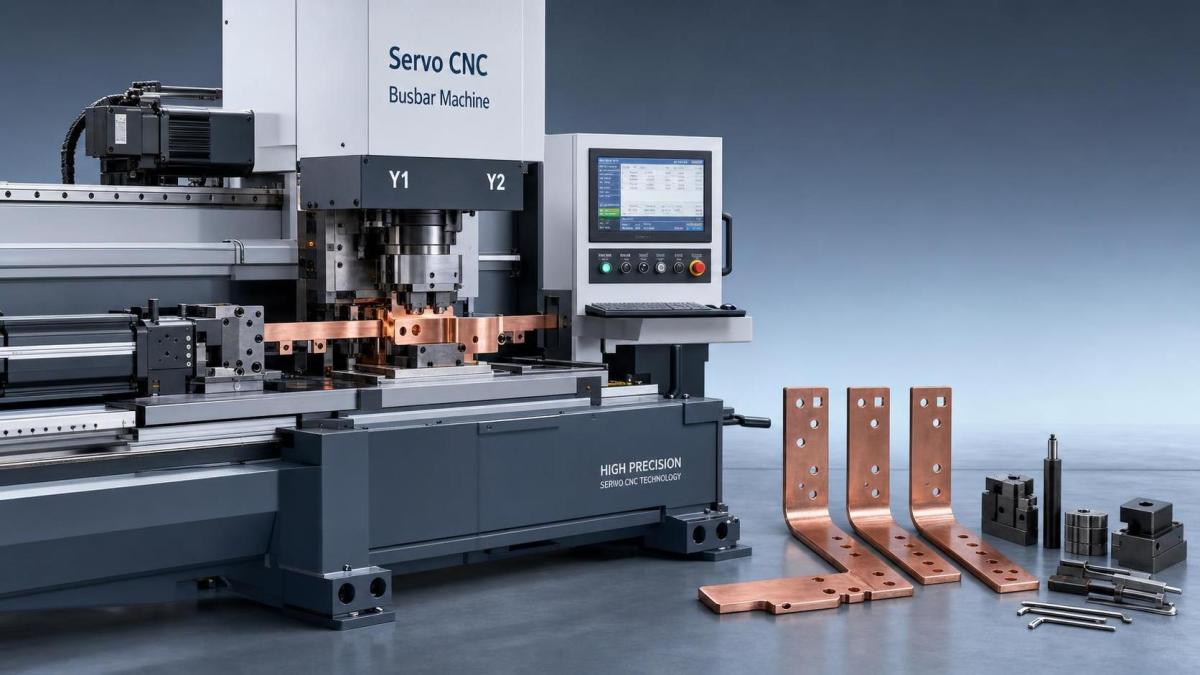
A lot of price difference sits in parts buyers cannot judge from a brochure. Machine frame rigidity, mold steel quality, machining accuracy, hydraulic stability where applicable, and motor quality all affect service life. Dexinjia, founded in 2014, positions its CNC busbar processing machines around high-quality materials, precision molds, and pure copper motors, which is exactly the kind of detail procurement should verify because those choices usually show up in noise level, durability, and consistency over time.
This is where experienced buyers ask for close-up photos, component lists, and maintenance recommendations instead of relying on general promises. If a supplier cannot clearly describe wear parts, expected replacement items, and mold maintenance requirements, the base price is telling you very little.
Accessory tooling also deserves attention. Sometimes a small item changes the real budget more than expected. For example, if your process needs edge finishing or mold support, a part such as Chamfering-Die may be a separate line item. The listed reference price of $75 is not large on its own, but these extras add up when you are equipping a full production setup.
Customization usually costs more, but sometimes saves more
Procurement teams often try to avoid customization because it lifts the initial quote. That is reasonable, but only up to a point. If your busbar widths, thickness range, hole patterns, or workflow differ from standard models, forcing a standard machine into a non-standard job can create higher labor cost, slower output, and more setup errors.
Custom fixtures, special molds, language localization, or program logic changes should be priced transparently. Ask one direct question: does this customization remove an ongoing production problem, or is it just nice to have? If it removes manual handling, reduces scrap, or avoids secondary processing, it deserves serious consideration.
Certification and export readiness affect landed cost
For international purchasing, compliance paperwork is part of cost, whether it appears in the machine price or not. Dexinjia states ISO, 3A, CE, and EAC certifications. That can matter when equipment is entering markets where buyer approval, customs clearance, distributor review, or project documentation require specific files. The practical procurement question is not “does the factory mention certifications,” but “which certificates apply to this machine model, and can the supplier provide the matching documents for shipment?”
If your project is tied to government utilities, EPC contracts, or formal plant acceptance, verify these documents early. Missing compliance documents can delay installation and create hidden cost that makes the cheaper quote irrelevant.
After-sales support is part of the price, whether you budget it or not
A busbar machine is not a disposable purchase. You are buying uptime. Technical support, spare parts availability, troubleshooting response, and training quality all influence total ownership cost. This is especially true if your team has limited experience with CNC busbar processing or if the machine will run in a market far from the supplier’s factory.
Ask for practical details:
- What spare parts are recommended for the first year?
- Can support be provided remotely, and in what language?
- How are warranty claims handled across borders?
- Is on-site service available, and who pays travel cost?
If the answers are unclear, put a risk premium in your evaluation. Many buyers do this informally anyway. Better to state it openly.
A quick comparison table helps when offers look close
What experienced buyers usually do before approval
They ask each supplier to quote the same production requirement, not just the same machine name. They request a clear configuration sheet. They compare consumables and spare parts. They check whether standard models are enough or whether the supplier has real experience with customized busbar processing solutions. And they treat global service capability as a cost factor, not a brochure sentence.
One last point: if two offers are very close, the better decision usually comes from whichever supplier gives cleaner technical answers and fewer vague exclusions. In this category, that tends to predict the ownership experience better than a small difference in the initial price.
For procurement, the right question is not “what is the price of the Servo CNC busbar Machine?” It is “what exactly are we paying for, what risks remain, and what will this machine cost us to run over time?” Once you review quotes that way, weak offers become easier to spot.
Send Us A Message
Get in Touch
*We respect your confidentiality and all information are protected.
First class quality service and professional after-sales team.