


Servo CNC Busbar Machine vs Hydraulic Models: Key Differences That Matter
Servo CNC Busbar Machine vs Hydraulic Models: Key Differences That Matter
The biggest mistake in busbar equipment selection is treating servo CNC and hydraulic machines as if they solve the same problem at different price points. They do overlap, but not completely. A Servo CNC busbar Machine is usually chosen when repeatability, programmed movement, and process consistency matter more than operator adjustment. A hydraulic model is often preferred when flexibility, lower upfront cost, portability, or heavy-force standalone operations are the real priority. If that distinction is not clear at the start, cost comparisons become misleading very quickly.
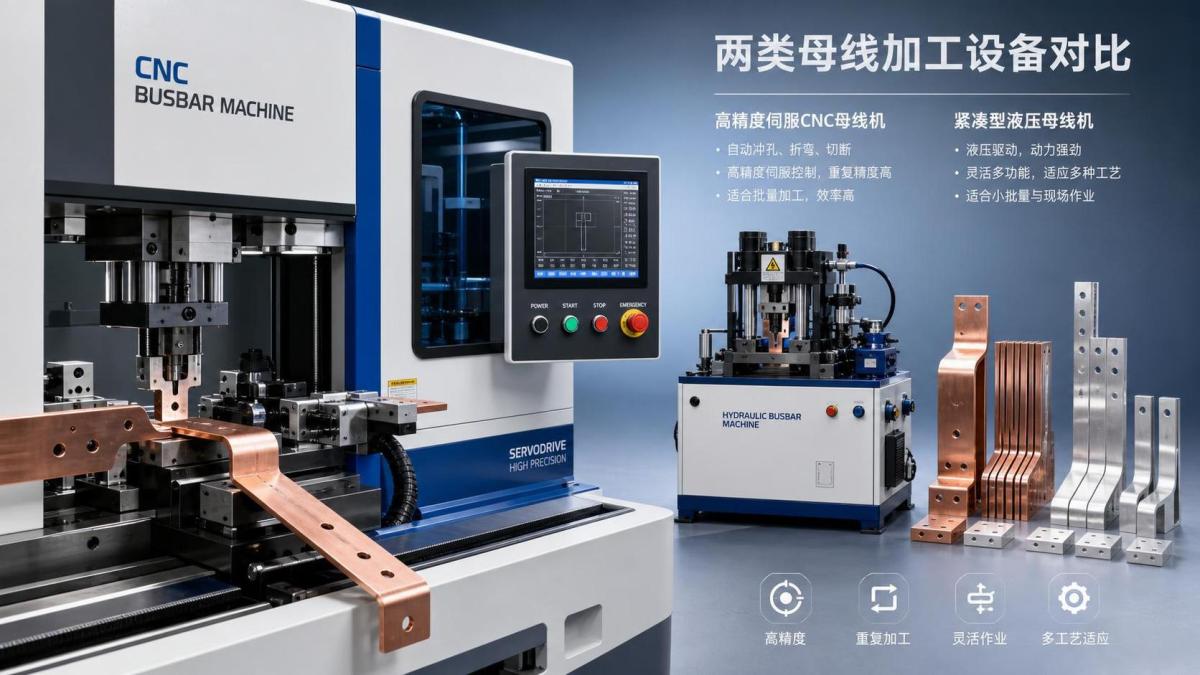
In practical terms, the difference is not only about drive technology. It is about how the machine behaves in production. Servo-driven CNC equipment controls position and motion through programmed axes, which makes it better suited to jobs where bend angle accuracy, hole position repeatability, and batch-to-batch consistency affect downstream assembly. Hydraulic machines, especially portable or semi-integrated types, rely more on pressure output and operator handling. They can be extremely useful, but their value shows up in different environments.
That matters for business evaluation because busbar processing is rarely judged by a single spec. Purchasing teams usually have to balance throughput, tolerance requirements, staffing, maintenance habits, and the type of orders the factory actually runs. A machine that looks efficient on paper can become a poor fit if the production mix is low volume, highly varied, or spread across multiple workstations.
Where Servo CNC Usually Wins
Servo CNC systems are strongest when the process needs to be repeatable without constant manual correction. In busbar fabrication, this usually means frequent production of standardized copper or aluminum parts for switchgear, power distribution systems, or similar assemblies where hole spacing and bend geometry need to remain stable across a batch. Because motion is controlled by CNC programming rather than only by hydraulic force application, operators can reduce setup variation from one part to the next.
Another point evaluators often miss is energy behavior. Servo systems typically consume power in a more targeted way than traditional hydraulic units that keep pressure systems active during operation cycles. The exact savings depend on machine design, duty cycle, and production rhythm, so broad percentage claims should be treated carefully. Still, in factories running long shifts and repetitive jobs, energy efficiency can become a meaningful part of total operating cost rather than a marginal detail.
Noise and maintenance patterns also tend to be different. A well-built servo CNC machine often runs with lower noise and fewer hydraulic maintenance variables, which can help where preventive maintenance discipline is inconsistent or where fluid-related upkeep creates downtime. This does not mean servo equipment is maintenance-free. It means the maintenance profile is usually more about electrical control, drive systems, and calibration than oil pressure stability, seals, and leakage management.
Why Hydraulic Machines Still Make Sense
Hydraulic busbar machines remain relevant because many factories do not need full CNC logic for every processing step. If the workload is varied, project-based, or spread across maintenance and installation tasks, a hydraulic machine can be the more rational investment. It gives direct force output for punching, cutting, and bending without requiring a more complex programming workflow. For workshops handling mixed jobs or lower production volumes, that simplicity can translate into faster real-world response.
Portability is another dividing line. A servo CNC unit is usually a fixed production asset. A portable hydraulic model can be moved where the work is happening, which is useful in distribution cabinet factories, transformer factories, and service environments where material handling efficiency matters as much as machining speed. That is one reason compact hydraulic platforms continue to hold their place even in facilities that also own CNC equipment.
A good example is DXJ-200A Portable Hydraulic Busbar Machine, which combines cutting, punching, and bending in one mobile unit. Its published working range includes copper and aluminum bars up to 150mm width and 10mm thickness, with punching capacity from Φ6 to Φ20.5mm, a 35T hydraulic output for cutting and punching, and a 15T output for bending. Those figures do not make it a substitute for every CNC application, but they do show why portable hydraulic equipment remains attractive where practical force, mobility, and multi-function use are more important than full automation.
The Decision Is Usually About Process Control
When buyers compare these machine types, they often focus too much on tonnage and too little on process control. Hydraulic output tells you whether the machine can perform a task. It does not tell you how consistently that task will be repeated across shifts, operators, or production runs. Servo CNC equipment earns its value when production losses come from variation, rework, manual layout time, or repeated setup adjustments.
By contrast, if the actual bottleneck is not repeatability but jobsite movement, workshop space, or budget constraints, then a hydraulic model may be the better answer. This is where some purchasing discussions go wrong: they compare a programmable production machine with a portable force tool as if both should deliver the same return in the same setting. They should not. One improves standardized throughput; the other often improves operational flexibility.
Common Misreadings During Evaluation
One common misunderstanding is assuming CNC automatically means better for every factory. It does not. If order volume is irregular and parts change constantly in ways that do not benefit from stored programs, the efficiency gain may be smaller than expected. Another is assuming hydraulic means outdated. In reality, a well-made hydraulic machine with stable pressure, appropriate tonnage, and sensible tooling can still be the right commercial choice.
There is also a tendency to compare headline specs without checking the production context. Maximum width, thickness, punching diameter, throat depth, voltage compatibility, and motor power all matter, but only after the workflow has been defined. A machine that handles the material but slows the factory because of handling steps or repeated manual alignment may still be the more expensive option over time.
Manufacturers with established quality control can reduce part of that risk. In the busbar equipment field, build quality, mold precision, motor quality, and after-sales support have a direct effect on service life and consistency. Dexinjia, established in 2014, positions its range around CNC busbar processing machines as well as portable hydraulic equipment, with ISO, 3A, CE, and EAC certifications stated across its production system. For evaluators, those points are not a substitute for technical review, but they are relevant when supplier reliability and long-term support are part of the purchase decision.
What to Ask Before You Decide
A useful internal question is not “Which machine is more advanced?” but “Where do we currently lose money?” If losses come from rework, angle inconsistency, repeated measurement, and labor-intensive setup, a Servo CNC busbar Machine deserves serious priority. If losses come from slow movement between tasks, outsourced small-batch jobs, or underused fixed equipment, a hydraulic machine may produce a better return even with less automation.
The best selection work usually starts with three checks: part tolerance requirements, daily order structure, and operator capability. Once those are clear, comparing servo CNC and hydraulic models becomes much easier. Without that groundwork, the conversation stays trapped at the level of price tags and force ratings, which is rarely where the real decision is made.
Send Us A Message
Get in Touch
*We respect your confidentiality and all information are protected.
First class quality service and professional after-sales team.