


Servo CNC or Hydraulic Bending: Which Busbar System Fits Your Output?
Choosing between servo CNC and hydraulic bending is not really a question of which technology is “better.” It is a question of where variation, labor time, and rework are currently entering your busbar operation. A compact hydraulic unit can be the sensible choice for occasional cabinet work. A servo CNC busbar bending machine becomes much easier to justify when the same parts must be produced repeatedly, tolerances need to remain consistent across shifts, and production planning is moving beyond one-off fabrication.
For manufacturers processing copper or aluminum busbars, the decision affects more than bending speed. It influences how jobs are programmed, how quickly operators can change between designs, whether downstream assembly receives parts in the correct orientation, and how much capacity is available when order volume rises unexpectedly.
Hydraulic Bending Still Has a Practical Place
Hydraulic bending equipment is often the right fit for workshops with varied, low-volume requirements. It is commonly chosen for maintenance departments, electrical panel builders handling custom projects, and smaller operations where busbar dimensions change frequently but repeat quantities stay limited. The equipment is generally straightforward: position the bar, select the tooling, align the bend point, and apply hydraulic force.
That simplicity is valuable. A skilled operator can make adjustments quickly when a drawing changes or when a site installation reveals an unexpected clearance issue. Portable hydraulic busbar processors are also useful where material must be handled close to the installation area rather than brought to a dedicated production line.
The trade-off appears when part repetition increases. Manual marking, positioning, and visual alignment can introduce small differences from one workpiece to the next. Those differences may be acceptable for a short run. They become expensive when a cabinet assembly team has to force-fit multiple busbars, correct hole-to-bend relationships, or sort parts that look similar but are not interchangeable.
Hydraulic systems should therefore be assessed honestly. They are not automatically inaccurate, but their real-world consistency depends heavily on tooling condition, operator practice, material springback, and the discipline of the setup process.
Where Servo CNC Changes the Production Equation
A servo CNC busbar bending machine is designed for repeatability. Instead of relying on each bend being laid out and positioned manually, the operator works from programmed coordinates, bending sequences, angles, and material settings. Once the program is verified, the machine can reproduce the same geometry with much less dependence on individual operator judgment.
This matters most in switchgear, power distribution, control cabinet, transformer, and electrical equipment production, where a busbar is rarely an isolated part. Its bends, offsets, punched holes, and mounting relationship must match other components. A bend that is only slightly misplaced can create trouble later, particularly in tightly packed assemblies where insulation clearances and connection points leave little room for adjustment.
Servo-driven control also gives production teams a more predictable rhythm. The advantage is not simply that the machine can move quickly. It is that programmed movements reduce avoidable pauses: checking dimensions again, finding the correct mark, confirming bend direction, or remaking a part after a sequence error. In a mixed-product factory, those small interruptions can consume more time than the bending stroke itself.
The Real Comparison: Output Pattern, Not Machine Price Alone
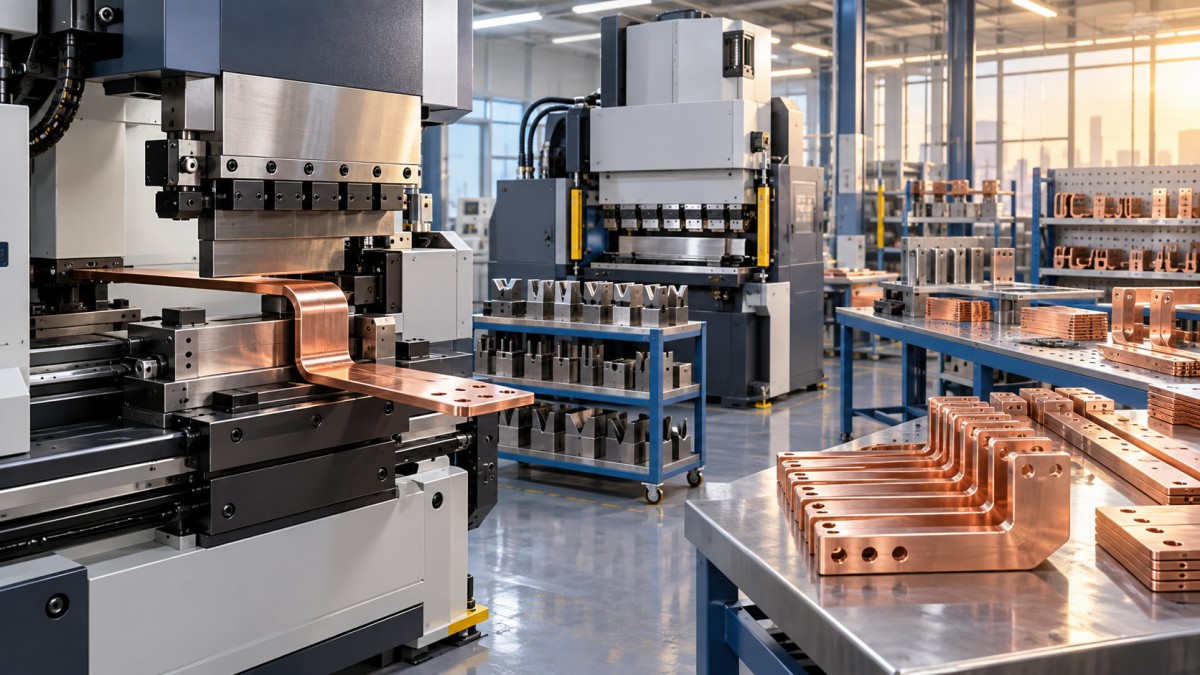
The common purchasing mistake is to compare only initial equipment cost. A more useful calculation looks at the total process: drawing interpretation, setup time, first-piece confirmation, rework, material scrap, and the number of people required to keep output stable. If an operation makes ten unique busbars this week and another ten different ones next week, hydraulic equipment may remain entirely appropriate. If it produces hundreds of similar connection bars over recurring projects, the labor and consistency argument shifts toward CNC.
Material Condition Can Decide Whether CNC Accuracy Delivers Value
Even a well-programmed bending machine cannot fully compensate for poor incoming material condition. Copper and aluminum bars may arrive with curvature, residual stress, or uneven flatness from handling and storage. If the bar does not sit consistently against locating surfaces, bend position and angle can become less predictable. This is especially relevant when punching, shearing, and bending are combined in a sequence.
For operations working with material up to 160 mm wide and 3–12 mm thick, a dedicated leveling stage can be worth considering before higher-precision processing. The DXJ-160 Copper Busbar Straightening & Leveling Machine is intended to level copper and aluminum busbars before punching, shearing, and bending. Its stated flatness performance is no more than 1 mm/m, with a leveling speed of 6500 mm/min. In practice, the point is not to add another machine for its own sake; it is to prevent material curvature from becoming a recurring quality problem downstream.
This is one area where buyers should ask suppliers to discuss the entire material flow, not only the bending station. A busbar line is only as consistent as the condition of the bar entering it, the quality of the dies, and the method used to verify the first finished part.
Questions That Separate a Good Investment from an Impressive Specification
Before selecting equipment, review actual job history rather than relying on an average monthly tonnage figure. The number of bends per part, number of repeat orders, material widths and thicknesses, and frequency of engineering changes are more revealing. A low material volume can still justify CNC if each part has several bends and a high cost of assembly error. Conversely, high material volume does not automatically require CNC if production consists mainly of simple, straight cut lengths.
It is also sensible to clarify whether programming will be handled by production staff, engineering staff, or both. CNC equipment reduces manual positioning work, but it does not remove the need for sound drawings, operator training, tooling inspection, and material-specific bend compensation. Copper and aluminum do not behave identically, and a program proven on one thickness should not be assumed suitable for another without checking the result.
Supplier capability matters after the purchase as well. Dexinjia, established in 2014, manufactures CNC busbar processing equipment covering bending, punching, cutting, and embossing, alongside 3-in-1 and portable hydraulic options. For a buyer, the practical value of a supplier with both CNC and hydraulic product lines is that the discussion can begin with the process requirement rather than forcing every project toward one machine category. Technical support, tooling quality, available customization, and access to after-sales service deserve the same scrutiny as headline specifications.
Choose the System That Matches the Next Three Years
Hydraulic bending remains a capable, economical answer for flexible and lower-volume busbar work. It is often the better choice when portability, simple operation, and rapid manual adaptation outweigh the need for programmed repetition.
A servo CNC busbar bending machine is usually the stronger option when recurring parts, tight assembly fit, workforce consistency, and production planning are becoming daily concerns. Do not buy CNC simply because automation sounds modern. Buy it when repeatability has become a measurable production need—and make sure the material preparation, tooling, programs, and operator process are ready to support it.
Send Us A Message
Get in Touch
*We respect your confidentiality and all information are protected.
First class quality service and professional after-sales team.