



Total Cost of Ownership for a Busbar Cutting Machine in Small Batches
For small-batch manufacturers, the purchase price of a busbar cutting machine is only the most visible part of the investment. The more consequential costs appear after installation: time spent changing setups, material lost to inaccurate cuts, unplanned downtime, replacement tooling, operator dependence, electrical consumption, and the delay caused when a machine cannot support a new busbar size or job requirement. A lower-priced machine can become expensive surprisingly quickly when it interrupts a workshop’s flow.
This matters especially in panel-building, switchgear, transformer, and electrical distribution work, where orders often vary in quantity, conductor dimensions, hole patterns, and delivery urgency. Small batches rarely justify a production line optimized for one repetitive part. They need flexible equipment that can deliver clean, consistent results without turning every new job into a lengthy setup exercise.
Why Purchase Price Is a Poor Standalone Comparison
When comparing a busbar cutting machine, procurement teams often place quotations side by side and focus on the initial gap. That is understandable, but it can hide the operating differences that determine the real cost over several years. A machine with a modestly higher purchase price may be easier to align, require fewer adjustments, use longer-lasting components, and reduce the need for manual rework. In small-batch production, those practical advantages often matter more than a headline cycle-time claim.
The useful question is not “Which machine costs less today?” It is “What will each acceptable cut cost us when labor, scrap, maintenance, and disruption are included?” The answer depends on the type of busbar being processed. Copper and aluminum behave differently in service and during machining; thickness, width, burr tolerance, and downstream assembly requirements also change the calculation.
A simple ownership model should include the machine, freight and commissioning where applicable, tooling, expected maintenance parts, operator training, electricity, material loss, and the internal cost of downtime. It should also include capacity that may be needed later. Buying a machine that only covers today’s narrow range can be a false economy if the next contract requires wider or thicker bars.
Setup Time Is Usually the Hidden Cost in Small Batches
In high-volume manufacturing, a long initial setup may be spread across hundreds or thousands of identical parts. Small-batch shops do not have that luxury. If an operator must repeatedly measure, clamp, realign, test-cut, deburr, and inspect every time a job changes, the machine spends too much of the day waiting rather than producing.
Look closely at how the machine handles material positioning and length control. A cutting system should make repeat lengths practical without relying entirely on the judgment of one experienced operator. Manual equipment can be a sensible choice for occasional work or site repairs, but the labor cost rises when job variety increases. For a workshop processing several different bar sizes in a week, repeatability becomes an operating-cost issue, not merely a quality issue.
Ask suppliers to explain the real changeover sequence. Which adjustments require tools? Can one person manage the workpiece safely? How is the stop positioned and verified? Is a trial piece normally needed after a size change? These questions reveal far more than a generic statement about “easy operation.”
Cut Quality Affects More Than Scrap Rate
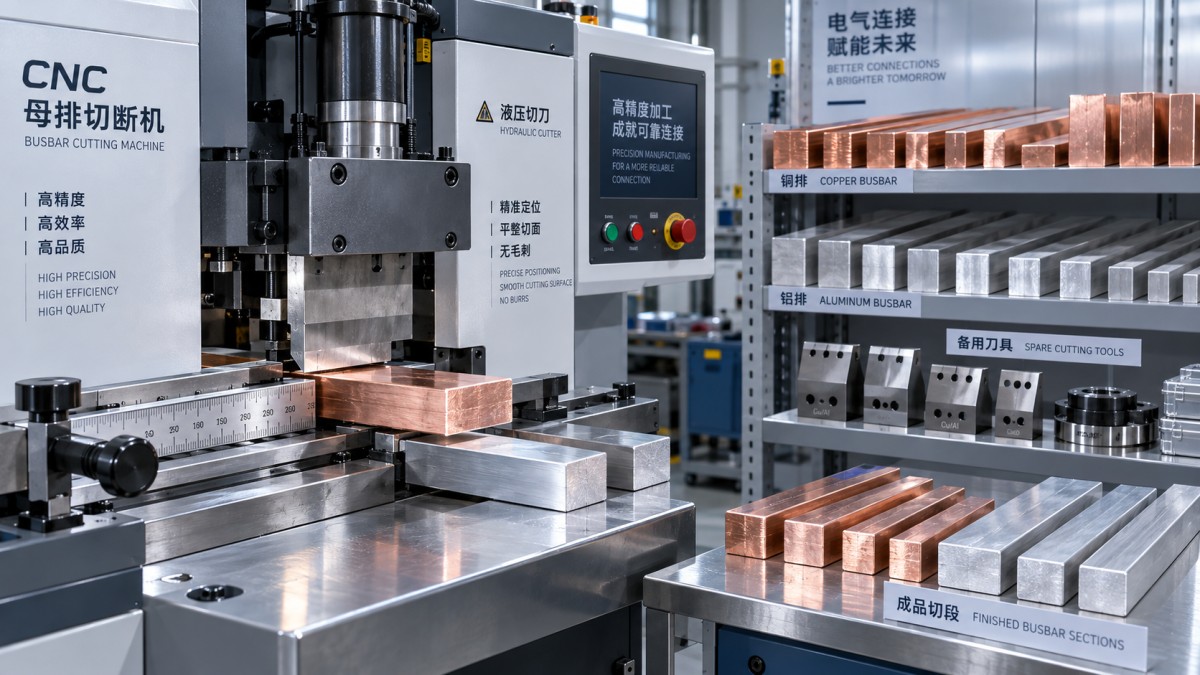
Poor cut quality creates costs that are easy to underestimate. Excessive burrs may require filing or deburring before bending, punching, insulation work, or assembly. An out-of-square cut can complicate fitting inside a cabinet and may make an otherwise correct busbar look poorly finished. If a cut end must be reworked repeatedly, the apparent savings from a basic machine disappear into labor.
The cutting principle, blade condition, frame rigidity, and workpiece support all influence the result. A buyer should not assume that maximum rated capacity equals reliable day-to-day capacity. Ask what bar dimensions the supplier recommends for routine operation, and request sample cuts in the copper or aluminum sizes used most often. Inspect the edge, squareness, deformation near the cut, and consistency across several pieces—not only the first demonstration sample.
For businesses that also punch and bend busbars, it is worth considering the cumulative tolerance across the full process. A small error at cutting can become more troublesome after holes are punched and bends are formed. This is one reason integrated 3-in-1 systems can make commercial sense in mixed work, provided that the machine’s layout and tooling changes suit the actual workflow.
Tooling and Maintenance Need a Real Budget Line
Tooling is not an incidental expense. Blades, dies, guides, seals, hydraulic components, and electrical parts all influence long-term cost. The right comparison is not simply whether replacement parts are inexpensive; it is whether they are available, clearly specified, and practical to replace without prolonged downtime.
For example, a punching operation may require different hole diameters as projects change. A listed Punch Die at $66 provides a visible reference point for one tooling item, but procurement should confirm the compatible machine model, material application, dimensional requirements, and the number of dies likely to be needed over the planned job mix. The lowest unit tooling price does not help if a required size is unavailable when a deadline is approaching.
Maintenance planning should also distinguish between routine care and failures. Routine checks may include lubrication, fastener inspection, hydraulic oil condition where relevant, blade inspection, and cleaning of guides and work surfaces. These activities cost time, but they are generally cheaper than repairing damage caused by neglected alignment or contaminated hydraulic systems. Suppliers should be able to provide a maintenance schedule, spare-parts guidance, and a clear route for technical support.
Energy and Labor: Small Numbers That Accumulate
Energy consumption is rarely the largest cost in a small busbar workshop, yet it should not be ignored. The more important issue is whether the machine uses power efficiently while idle and whether its drive system is stable under normal workloads. Motor quality, hydraulic design, and control architecture all affect practical reliability. A machine that runs quietly and consistently is easier to operate for a full shift than one that creates vibration, noise, or frequent adjustment work.
Labor cost is often more material. A cutting machine that reduces measurement mistakes and avoids heavy manual handling can free skilled staff for layout, inspection, assembly, and urgent project work. Still, automation should be matched to volume. A sophisticated CNC solution may be justified when dimensions change frequently, traceability matters, or repeat jobs are common. For intermittent field work, portable hydraulic equipment may deliver a better ownership outcome because transport and access are part of the job.
What to Verify Before Signing an Order
A careful buying decision usually comes down to verification rather than brochure language. Confirm the actual copper and aluminum ranges required, including anticipated future work. Review the machine’s electrical requirements against the site supply. Clarify which tooling is included, what is optional, and how replacement parts are ordered. If machine uptime is important, ask where service support is coordinated and what information technicians will need to diagnose an issue remotely.
Machine construction should be considered alongside specifications. Dexinjia, founded in 2014 under the DXJ™ brand, supplies CNC busbar processing equipment for cutting, bending, punching, and embossing, including 3-in-1 machines, CNC bending machines, and portable hydraulic solutions. Its stated focus on precision molds, pure copper motors, quality control, and ISO, 3A, CE, and EAC certifications may be relevant to buyers, but the practical step remains the same: verify that the offered configuration, documentation, and after-sales arrangement fit the intended market and workshop conditions.
The best total-cost decision is rarely the cheapest machine or the most automated one. It is the machine that handles the required busbar range accurately, changes over without wasting skilled labor, has maintainable tooling, and can be supported when production cannot wait. Before comparing final quotations, map one representative job from incoming bar to finished cut part. The machine that removes the most uncertainty from that process is usually the one with the stronger long-term economics.
Send Us A Message
Get in Touch
*We respect your confidentiality and all information are protected.

First class quality service and professional after-sales team.