


What Factory Capabilities Should a CNC Busbar Bender Manufacturer Prove?
For an automatic CNC busbar bender manufacturer, a machine specification sheet is only the starting point. Procurement teams need evidence that the factory can repeatedly build, test, support, and adapt equipment for the busbar sizes, materials, tolerances, and production flow they actually operate.
A supplier may quote bending force, maximum working width, and CNC axes correctly while still lacking the controls needed to deliver consistent parts over time. The practical question is whether the manufacturer can prove control of the factors behind bending accuracy: machine-frame rigidity, tooling quality, motion calibration, material handling, assembly discipline, and service responsiveness. A factory that can demonstrate those capabilities gives a buyer a more defensible basis for comparing total operating cost, not merely purchase price.
Ask for proof of the manufacturing process behind the machine
The first capability to assess is how much of the critical machine build the supplier controls. This does not mean every component must be made in-house. CNC controls, hydraulic valves, bearings, electrical components, and motors often come from specialized suppliers. What matters is whether the manufacturer owns the design, machining, fit-up, and verification work that determines the final machine's performance.
For a CNC busbar bender, buyers should look closely at the bending head, clamping arrangement, guide surfaces, transmission system, and structural frame. These elements must work together under repeated load. A heavy or well-painted frame alone is not evidence of rigidity. Ask how the frame is fabricated and stress-relieved, which dimensions are machined after welding, and how alignment is checked before final assembly.
The supplier should also be able to explain its control of bending molds and dies. Tooling has a direct effect on bend radius, surface marking, springback consistency, and the risk of edge deformation. A manufacturer that can produce or accurately manage precision tooling is generally in a better position to respond when a buyer needs an unusual bar width, thickness, bend geometry, or material grade.
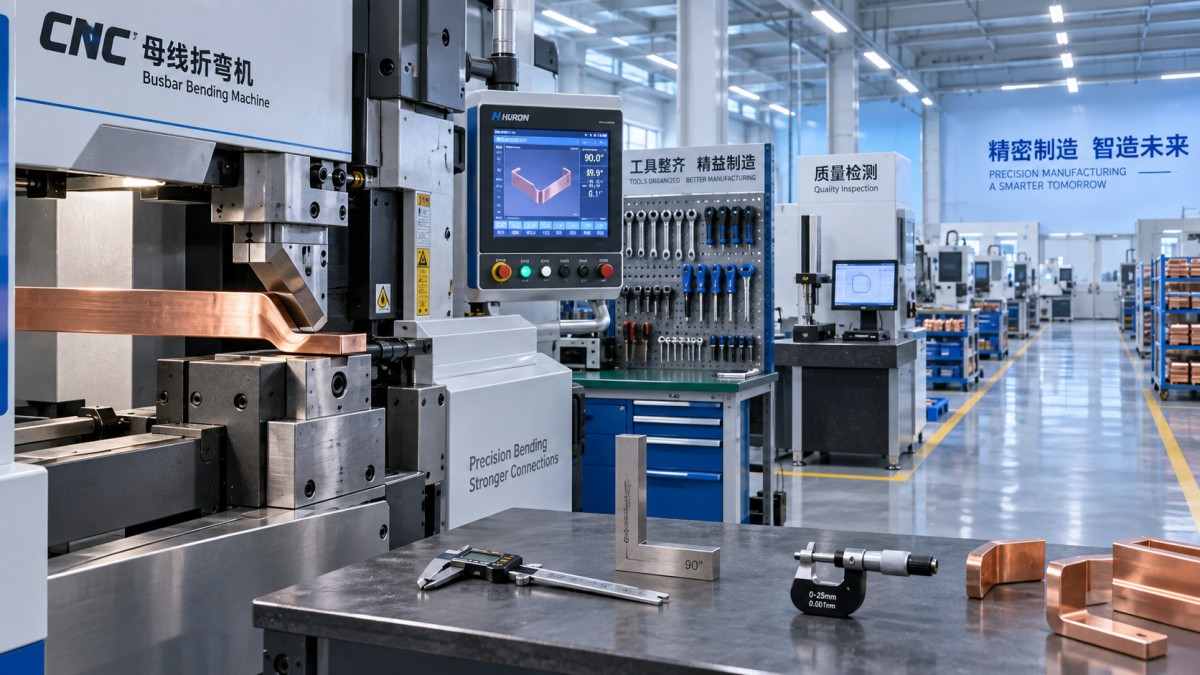
- Request photos or videos of machining, assembly, tooling preparation, and final testing, rather than only finished-machine images.
- Ask which core assemblies are made internally and which are sourced.
- Check whether the quoted tool set is designed for the buyer's stated copper or aluminum dimensions, not simply a standard configuration.
- Require the supplier to identify wear parts, recommended replacement intervals, and the normal lead time for spares.
These questions help separate a factory with repeatable production control from a trading operation or an assembler working from generic machine configurations.
Verify accuracy through a witnessed part process
A quoted positioning accuracy has limited value unless the supplier can show how it is maintained through the complete bending cycle. In busbar work, the finished result can be affected by material thickness variation, conductivity-grade copper hardness, aluminum behavior, burr condition, prior punching, and the selected bend radius. A capable manufacturer should discuss these variables before promising a final tolerance.
The most useful acceptance approach is to define representative parts early. Supply drawings that include material, width, thickness, holes or slots near the bend area, bend angle, inside radius, and acceptable dimensional deviation. Then ask the factory to produce samples or conduct a remote factory acceptance test using the agreed conditions. The objective is not to demand an unrealistic zero-deviation result; it is to establish how the machine performs on work that resembles the buyer's production.
During this review, procurement teams should ask how the operator enters material data, how the control handles bend compensation, and whether programs can be stored and recalled without re-establishing every dimension. If the machine will process several busbar sizes, changing from one job to another should be demonstrated. A fast cycle time is less valuable when setup, correction, or trial pieces consume a large share of the shift.
Evidence of calibration procedures matters as well. The supplier should be able to describe how it checks axis position, tool alignment, hydraulic pressure or servo response, and repeatability after assembly. A documented inspection record is more useful than a broad statement that every machine is tested.
Assess customization as an engineering capability, not a sales promise
Many busbar bending applications are close to standard, but “close” can still create expensive production friction. Cabinet builders, switchgear producers, panel shops, and electrical equipment manufacturers may have different bar profiles, layout rules, material flows, and part families. Buyers should therefore distinguish between a supplier willing to change a color or label and one able to engineer a functional adaptation.
Useful customization may include non-standard dies, modified working length, dedicated material supports, loading and unloading arrangements, safety guarding, control-language requirements, or integration with punching and cutting equipment. Each change affects delivery, commissioning, and future maintenance. A manufacturer should be able to provide revised drawings, confirm the design assumptions, and state whether the modification changes throughput, required floor space, power supply, or tooling compatibility.
There is also a boundary to consider. Excessive customization can turn a routine production machine into a one-off asset with difficult spare-parts support. Procurement should ask which parts remain standard and interchangeable, and which become unique to the project. The strongest solution often preserves standard mechanical and electrical modules while adapting only the interfaces needed for the application.
Upstream material condition deserves attention in this conversation. Bent or uneven stock can undermine the output of downstream punching and bending equipment, particularly where flatness affects locating and repeatability. For operations processing copper or aluminum bars up to 160 mm wide and 3-12 mm thick, a leveling stage such as the DXJ-160 Copper Busbar Straightening & Leveling Machine can be evaluated as part of the line rather than as an isolated accessory. Its value depends on whether incoming material curvature is causing handling errors, inconsistent positioning, or avoidable adjustment at later stations.
Look beyond certificates and inspect quality-system behavior
Certification can be relevant, especially when equipment is being purchased for export or must fit a defined compliance process. However, certificates do not by themselves establish that a particular machine was assembled with the right components, wiring practices, guards, and test discipline. The buyer should connect claimed certifications to the actual equipment scope and destination-market requirements.
A stronger conversation focuses on traceability and release control. Can the factory identify the major purchased components installed on a machine? Does it use an assembly checklist? Is electrical wiring checked against a schematic? Are hydraulic connections inspected for leaks under operating conditions? Are safety devices tested before shipment? Can the buyer receive operating manuals, electrical diagrams, spare-parts lists, and an acceptance record in a usable language?
For a procurement team, these documents reduce handover risk. They also make it easier for maintenance staff to diagnose faults, source approved replacements, and train new operators after commissioning. A lower-priced machine without clear documentation can become costly when a simple electrical or tooling issue halts production.
Test service capability before placing the order
After-sales support is often discussed late in negotiations, when it should be a selection criterion from the start. CNC busbar equipment combines mechanical, electrical, hydraulic, and software-related issues. A manufacturer does not need to have a service engineer in every country to be viable, but it should show a workable support process for the buyer's location.
Ask who will handle installation guidance, operator training, troubleshooting, software questions, warranty decisions, and spare-parts dispatch. Clarify support hours, communication channels, expected diagnostic information, and whether remote assistance can be provided through drawings, video, or controller access where appropriate. Request a recommended spare-parts package based on the machine configuration rather than accepting a generic list.
Service capability is especially important when the equipment will be the only bending station in a production line. In that case, buyers should calculate the cost of downtime and decide whether to stock critical sensors, seals, switches, tooling inserts, or control-related components locally. The supplier's ability to identify critical spares is itself a useful indication of product maturity.
Compare suppliers on lifecycle risk, not headline price
The lowest quotation can be economical when the machine is genuinely standard, the production requirement is modest, and local maintenance resources are strong. It becomes less attractive when the order includes custom tooling, tight part tolerances, multiple material sizes, or a compressed commissioning schedule.
When comparing an automatic CNC busbar bender manufacturer, evaluate the offer against four practical questions: Can the factory build the critical assemblies consistently? Can it prove the machine on representative parts? Can it document and control the customized elements? Can it keep the machine productive when support or replacement parts are needed?
A supplier that answers those questions with drawings, test records, process visibility, and precise service commitments is offering more than equipment. It is reducing the uncertainty that usually appears after the purchase order has been issued.
Send Us A Message
Get in Touch
*We respect your confidentiality and all information are protected.
First class quality service and professional after-sales team.