



What Is a Busbar Machine and How Does It Improve Panel Manufacturing Efficiency?
What a Busbar Machine Really Does in Panel Manufacturing
A Busbar Machine is not just a metalworking tool with a narrow job. In panel manufacturing, it is the equipment that turns copper or aluminum bar stock into repeatable conductive components that actually fit the electrical design, the enclosure layout, and the assembly schedule. That distinction matters, because many people first assume busbar processing is simply cutting metal to length. In practice, the difficult part is keeping hole position, bend angle, edge quality, and part consistency under control while production volume increases.
That is why this machine sits in a very specific place between raw material handling and final panel assembly. It is used to process flat busbars through operations such as punching, cutting, bending, and in some cases embossing or marking. The goal is not only to shape metal, but to produce current-carrying parts that align with switchgear, breakers, connection points, and insulation clearances without creating rework downstream.
In other words, when panel builders talk about efficiency, they are rarely talking about machine speed alone. They are talking about how quickly a workshop can move from drawing to finished busbar set with acceptable dimensional accuracy, minimal scrap, and fewer manual corrections at the assembly bench.
Why Manual Processing Becomes a Bottleneck
Small shops sometimes begin with separate hydraulic tools, saws, drill presses, and manual bending setups. That can work for low volume or simple projects. The problem appears when design complexity increases. Modern electrical panels often require multiple hole patterns, tight bend positioning, and consistent part matching across repeated jobs. Each manual step adds setup variation. One operator measures from one edge, another references a centerline, and suddenly parts that look similar on the bench do not line up inside the cabinet.
A Busbar Machine improves this by reducing the number of uncontrolled handoffs. On a 3-in-1 or CNC system, processing steps are either integrated or managed through more stable positioning logic. That means less time spent rechecking dimensions and less dependence on individual operator technique. For manufacturers, this is usually where the real efficiency gain comes from: fewer interruptions, not just faster strokes.
There is also a quality issue that is easy to overlook. Poor punching or bending does not only waste material. It can create burrs, deformation, or misalignment that slows installation and may affect connection quality. In electrical work, that is not a cosmetic problem. Fit and surface condition influence how reliably the busbar can be mounted, insulated, and connected.
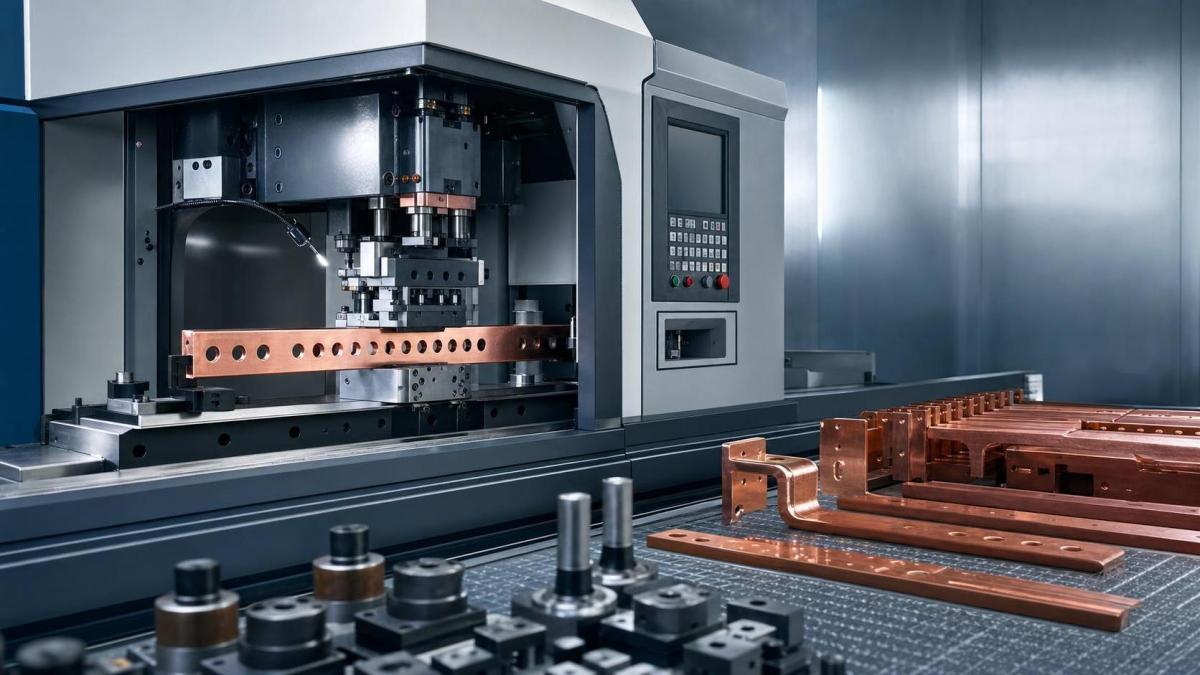
How the Machine Improves Throughput Without Simplifying the Work
The value of busbar processing equipment is often misunderstood as “automation replaces skill.” That is not quite right. Skilled judgment is still needed to choose tooling, define bend sequence, confirm material suitability, and check whether the design itself is practical to manufacture. What the machine changes is the amount of variation introduced during execution.
A well-built machine supports efficiency in several concrete ways:
- It keeps hole location and bend position more consistent across batches.
- It reduces repeated layout and measuring work for operators.
- It shortens changeover between common operations such as cutting and punching.
- It lowers the chance of material waste caused by avoidable human error.
- It makes repeat orders easier to reproduce when the same bar design is needed again.
CNC models go a step further by improving repeatability on more demanding parts. That matters in projects where panel dimensions are tight, conductor paths are layered, or multiple busbar pieces must align with pre-installed components. Portable hydraulic equipment still has a place, especially for on-site work, maintenance, or lower-volume processing, but it serves a different production logic than a dedicated CNC line.
What Buyers Should Actually Look At
When people ask whether one machine is “better,” the useful answer depends on the work mix. A shop producing standard low-voltage panels in medium volume may care most about reliable daily output and simple operation. A manufacturer handling varied custom jobs may place more value on flexible programming and tooling compatibility. The machine should be judged against process stability, not just advertised tonnage or feature count.
Tooling quality is part of that equation. A busbar machine can only perform as well as the dies and molds used in real production. Punch accuracy, edge finish, and tooling life all influence whether the machine keeps pace over time. In busbar mold supply, details like the fit and durability of a Punch Die can have a direct effect on consistency, especially when identical hole patterns are produced repeatedly.
Material handling also deserves attention. Copper and aluminum do not behave exactly the same in forming and punching, and not every workshop processes both in equal volume. A suitable machine setup should match the actual bar sizes, material types, and process sequence used on the shop floor. Otherwise, capacity on paper may not translate into easier production.
Where Manufacturers See the Difference
In day-to-day panel production, efficiency is usually lost in small delays: operators waiting for the next step, remaking a bent part, correcting hole offset, or searching for the right tooling. A Busbar Machine helps by organizing those tasks into a more controlled workflow. The improvement is cumulative. One minute saved on layout, another on setup, and a few avoided errors across a batch can make a noticeable difference to lead time.
This is also where machine construction matters more than catalog language. Manufacturers such as Dexinjia, established in 2014 and focused on CNC busbar processing machines, tend to emphasize stable mechanical performance, mold precision, motor quality, and service life because these factors affect how reliably the machine runs under production conditions. Certifications such as ISO, 3A, CE, and EAC indicate a structured approach to quality and compliance, but they should be read as part of the overall manufacturing discipline rather than as proof that every machine fits every application.
A Common Mistake: Treating It as a Standalone Purchase
One common mistake is to evaluate busbar equipment as if it were independent from the rest of the production system. In reality, its performance depends on drawings, operator training, tooling condition, maintenance habits, and the consistency of incoming material. Even a strong machine will not solve poor process planning. On the other hand, when the workflow is well organized, the machine becomes a practical lever for reducing labor intensity and making output more predictable.
That is why the better question is not simply “What is a Busbar Machine?” but “What part of our manufacturing variability should it remove?” For some factories, the answer is manual measuring. For others, it is repeat bending accuracy, faster punching cycles, or the ability to support custom busbar processing with less rework. If you understand that process gap clearly, the right machine category becomes much easier to identify.
So, a Busbar Machine is best understood as a precision production tool for making conductive bars manufacturable at scale. It improves panel manufacturing efficiency when it reduces variation, keeps parts consistent, and shortens the distance between design intent and assembly reality. That is the standard worth using when you compare options, whether you are considering a compact hydraulic unit, a 3-in-1 system, or a CNC solution with dedicated tooling such as a Punch Die.
Send Us A Message
Get in Touch
*We respect your confidentiality and all information are protected.

First class quality service and professional after-sales team.