



What Maintenance Points Affect Servo CNC Busbar Machine Uptime Most?
Why uptime problems on a Servo CNC busbar Machine usually start in maintenance, not in programming
When a Servo CNC busbar Machine stops unexpectedly, people often suspect the control system first. In practice, the bigger causes of lost uptime are usually more physical and more ordinary: lubrication that is present but not reaching the right point, dies that are still usable but no longer accurate, unstable bus communication inside the machine, motor heat that was ignored for too long, hydraulic drift, or electrical parts that fail intermittently rather than completely. For maintenance teams, that distinction matters. Uptime is not protected by checking whether the machine can run once; it is protected by keeping its motion, feedback, power, and tooling conditions stable over weeks of production.
That is especially true in busbar processing. Copper and aluminum busbars are not forgiving materials when alignment, pressure, or feed accuracy begins to wander. A machine may still complete a bending, punching, or cutting cycle while already showing the early signs of downtime risk. Small burr changes, bending angle inconsistency, servo load fluctuation, unusual noise at a slide, or random alarm recovery after restart are often maintenance signals before they become production failures.
The maintenance points that influence uptime most
Lubrication comes first, but not in the simplistic sense of “add oil regularly.” On a CNC busbar machine, the real issue is lubrication accuracy: whether the correct lubricant reaches guide rails, ball screws, moving joints, or other friction surfaces in the required amount and at the required interval. Over-lubrication can attract metallic dust and debris; under-lubrication raises friction, temperature, and servo load. Both conditions shorten component life and can create positioning instability before anyone sees obvious mechanical damage.
Tooling condition is close behind. In busbar processing, maintenance is not limited to the machine frame and drive system. Molds and dies are part of the uptime equation because worn tooling increases forming resistance, changes stress distribution, and pushes the machine to compensate. A bend die that has lost edge condition or dimensional consistency may not stop the machine immediately, but it can raise servo load, increase correction cycles, and create downstream quality disputes. For bending work, the condition and matching of the die set is often more important than many operators assume. In that context, components such as Bend-Die matter not as accessories, but as wear items that directly affect machine stability.
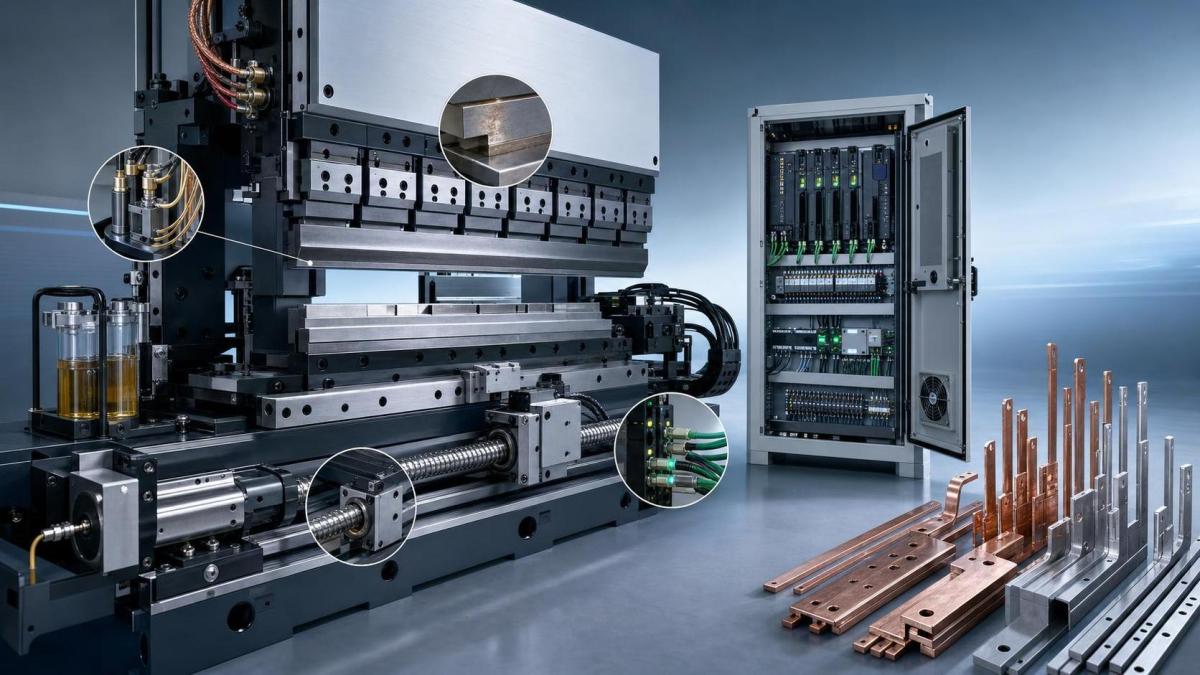
The servo system itself is another major uptime factor, although the fault is not always in the servo motor. Maintenance teams should distinguish between motor condition, drive condition, and motion transmission condition. If a servo axis starts drawing abnormal current, the reason may be bearing wear, coupling looseness, mechanical resistance, encoder contamination, or poor tuning after mechanical changes. Replacing electrical parts without checking the transmission chain can waste time and leave the original cause untouched.
Bus system stability is less visible, but in modern CNC equipment it is one of the most disruptive failure points when neglected. Loose connectors, shielding problems, vibration-related contact issues, and electrical noise can create intermittent communication faults that are hard to reproduce. These are the failures that consume maintenance hours because the machine may restart normally and run again for some time. If alarms appear randomly across axes or I/O stations, the right response is not only alarm clearing. Cable fixation, connector locking, grounding integrity, cabinet cleanliness, and heat dissipation inside the control cabinet all need to be checked together.
Hydraulics still affect uptime even on servo-controlled equipment
A common misunderstanding is that a servo-driven CNC machine is mainly an electrical system. In busbar processing equipment, hydraulic performance can still be critical, depending on the machine architecture and working stations. Pressure instability, oil contamination, internal leakage, seal aging, and temperature-related viscosity changes can all reduce repeatability or slow cycle performance. The machine may continue operating while producing marginal results, which is why hydraulic deterioration is often discovered late.
Oil condition deserves more attention than many maintenance schedules give it. Dirty hydraulic oil does not only damage pumps and valves; it can also make troubleshooting confusing because symptoms appear across different functions. When pressure response becomes inconsistent, teams sometimes suspect sensors or control logic first. In reality, contamination or air entrainment may be the root cause. The same applies to filter condition. A clogged filter can quietly change the machine’s behavior long before there is a complete stoppage.
Electrical components fail gradually more often than suddenly
Limit switches, relays, terminal blocks, fans, power supplies, and sensor wiring rarely attract attention when the machine is new. Later, they become the source of many “random” stops. The important maintenance habit here is trend observation. A fan that slows down, a terminal that darkens from heat, a sensor bracket that shifts slightly under vibration, or a cable drag chain that begins to stiffen can all reduce uptime without producing a clear fault pattern at first.
This is where disciplined inspection beats reactive repair. A maintenance team that records recurring alarm codes, restart frequency, axis temperature differences, oil changes, and tooling replacement intervals will usually diagnose faster than a team relying only on operator descriptions. In machine tool service, the best troubleshooting often comes from comparing today’s condition with the machine’s own previous baseline, not from generic fault lists.
What should be checked first when uptime starts slipping
When a Servo CNC busbar Machine is still running but uptime is getting worse, the fastest way to isolate risk is to check in layers:
- Mechanical resistance: rails, screws, couplings, lubrication points, abnormal vibration, tooling wear.
- Motion feedback: encoder condition, repeat positioning behavior, unusual servo load changes.
- Hydraulic response: pressure consistency, oil cleanliness, leakage, filter status, temperature behavior.
- Electrical reliability: terminals, sensor signals, cabinet cooling, connectors, power stability.
- Communication integrity: bus cable routing, shielding, grounding, intermittent node loss.
This order is practical because many control alarms are secondary symptoms. If a bend station is mechanically overloaded due to die wear or poor lubrication, the drive alarm that appears later is still real, but it is not the beginning of the problem. Even something as basic as replacing a bending mold with an inaccurately matched one can disturb repeatability and create misleading fault patterns. That is one reason experienced maintenance teams look at tooling condition and process load together, not separately.
How equipment quality changes the maintenance baseline
Maintenance discipline matters on any machine, but machine build quality sets the starting point. In busbar equipment, factors such as material quality, mold precision, motor construction, assembly accuracy, and production quality control affect how quickly maintenance issues appear and how predictable they are. Manufacturers that build around stable mechanical structure and controlled component selection usually give service teams a more manageable maintenance environment. That is one reason companies such as Dexinjia, which produces CNC busbar processing machines for bending, punching, cutting, and embossing, emphasize controlled manufacturing, certified quality systems, and after-sales technical support rather than treating uptime as a user-side issue only.
Still, no certification removes the need for field judgment. ISO, CE, EAC, or other marks tell you something about manufacturing and compliance scope, but they do not replace daily inspection, proper tooling management, or disciplined replacement of consumable parts. Uptime is built in operation, not only in procurement.
A useful way to think about uptime
The most reliable maintenance mindset is to treat uptime as a chain of stability: tool load, motion accuracy, signal integrity, hydraulic consistency, and thermal control all have to hold together. If one link starts drifting, the machine may continue producing for a while, but the risk has already entered the system. For after-sales teams, the real skill is not only fixing stoppages quickly. It is recognizing which small changes are early warnings and which are harmless variation.
In other words, the maintenance points that affect uptime most are the ones that change gradually and are easy to normalize: lubrication quality, die wear, servo load behavior, cable and connector condition, oil cleanliness, and cabinet heat. Those are rarely dramatic failures at the beginning. They are the quiet reasons a machine that looked healthy last month starts losing availability this month.
Send Us A Message
Get in Touch
*We respect your confidentiality and all information are protected.

First class quality service and professional after-sales team.