


What Safety and Quality Standards Should a Busbar Machine Meet in Industrial Production?
What Safety and Quality Standards Should a Busbar Machine Meet in Industrial Production?
In industrial production, a Busbar Machine is judged less by how fast it bends or punches and more by whether it can do that work repeatedly, safely, and within a controlled quality framework. That distinction matters because busbar processing sits close to power distribution, switchgear manufacturing, and electrical assembly, where dimensional error, burrs, cracks, or unsafe machine behavior can create downstream problems that are expensive to trace and harder to correct once parts are installed.
A common mistake is to treat certification marks as proof of everything. They are not. A CE mark, for example, is highly relevant for market access and machine safety compliance in applicable regions, but it does not automatically mean the machine will hold tight tolerance over time, resist mold wear, or stay stable under continuous production loads. Safety compliance and manufacturing quality overlap, but they are not the same thing. A machine suitable for factory use needs both.
What “standard-compliant” really means on the shop floor
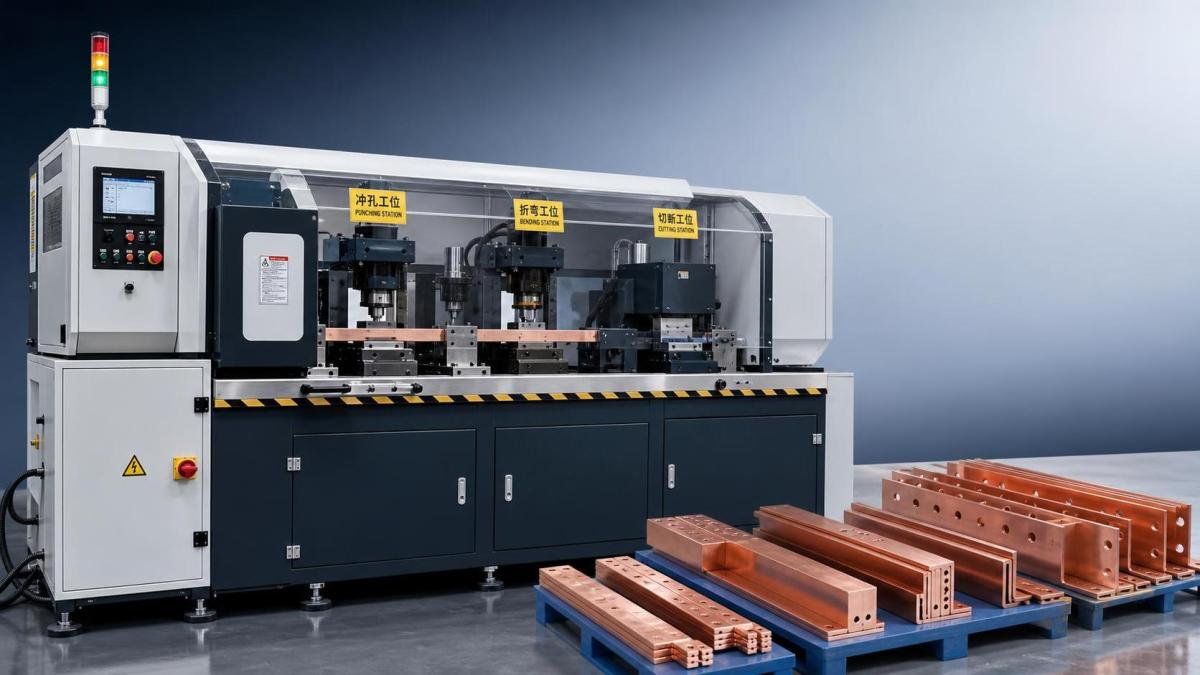
For quality and safety managers, the practical question is not whether a machine has a list of approvals on paper. It is whether the entire machine system has been designed and built around recognized requirements: electrical safety, guarding, mechanical reliability, control consistency, and traceable production quality. In busbar processing, that usually covers bending units, punching stations, cutting assemblies, hydraulic or servo systems, electrical cabinets, emergency stop logic, and the tooling interface.
The standards that matter most are usually grouped into three layers. The first is machine safety certification, such as CE for relevant markets, along with supporting conformity to applicable machinery and electrical safety requirements. The second is manufacturer quality management, where ISO-based production control is often the clearest signal that incoming materials, assembly, inspection, and final testing are handled through a documented system. The third is regional market certification, such as EAC for Eurasian markets, which addresses legal access and compliance expectations in those territories.
This is where a manufacturer’s process discipline starts to matter. Dexinjia, for example, states compliance with ISO, 3A, CE, and EAC certifications and positions its busbar equipment around strict quality control, precision molds, and pure copper motors. That combination is more useful than a simple feature list because it points to the things factory buyers actually have to verify: component quality, consistency of assembly, and whether the machine remains stable after months of use rather than only during factory demonstration.
Safety is broader than emergency stops
People often reduce machine safety to obvious hardware: an emergency stop button, a protective cover, a warning label. Those are necessary, but they are the visible layer. In a Busbar Machine, real safety also involves control reliability, electrical insulation, overload behavior, hydraulic stability, and protection against hazardous access during punching or cutting cycles. If a guard is easy to bypass, if the foot switch logic is poorly isolated, or if maintenance points expose operators to stored energy, the machine may still present risk even when it appears compliant at first glance.
For industrial buyers, useful checks include:
- Whether emergency stop and interlock functions are clearly integrated into the control system.
- Whether moving and cutting zones are physically guarded or designed to reduce accidental access.
- Whether electrical components, wiring layout, and grounding are organized for safe operation and maintenance.
- Whether noise, vibration, and hydraulic pressure behavior remain within a stable operating range during continuous use.
- Whether the machine documentation supports safe setup, tooling replacement, inspection, and troubleshooting.
Low noise is sometimes marketed as a comfort feature, but in production it is also a quality signal. Excessive noise can indicate poor alignment, unstable hydraulics, weak structural rigidity, or accelerated component wear. A quieter machine is not always a better machine, but a well-built one often shows smoother mechanical behavior.
Quality standards show up in the finished busbar
Quality in busbar processing is visible in part geometry and invisible in process repeatability. A machine may produce one acceptable sample and still fail production needs if hole position drifts, bending angle varies with material batch, or cut edges degrade as tooling wears. That is why quality managers usually care about machine structure, tooling precision, and process stability at least as much as catalog specifications.
For punching operations in particular, tooling quality directly affects the compliance conversation. Even with a sound main machine, poor die accuracy can lead to burr formation, off-center holes, or stress concentration around punched areas. In mold supply scenarios, the tooling interface deserves its own review, including material compatibility, replacement repeatability, and dimensional consistency. A component such as Punch Die is not just an accessory; it is part of the quality chain that determines whether the machine can reliably meet production standards.
This is one of the more persistent misunderstandings in procurement: buyers compare machines while overlooking molds and wear parts. In reality, busbar quality depends on the machine frame, drive system, controller, and tooling acting as one production system. If one element is weak, the output quality will reflect it.
Certification matters, but so does manufacturing discipline
When a supplier claims compliance, the next step is to understand how that compliance is sustained. A factory with documented incoming inspection, machining control, assembly checks, and final verification is usually easier to evaluate than one that relies only on end-of-line testing. ISO-based quality management is valuable here because it tends to reflect process consistency rather than one-time performance.
For busbar equipment, durable materials and core component choices are not minor details. High-quality structural materials affect rigidity. Precision molds affect edge finish and dimensional accuracy. Pure copper motors, when properly specified and integrated, are associated with efficient power transmission and stable long-run behavior. None of these points should be read as a substitute for inspection data, but they are legitimate indicators of how seriously a manufacturer treats machine reliability.
That is also why standard models and customized solutions need different review logic. A standard 3-in-1 busbar machine may already have a mature compliance path. A customized line, additional station, or portable hydraulic configuration may require closer attention to guarding, control modifications, tooling adaptation, and local certification applicability. Customization is not a problem in itself; undocumented customization is.
How to assess a machine without relying on brochure language
A useful evaluation is usually built around evidence rather than slogans. Ask for the certification scope, not only the logo. Check whether the supplier can explain its quality control points in production. Review the machine’s safety logic, not just the external guard design. Look at processed samples for burrs, deformation, angle consistency, and surface damage. If the machine will handle both copper and aluminum busbars, confirm how the tooling and process settings address the different material behaviors.
Another practical checkpoint is serviceability. A Busbar Machine that meets standards at delivery but becomes difficult to maintain is not a strong industrial solution. Spare parts availability, tooling replacement accuracy, technical support, and after-sales response all affect whether compliance and quality can be maintained over the machine’s service life. That point is often underweighted during purchasing and overfelt after installation.
The right question, then, is not simply “Does this machine have certification?” It is “Can this machine keep people safe, produce repeatable parts, and remain controllable under real factory conditions?” When a supplier can answer that through documented certifications, disciplined manufacturing, suitable tooling, and clear technical support, the machine is much closer to meeting the standard that industrial production actually demands.
Send Us A Message
Get in Touch
*We respect your confidentiality and all information are protected.
First class quality service and professional after-sales team.