



What Thickness and Material Range Can a Servo CNC Busbar Machine Handle?
What Thickness and Material Range Can a Servo CNC Busbar Machine Handle?
Choosing the right Servo CNC busbar Machine starts with a simple check: what busbar sizes actually run through your shop every week, and what sizes only appear on quotes or special jobs? That sounds basic, but many buying mistakes start here. A machine may look capable on paper, yet if its thickness range, bending force, tooling setup, or material compatibility does not match your real production mix, accuracy and cycle time suffer fast. For buyers comparing copper and aluminum busbar processing, the key is not just maximum capacity. It is the usable range where the machine stays stable, repeatable, and efficient.
In day-to-day busbar fabrication, the thickness and material range a machine can handle affects far more than whether a bar physically fits. It changes springback behavior, punch quality, bend radius consistency, burr control, tool wear, and even operator workload. If you are still in the research stage, use this checklist the way experienced production teams do: not to chase the biggest number, but to confirm what the machine can process reliably without constant adjustment.
Start with the actual material, not the machine brochure
A Servo CNC busbar Machine is usually selected for copper and aluminum busbars, but those two materials do not behave the same in bending and punching. Copper generally needs higher forming force, while aluminum is softer but more prone to surface marking and shape variation if clamping or tooling is not right. So the first question is not “What is the max thickness?” It is “At what thickness can this machine process copper, and at what thickness can it process aluminum, with acceptable accuracy?”
If a supplier gives one headline capacity number without separating material type, ask for a clearer breakdown. For example, a machine may support a certain width and thickness range for aluminum but require reduced width, slower cycle speed, or different tooling when running copper at the same thickness. That is a normal engineering limitation, not a defect. The issue is whether it is stated clearly.
- Confirm whether the stated thickness range applies to copper, aluminum, or both.
- Ask whether maximum figures are for bending, punching, cutting, or embossing, because they are often different.
- Check whether full-width bars can be processed at maximum thickness, or only narrower bars.
- Verify if special dies are required when moving between softer aluminum and harder copper.
The practical thickness range matters more than the peak limit
This is where buyers often get tripped up. A machine’s maximum thickness rating is usually the upper boundary under defined conditions. Your real concern should be the thickness range where repeatability remains good across normal production runs. If most of your work is around 8 mm to 12 mm copper busbar, and the machine only reaches its best performance at lighter loads, you will feel that gap in rework, setup time, and mold life.
For smaller workshops or field jobs, some portable systems are designed around this practical range. One example is the DXJ-200B Portable Busbar Bending Machine, which is specified for 200 mm width and 3-12 mm thickness, and supports copper/aluminum bars along with certain steel-related materials listed by the manufacturer. That does not make it a replacement for every servo CNC line, but it is a useful reference point: if your regular work stays within that envelope, capacity planning becomes much more grounded.
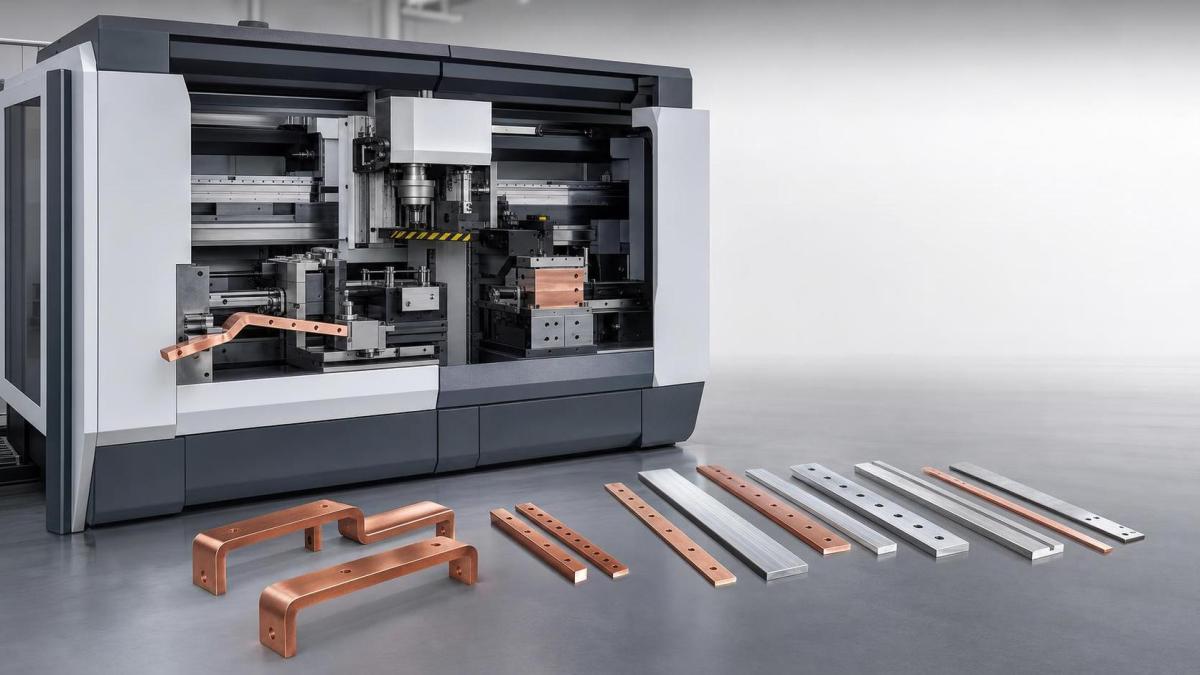
A useful buying habit is to map your order history into three zones: common jobs, occasional heavy jobs, and rare edge cases. If 80% of your work sits in a stable middle range, buy for that range first. Sending one oversized sample through a machine during a demo does not prove long-run suitability.
Width, thickness, and force should be checked together
Thickness never stands alone. A 12 mm bar at modest width is one thing; a 12 mm bar at near-maximum width is another. The wider the bar, the more attention you need to pay to deflection, clamping stability, and whether the bending force remains uniform across the workpiece. On punching operations, hole diameter and throat depth also matter. A machine may handle thick material but still struggle when the hole position is deep inside a wide bar.
This is also why combination equipment deserves a closer look when floor space or budget is tight. A unit with cutting, bending, and punching in one setup can reduce handling steps, but only if each function still meets the material range you need. Otherwise the convenience is real, but the production bottleneck simply moves from one station to another.
Ask how the machine behaves near the top of its range
This is one of the more useful questions in supplier discussions, and it usually gets a better answer than asking for “best model recommendation.” Near maximum thickness, does cycle speed slow down? Are there tighter limits on bend angle accuracy? Does tool life shorten noticeably? Is there more manual correction on aluminum because of rebound variation? These are normal tradeoffs, but they should be visible before purchase, not after installation.
For example, some portable or semi-integrated machines list clear operating figures such as 35 tons of maximum pressure, punching capacity from Φ6 to Φ20.5, and 110 mm throat depth. Those numbers help you judge fit for your process, especially in transformer factories and distribution cabinet work where hole size consistency and workpiece access matter. What you still need to verify is whether those values reflect continuous working conditions or only peak capability under controlled tests.【待核实】
Do not ignore material surface requirements
If your customers care about appearance, coating readiness, or low post-processing effort, thickness capacity alone tells only half the story. Aluminum bars can scratch more easily. Copper bars can show mark lines if tooling alignment or pressure distribution is off. On heavier sections, the risk increases because more force is involved. A machine that technically handles the bar may still create extra polishing or rejection work.
This is where build quality and tooling quality matter more than many first-time buyers expect. Dexinjia positions its equipment around precision molds, pure copper motors, and controlled manufacturing with ISO, 3A, CE, and EAC certifications. Certifications do not automatically prove your specific processing result, but they are relevant when you are screening suppliers for process discipline, export readiness, and after-sales support.
A short checklist before you compare quotes
- List your regular busbar materials separately: copper and aluminum should not be grouped into one line item.
- Record normal width and thickness ranges, not just the largest bar ever processed.
- Match capacity by function: bending, punching, cutting, embossing.
- Ask for tooling details, including standard and customizable die sizes.
- Verify power supply, especially if the machine will be used in field service or mixed-facility environments.
- Check support scope: installation guidance, technical support, spare parts, and global after-sales service can matter as much as nameplate capacity.
If you are evaluating a Servo CNC busbar Machine for general understanding, the safest conclusion is this: thickness and material range should be judged as a working window, not a single max number. Look at copper and aluminum separately, check width together with thickness, and ask what happens near the upper limit. That approach usually gives a clearer answer than a long list of marketing claims, and it is the better way to avoid buying a machine that fits the brochure better than it fits your production.
Send Us A Message
Get in Touch
*We respect your confidentiality and all information are protected.

First class quality service and professional after-sales team.