



When a 3 in 1 CNC Busbar Machine Is Better Than Separate Equipment
A 3 in 1 CNC busbar machine is usually the better choice when punching, bending, and cutting are repeated steps within the same production flow and the work changes often enough that manual transfer becomes a source of delay or inconsistency. The value does not come simply from putting three functions in one cabinet. It comes from controlling datum positions, reducing material handling, and keeping the sequence of operations closer to the programmed part geometry.
Separate equipment can still be the stronger arrangement when each process has a consistently high, independent workload. A dedicated punch press, cutting station, and bending machine can run simultaneously with separate material flows. For mixed batches, frequent drawing revisions, distribution-panel work, or busbar kits requiring several features on each piece, an integrated CNC arrangement often creates a cleaner and more predictable route from raw bar to finished component.
Where Separate Stations Lose Time
The obvious delay is walking a copper or aluminum bar from one machine to another. The larger loss is less visible: locating the workpiece again at each station. A bar that is cut, moved, punched, stacked, and later bent can accumulate small positional differences. Each station may be accurate on its own, yet the final hole-to-bend relationship can still drift when the original reference edge is not maintained consistently.
This matters especially where a punched hole must align with a breaker terminal, support insulator, enclosure opening, or mating busbar. Rework is not always caused by an inaccurate tool. It can result from a correct drawing being interpreted from different ends of the bar, a cut length being measured from a burr, or a bend being set out after the bar has already been rotated during handling.
With a 3 in 1 CNC busbar machine, the part program can establish a sequence and reference logic before processing begins. The operator still needs to load material correctly and confirm the correct program, but the process no longer relies on recreating dimensions at every station. This is most valuable for parts with multiple holes, offset bends, and short finished lengths, where a minor setup error consumes a large share of the piece.
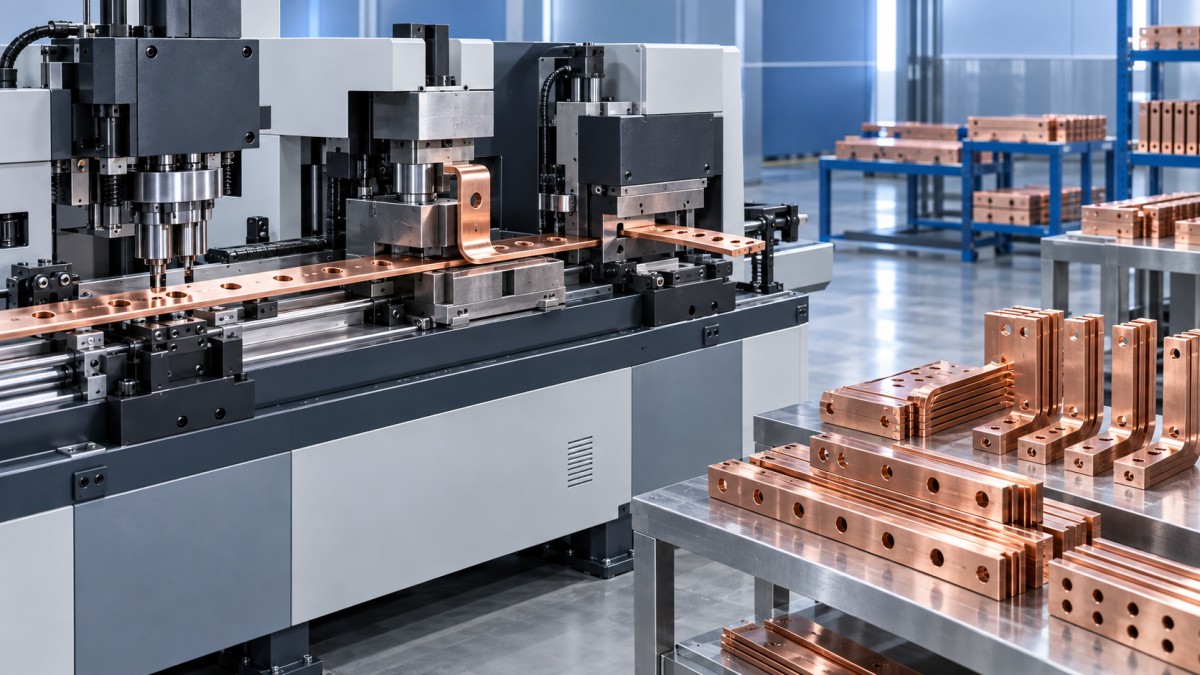
Conditions That Favor an Integrated CNC Machine
An integrated machine tends to justify itself when production is characterized by variety rather than a single uninterrupted part number. Switchgear assemblies, distribution cabinets, transformer connections, and electrical control systems often involve busbars with changing widths, hole patterns, bend directions, and quantities. The work may arrive as sets rather than long runs. In that setting, the time saved between operations can exceed the cycle-time advantage of a dedicated high-output station.
- Frequent changeovers: A single setup environment reduces the number of fixtures, stop settings, and handwritten measurements that must be updated after a drawing revision.
- Restricted floor space: One integrated processing cell requires less aisle space and fewer material staging points than three separate machines with their own infeed and outfeed areas.
- Short or medium production batches: The benefit is strongest when setup discipline matters as much as press speed.
- Parts with positional relationships: Hole spacing relative to bends, end cuts, and centerlines is easier to manage when operations follow one controlled coordinate system.
- Limited internal movement: Reducing transfers lowers the chances of surface damage, mixing completed and unfinished bars, or sending a part to bending before all holes are made.
The decision becomes less favorable if punching, cutting, and bending are each continuously occupied by different products. In a stable, high-volume line, separate machines allow parallel work. One operator can prepare material at the cutting station while another runs punching, and a third handles bending. An integrated unit processes the part through its sequence, so its throughput must be assessed against the actual mix of parts rather than against the theoretical speed of three machines running at once.
Compare the Whole Flow, Not the Headline Capacity
Machine tonnage is often read as a direct indicator of suitability, but it only answers part of the question. Punching capacity depends on material thickness, hole diameter, tooling condition, and the available throat depth. Bending capability depends on bar width, thickness, bend geometry, die selection, and the required inside radius. A nominal capacity figure does not confirm that a specific busbar can be processed without marking, cracking, deformation, or excessive springback.
Copper and aluminum should also be considered separately. Their behavior during punching and bending differs, and surface condition matters. Protective film, oxidation, burrs from prior cutting, or inconsistent bar thickness can affect alignment and finish. When copper busbar has a polished or plated surface, every extra transfer point creates another opportunity for scratches that may be unacceptable in visible cabinet assemblies.
Do Not Treat Automation and Integration as the Same Decision
A CNC system is appropriate when programmed dimensions, repeatability, and controlled sequencing are the main constraints. A compact integrated hydraulic machine can be appropriate when the workload is lower, installation is temporary, or busbar work must be carried out near assembly rather than in a dedicated fabrication area. These are different production needs, even though both combine cutting, bending, and punching.
For example, the DXJ-200A Portable Hydraulic Busbar Machine combines those three functions for copper and aluminum bars up to 200 mm wide and 3-12 mm thick. Its stated punching output is 35T, while cutting and bending output are 20T. Standard punch dies cover diameters from 7 mm to 20.5 mm. That specification is relevant when comparing a mobile hydraulic setup against separate portable tools, but it should not be treated as a substitute for CNC positioning where complex repeatable geometry is required.
This distinction prevents a common procurement error: selecting a machine because it has three stations, then discovering that the real bottleneck was layout control, program management, tool-change time, or material loading. Conversely, specifying CNC simply because the part has several operations can add cost and complexity where a small number of straightforward bars are made intermittently.
Assess the Cost of Coordination
Separate equipment usually has a lower risk of complete process stoppage because a problem at one station does not automatically disable the others. That advantage should be weighed against the coordination required to keep material moving. Work-in-progress racks, labels, routing sheets, and inspection points become necessary when bars are processed at different locations. Without disciplined identification, similar-looking copper pieces can be mixed after punching, particularly when left- and right-hand bends are scheduled later.
An integrated machine simplifies routing, but it concentrates maintenance responsibility. Tooling wear, hydraulic condition, guides, clamps, sensors, and program data should be controlled as part of one process. Before selecting a unit, confirm access around the machine for loading long bars, removal of finished pieces, die changes, routine cleaning, and service work. A compact footprint on a brochure does not account for the clearance needed to turn and support material safely.
Electrical supply and material support deserve equal attention. Long busbars can sag or twist when unsupported, producing a positional error that looks like a machine problem. The support arrangement should match the longest bar, expected weight, and direction of feed. The machine must also match the available voltage and the site’s installation conditions. These details are easy to defer during purchasing and expensive to correct after delivery.
The Better Choice Follows the Part Mix
A 3 in 1 CNC busbar machine is strongest where production requires consistent geometry across varied busbar sets, where transfer and re-measuring create avoidable defects, and where floor space cannot support several independent work cells. Separate equipment remains justified when output is dominated by long, stable runs that keep each dedicated station busy in parallel.
The final comparison should use actual drawings from the current workload: material sizes, hole diameters, number of bends, batch quantities, revision frequency, finished-length tolerances, and the distance material travels between processes. Those factors reveal whether the constraint is press capacity or process coordination. For many mixed busbar jobs, coordination is the more expensive problem, and integration is the direct way to remove it.
Send Us A Message
Get in Touch
*We respect your confidentiality and all information are protected.

First class quality service and professional after-sales team.