



When Does a Servo CNC Busbar Machine Improve Panel Shop Efficiency?
When a Servo CNC Busbar Machine Actually Changes Throughput in a Panel Shop
The clearest point to invest in a Servo CNC busbar Machine is not when a workshop wants newer equipment. It is when busbar work has started to control the pace of panel assembly. That usually shows up in familiar ways: electrical cabinets waiting for copper work to be released, bending accuracy depending too much on one experienced operator, hole positions needing rework during fit-up, or production planning breaking down whenever a project mix shifts from standard low-voltage boards to denser power distribution assemblies.
In many panel shops, the bottleneck is not raw cutting speed. It is the accumulated loss between measuring, marking, punching, checking, bending, correcting, and separating qualified parts from near-miss parts. Manual and semi-automatic processing can still be completely practical for low volume or repair work, but once the job list includes repeated busbar sets, multi-bend geometries, or tighter installation windows, automation starts saving time in the invisible parts of the process: setup discipline, repeatability, and fewer interruptions between stations.
That is where servo-based CNC control earns its place. The benefit is not only that the machine bends, punches, and cuts faster. The real gain is that each step becomes more predictable, especially when several operators share the same equipment across shifts.
High-mix panel production is usually the turning point
A shop building one busbar design all week can often live with conventional processing methods. A shop building ten slightly different designs in three days usually cannot. The efficiency gap widens when each project includes different bar widths, thicknesses, hole patterns, and bending angles. Under those conditions, manual layout time grows faster than machine time, and every drawing revision creates a new chance for dimensional drift.
Servo CNC equipment makes the biggest difference here because it removes repeated judgment calls from the operator. Once angle input, positioning logic, and sequence control are handled consistently, the output becomes less dependent on who is standing at the machine. For engineering managers, that matters as much as speed. Stable repeatability is what protects delivery schedules when staffing changes, overtime increases, or urgent project inserts disrupt the original plan.
A related issue is material waste. Copper and aluminum busbar are not forgiving when measurement errors stack up across multiple operations. One wrong hole location can scrap a long finished piece. On a busy floor, reducing those avoidable losses is often a stronger economic argument than labor reduction alone.
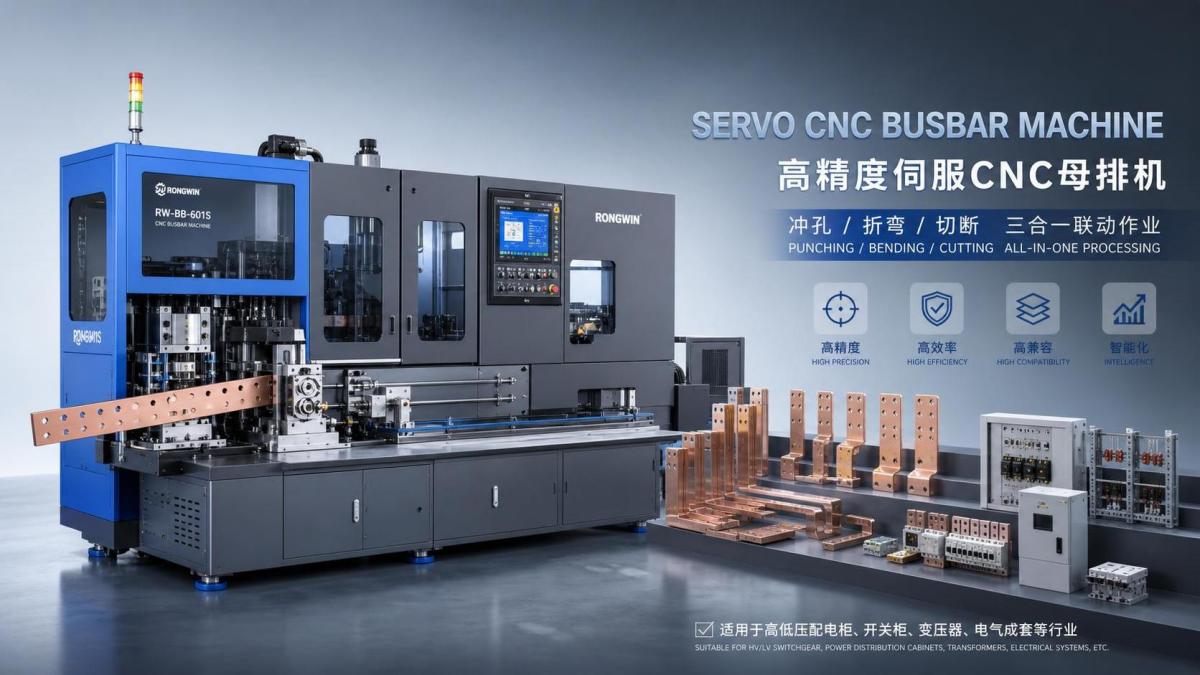
Where the machine helps most, and where it does not
Not every panel shop sees the same return. The table below is a practical way to judge whether a Servo CNC busbar Machine is likely to change output meaningfully or simply replace one workable process with another.
One common misjudgment is assuming that a servo system is justified only by very high volume. In practice, medium-volume shops with unstable part variety often benefit earlier than large repetitive factories, because the real pain is coordination and correction, not just machine runtime.
Site conditions matter more than brochure logic
A technically capable machine will not deliver expected efficiency if the surrounding conditions are weak. Busbar processing is sensitive to workflow discipline. Material racks must be arranged so operators do not lose time handling long copper sections. Drawings need to reach the machine in a form that supports consistent sequencing. Tooling management also matters. If punch sizes, bending dies, and inspection gauges are scattered or poorly identified, the machine’s control advantages get diluted very quickly.
Power supply, floor space, and operator access should also be checked before selection. A unit built for heavy copper work may fit the process technically but still create congestion if the loading side and finished-part discharge side are cramped. This becomes more important in panel shops where busbar fabrication shares space with enclosure assembly, wiring, and final inspection.
That is why some workshops do better with a compact integrated machine rather than several separated stations. A model such as DXJ-80CN Copper Busbar Machine reflects that logic: independent hydraulic stations for punching, cutting, and bending can work without interfering with one another, which suits shops trying to shorten internal waiting time rather than simply increase peak force. For heavier copper and aluminum bars, the published range is also relevant, including up to 300 mm cutting width, up to 20 mm thickness, and bending accuracy stated at plus or minus 0.5 degree. Those figures are not the whole decision, but they help define whether the equipment matches real fabrication loads.
The biggest efficiency gain often appears downstream
Panel shops sometimes evaluate busbar equipment too narrowly, focusing only on how many holes can be punched per hour. That misses the wider effect on assembly. Better consistency in busbar geometry reduces trial fitting inside cabinets. It lowers the chance that insulation clearances or connection alignments need adjustment at the last stage, when labor is more expensive and schedules are least flexible.
This is especially relevant in projects with layered busbar layouts, compact switchgear compartments, or customer specifications that leave little room for dimensional improvisation. If the assembly team is frequently filing edges, opening holes, or re-bending parts at the bench, the busbar process is already costing more than its machine-cycle report suggests.
Another practical point is language and operator interface. In multi-region manufacturing or mixed labor teams, a machine that supports more than one operating language can reduce training friction and setup mistakes. That sounds minor until production has to continue across shifts with different operator backgrounds.
What buyers tend to overlook before deciding
Three questions usually deserve more attention than they get.
The first is whether the shop has enough repeatability in drawings and process release. CNC capability is underused when fabrication data still depends on informal operator interpretation.
The second is tooling durability. For busbar work, mold life and edge quality affect uptime directly. Wear-resistant materials such as Cr12MoV punching dies and forged bending molds are relevant because maintenance intervals and dimensional consistency are tied to them, not just to the control system.
The third is service response. A panel shop buying machine capacity is really buying schedule protection. Certifications such as ISO, CE, 3A, and EAC can indicate manufacturing discipline or market suitability, but they do not replace technical support, commissioning guidance, and parts availability. Those points matter more once the machine becomes a production-critical asset.
If your workshop is still dominated by occasional custom work, emergency repairs, or low daily throughput, a Servo CNC busbar Machine may be more capability than you can currently convert into real savings. If busbar processing has become the pace-setting step in panel delivery, the decision changes. At that point, the right question is no longer whether automation is attractive. It is whether your current process can keep absorbing variation, rework, and labor dependency without slowing the whole shop.
Send Us A Message
Get in Touch
*We respect your confidentiality and all information are protected.

First class quality service and professional after-sales team.