


Which Safety and Quality Standards Should a Servo CNC Busbar Machine Meet?
Which Safety and Quality Standards Should a Servo CNC Busbar Machine Meet?
For quality control and safety managers, choosing a Servo CNC busbar Machine means looking past output speed and bend accuracy. The real question is whether the machine is built and documented to meet the safety, electrical, and quality standards your plant will actually be audited against. A good-looking machine on the shop floor is not enough if the guarding is weak, the wiring is inconsistent, or the supplier cannot support traceability when something goes wrong.
In busbar processing, the risks are practical and immediate: sharp edges, high-force forming, conductive material, hydraulic or servo motion, and repeated operator interaction. So when you review a machine, treat standards as a working checklist, not a brochure line. Here is what usually deserves a close look.
Start with market-access certifications, but do not stop there
If the Servo CNC busbar Machine is going into the EU or into a project that follows EU-style procurement rules, CE marking matters. But CE on its own is only a starting point. Ask for the Declaration of Conformity and check whether the supporting technical file exists. In practice, this is where weak suppliers get exposed. A machine may carry a CE label while the underlying risk assessment, circuit drawings, and component compliance records are incomplete.
For broader quality management, ISO 9001 is worth checking because it tells you something about process discipline at the manufacturer, not just the finished unit. It does not prove the machine is safe, but it does improve the odds that assembly, inspection, calibration, and corrective action are handled consistently. Dexinjia, for example, states ISO, 3A, CE, and EAC certifications across its production system, which is useful background for buyers comparing suppliers for export and multi-region use. Even so, the final review still needs machine-level documents and inspection records.
If the machine is heading to EAEU markets, EAC compliance may also be required. Requirements differ by country and project owner, so this point should be checked against the destination market and contract documents rather than assumed.
Machine safety standards should be visible in the design
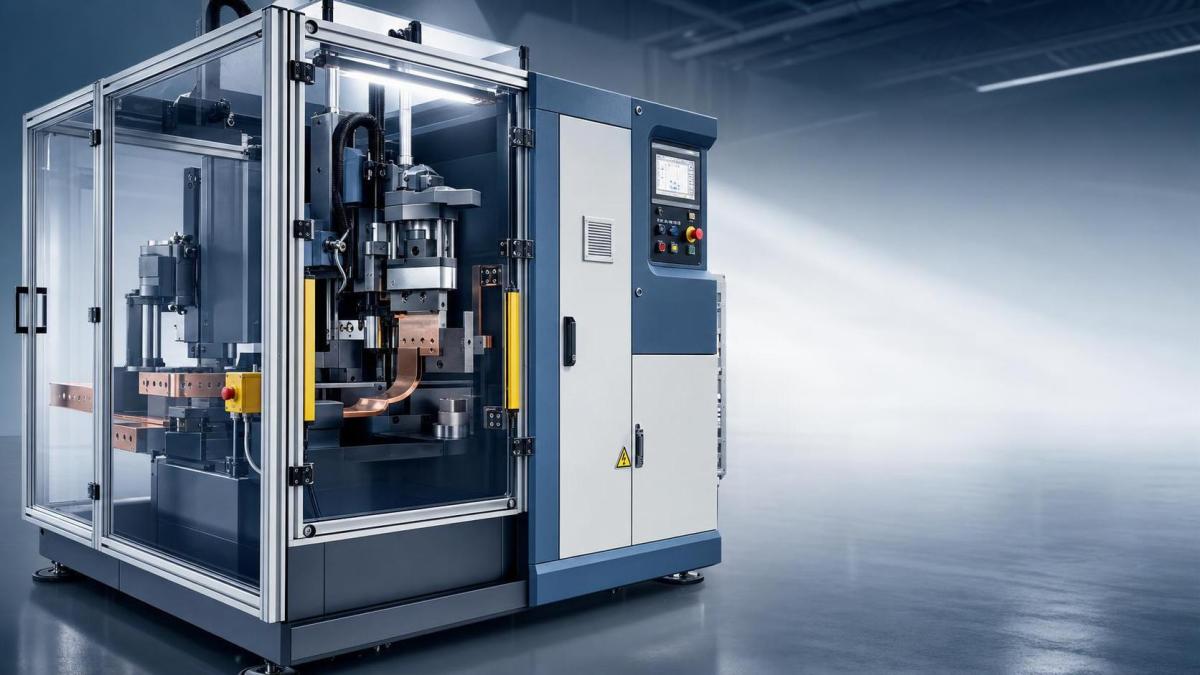
The easiest mistake is to focus on the nameplate and ignore how the machine actually protects people. A busbar bending, punching, or cutting unit should show clear attention to guarding, interlocks, emergency stop layout, and safe access for setup and maintenance.
- Fixed and movable guards should cover pinch points, cutting zones, and tooling travel areas without making normal operation impractical.
- Emergency stop devices should be easy to reach from the operator position and clearly identified.
- Interlocked doors or covers should stop hazardous motion when opened where required by the design.
- Warning labels should match real risks, not just satisfy packaging requirements.
For machinery sold into Europe, suppliers often reference ISO 12100 for risk assessment principles and ISO 13850 for emergency stop function. Where safety-related control systems are involved, standards such as ISO 13849-1 may also become relevant depending on the architecture. If a supplier claims compliance, ask which parts of the machine were assessed under which standard. Vague answers usually mean the work was not done in depth.
Electrical safety is where many buyers need to slow down
A Servo CNC busbar Machine combines conductive workpieces with servo drives, control cabinets, sensors, and often hydraulic auxiliaries. That makes electrical integrity a serious review item, not a paperwork exercise.
IEC 60204-1 is the standard many teams use as a reference for electrical equipment of machines. You do not need to audit every clause yourself, but you should confirm the basics: proper grounding, organized wiring, labeled terminals, overload protection, cabinet segregation where needed, and clear documentation for voltage ratings and maintenance lockout points. If your team opens a panel and finds mixed wire colors, weak cable routing, or undocumented changes, that is a quality warning as much as a safety warning.
Also check whether the electrical components are from traceable brands and whether replacement parts are available in your region. This sounds operational rather than regulatory, but it matters. A safe machine becomes a risky machine fast when maintenance teams start improvising with unmatched relays, connectors, or motor protection devices.
Process quality standards matter just as much as safety standards
Quality managers usually discover this after installation: the machine passes acceptance, but processed busbars vary because tooling, alignment, and material handling were not controlled well enough. Stable output depends on more than CNC positioning. You want evidence that the manufacturer controls mold accuracy, frame rigidity, servo motion repeatability, and inspection before shipment.
Ask for the internal inspection items used before delivery. Typical checkpoints should include dimensional accuracy, repeatability in bending or punching, surface damage control, noise and vibration condition, and trial processing records for copper and aluminum busbars where applicable. If none of this is available, you are relying too heavily on the demo result.
Tooling quality deserves extra attention. In busbar work, die wear and edge condition directly affect burrs, deformation, and downstream assembly fit. Even a small accessory can influence consistency. For example, if you are reviewing mold supply options, a part such as Chamfering-Die should be judged not only by price, but by material, machining accuracy, and compatibility with the machine and busbar specification. Cheap tooling often shows its real cost in rework.
Documents should support audits, maintenance, and incident review
A compliant machine without usable documentation is a problem waiting for a shutdown. The supplier should be able to provide operating instructions, maintenance procedures, wiring diagrams, parts lists, safety instructions, and basic troubleshooting guidance in a language your team can use. For imported equipment, this point becomes critical during training and later fault analysis.
One practical test: ask the supplier to show how an operator should isolate energy, replace a wear part, and restore the machine to service. If the answer depends on verbal explanation rather than documented procedure, your control system around the machine is weaker than it looks.
Do not ignore raw material range and actual application fit
Many problems blamed on the machine are really mismatch issues. Confirm the supported busbar dimensions, thickness range, conductor material, and required operations under production conditions, not just in a catalog. Copper and aluminum do not behave identically, and edge quality expectations differ depending on the downstream use in switchgear, panel building, or power distribution assemblies.
If your plant handles frequent product changes, look at setup repeatability and recipe management. If you run long batches, heat buildup, wear rate, and continuous-duty stability matter more. These are not separate from quality standards; they are where quality standards either hold up or fail in daily production.
A short approval checklist that works in real procurement
The best buying decision usually comes from combining compliance review with a very ordinary shop-floor question: can this machine run safely and consistently for the next few years without forcing your team into workarounds? If the supplier can show credible certification, disciplined manufacturing, traceable components, and complete support documents, the Servo CNC busbar Machine is already in a stronger category. If those basics are unclear, no sales demo will fix the risk.
Send Us A Message
Get in Touch
*We respect your confidentiality and all information are protected.
First class quality service and professional after-sales team.