



Busbar Machine Market Trends: Why Automation Demand Is Rising in Power Equipment Plants
Why automation is becoming the center of the Busbar Machine market
The phrase “Busbar Machine market growth” is often explained as a simple capacity story: more electrical infrastructure, more switchgear, more busbar processing. That is only part of it. What is changing inside power equipment plants is not just output demand, but the way manufacturers want to control production. Copper and aluminum busbars are no longer treated as semi-manual components that can tolerate wide operator variation. In many factories, they have become precision parts tied to delivery schedules, assembly consistency, and traceable quality requirements. That shift is what is pushing automation demand upward.
For distributors and agents, this matters because buyers are asking different questions than they did a few years ago. They still care about tonnage, bending accuracy, punching capacity, and tooling life. But they are also asking whether a machine can stabilize output across shifts, reduce setup dependency on experienced operators, and fit into a more standardized production flow. In other words, the market is moving from “Can this machine process busbar?” to “Can this equipment support repeatable manufacturing at scale?”
That is why CNC and integrated platforms are gaining attention. A manual or single-function setup can still make sense in low-volume or highly variable work. But once a plant is producing distribution cabinets, switchboards, transformer connections, or power system assemblies in batches, the cost of inconsistency becomes visible very quickly. Scrap is one cost. Rework is another. Production interruption caused by tool change delays, counting mistakes, or operator fatigue is often the larger problem.
One common misunderstanding is to treat automation as a luxury layer added after the core machine is chosen. In practice, the automation level often determines whether the machine really matches the factory’s business model. A plant serving custom low-volume orders may value flexibility above all else. A plant supplying repeat power equipment programs usually wants process discipline: fixed bending angles, accurate hole positioning, cleaner cut quality, lower noise, and less dependence on manual judgment. Those are not marketing preferences. They affect downstream assembly speed and the likelihood of field-fit problems.
What buyers now mean by “automation”
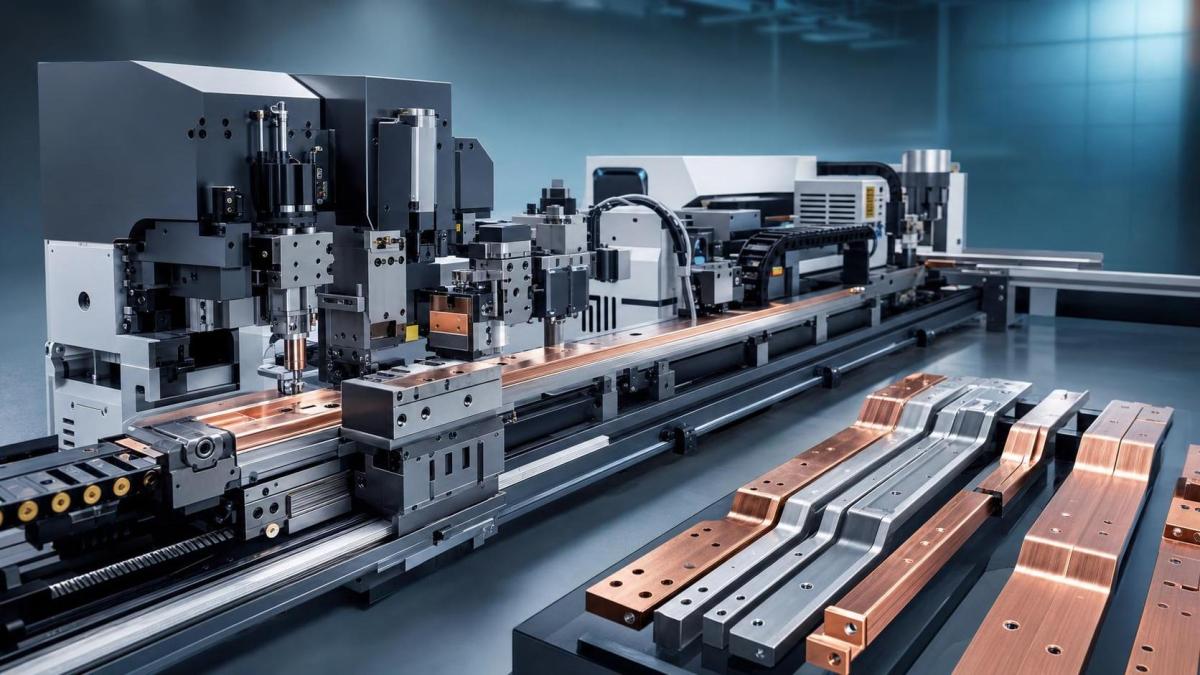
In the busbar field, automation does not always mean a fully unmanned line. More often, it means that critical processing steps are controlled in a way that reduces variation. That can include CNC bending with programmable angles, integrated punching and cutting, digital positioning, preset job parameters, and safer, faster changeover between different workpieces. A 3-in-1 machine may be attractive not because it looks advanced, but because it compresses multiple handling steps into one organized workflow.
This is also why equipment quality details matter more as plants automate. If the machine frame, mold precision, motor stability, and hydraulic or electrical control quality are weak, automation will only expose those weaknesses faster. Manufacturers such as Dexinjia (DXJ), which focuses on CNC busbar processing machines for bending, punching, cutting, and embossing, are operating in a market where buyers increasingly connect machine construction quality with process reliability. Certifications such as ISO, CE, 3A, and EAC do not replace technical evaluation, but they do signal that formal quality control and compliance expectations are part of the purchasing conversation.
A useful way to read current demand is this: factories are not buying automation for appearance; they are buying control. Control over cycle time. Control over dimensional repeatability. Control over labor exposure in operations where skilled operators are harder to recruit and retain. Labor cost is part of the equation, but labor volatility is often just as important.
Where the demand is strongest
Automation demand tends to be strongest in plants where busbar components are tied directly to delivery-critical assemblies. Switchgear, transformer-related equipment, power distribution systems, and industrial electrical panels are typical examples. In these settings, a delay in one processing stage can hold up final assembly. That makes machine uptime, process simplicity, and part consistency commercially important in a very practical sense.
There is also a broader equipment-linkage effect. Busbar processing does not exist in isolation. In transformer and reactor manufacturing, for example, winding, conductor preparation, insulation handling, and connection fabrication all influence one another. A buyer comparing production upgrades may look at busbar automation alongside other efficiency-focused equipment, including solutions such as DXJ-RX2T Horizontal Coil Winding Machine (2 Ton). That model is intended for winding high and low voltage coils of reactors and power transformers, with features such as 0-80 r/min speed control, a 2 ton load capacity, frequency-converter stepless speed regulation, automatic counting, and braking to prevent reverse movement after stop. It is not a busbar machine, but it reflects the same purchasing logic: reduce manual correction, improve consistency, and make output easier to manage in batch production.
For channel partners, this cross-equipment logic is worth noticing. Buyers are increasingly evaluating workshop efficiency as a system, not as a list of isolated machines. A customer who asks about busbar bending accuracy may soon ask about upstream or adjacent equipment that affects throughput balance across the plant.
What separates a real market opportunity from short-term demand
Not every increase in inquiries means the same thing. Some demand is price-driven and temporary. More durable opportunity usually appears when customers begin shifting their decision criteria. In the current Busbar Machine market, several signals suggest a structural change rather than a passing spike:
- More interest in CNC control and integrated processing rather than single manual functions.
- Greater emphasis on machine durability, mold precision, and motor quality because downtime costs are less acceptable.
- More frequent requests for customized solutions, which suggests buyers are aligning equipment with specific production layouts.
- Higher attention to after-sales support, installation guidance, and long-term service response, especially in export markets.
These are practical indicators that customers are thinking beyond the initial purchase. A dealer who only presents nominal machine specifications may miss the actual sales conversation. The stronger position is to help the buyer judge fit: expected batch size, material type, operator skill level, required process stability, and how much setup variation the plant can tolerate.
Another misunderstanding is that automation always eliminates flexibility. Sometimes it does the opposite. Well-designed CNC equipment can make small-batch changeovers more manageable because settings are easier to repeat and less dependent on one experienced operator remembering manual adjustments. The boundary is that automation has to be matched to the product mix. A factory with frequent design changes and low repetition may need modular flexibility more than high-line integration. A factory with stable, repeatable orders will usually benefit more from process consolidation and programming repeatability.
How distributors should read the trend
The safest reading of the market is not that every customer wants the highest level of automation. It is that more customers now want measurable control over output quality and labor dependence. That distinction matters. It leads to better product matching, more credible technical discussions, and fewer mismatched quotations.
For distributors, the opportunity is strongest when they can translate broad market language into workshop-level judgment: which plants need integrated busbar processing, which ones still fit portable hydraulic equipment, and which ones are ready for CNC upgrades because the cost of inconsistency has overtaken the cost of investment. Suppliers with stable manufacturing, quality control discipline, and the ability to support both standard and customized solutions are likely to be easier partners in that process.
The rise in automation demand is really a sign that busbar processing is being treated more seriously as a controlled manufacturing stage. Once that becomes the customer’s mindset, the market no longer revolves around a machine in isolation. It revolves around whether the equipment can keep production steady, accurate, and commercially predictable.
Send Us A Message
Get in Touch
*We respect your confidentiality and all information are protected.
First class quality service and professional after-sales team.