



Busbar Machine Technical Parameters Explained: Tonnage, Accuracy, and Processing Range
Start with the load case, not the catalog tonnage
When a technical team evaluates a Busbar Machine, the three numbers that usually drive the whole decision are forming force, machining accuracy, and usable processing range. Those figures look simple on a datasheet, but they only become meaningful when tied back to the actual job: copper or aluminum grade, bar width and thickness, hole pattern, bend radius, batch size, and whether the line runs mixed specifications every day.
The common mistake is to treat tonnage as the headline parameter and everything else as secondary. In practice, an oversized machine can still produce poor parts if the tooling, positioning system, or stroke control is weak. A smaller machine, on the other hand, may run well for a narrow product range but become a bottleneck as soon as busbar dimensions expand.
So the first check is straightforward: write down the largest copper and aluminum sections you actually need to bend, punch, cut, or emboss. Then compare that requirement against the machine’s rated working capability by process, not by one overall number.
Check tonnage by operation
A Busbar Machine does not consume force the same way across every function. Bending, punching, and cutting place different loads on the hydraulic or servo system, and the risk is different too. Bending short thick bars may challenge force capacity. Punching dense hole patterns often exposes frame rigidity and die quality. Cutting thick aluminum may look easy on paper but still leave edge deformation if clearance and blade condition are not right.
- For bending: verify the maximum bar width and thickness the machine can bend at the required angle and radius. Tonnage without bend geometry is incomplete.
- For punching: check the largest hole diameter and maximum thickness under continuous production, not just one-off punching capacity.
- For cutting: look at edge quality after the cut. If the machine can cut the section but produces burrs or distortion, the nominal capacity does not help much.
- For embossing: confirm whether the rated force still holds when using the embossing station and the actual die set planned for your parts.
This is where experienced buyers usually ask for sample parts or at least process-specific limits. A single tonnage figure is useful, but it is never the whole answer.
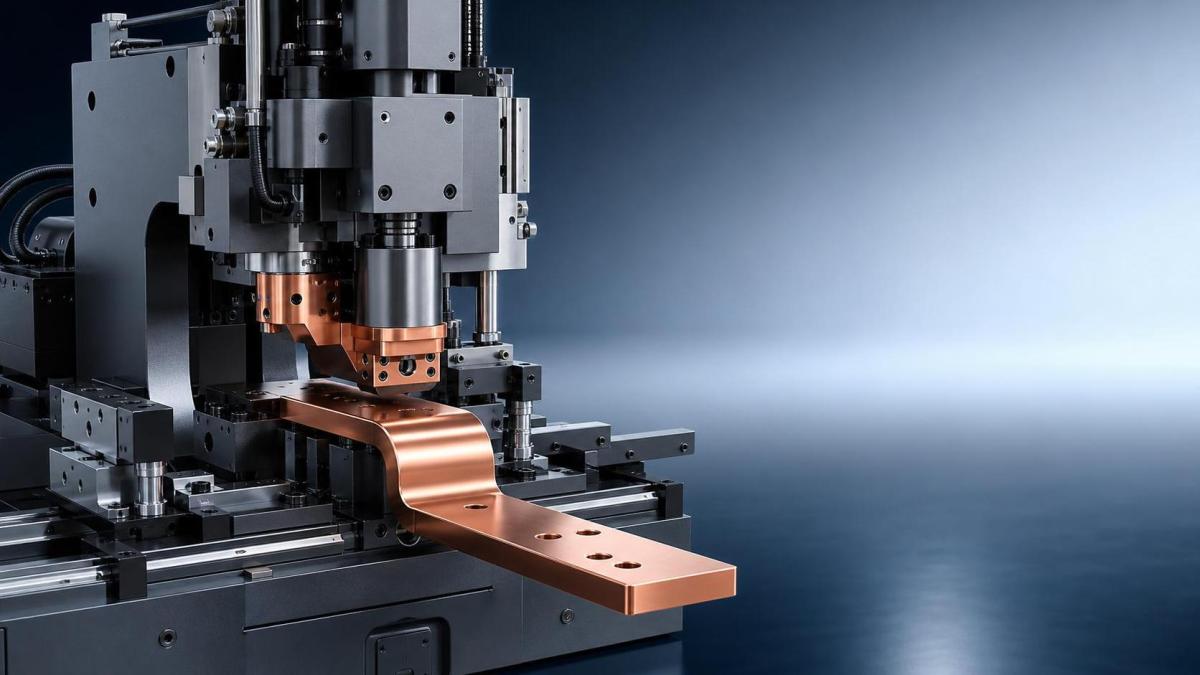
Accuracy is more than dimensional tolerance
Accuracy in busbar processing should be read as a combination of position repeatability, angle consistency, hole-to-edge relationship, and part-to-part stability over a full shift. Technical evaluators often focus on the final dimension, but repeatability is what protects assembly quality later.
If the machine punches accurately on the first few parts and then drifts as the die heats up or the operator changes material thickness, that is an operational problem, not just a metrology problem. The same applies to bending. A machine may hit the programmed angle in trial mode yet vary once different bar widths are loaded in sequence.
A practical review usually includes these questions:
- How is positioning achieved: manual stop, mechanical backgauge, CNC axis, or servo positioning?
- What controls the stroke and return point, and how repeatable is that method over continuous cycles?
- Are the molds and dies built for stable alignment, or does setup quality depend too much on operator correction?
- How easy is it to maintain the same result across both copper and aluminum, which do not behave identically in forming?
If you are comparing machines with similar force ratings, this is usually where the real difference appears. DXJ positions its busbar equipment around precision molds, stable drive components, and controlled manufacturing quality, which matters because accuracy loss often starts with mechanical wear and poor tooling before it shows up in the finished bar.
Define processing range the way production uses it
“Processing range” sounds like a basic size specification, but it should be read much more carefully. The usable range is not only the maximum width, thickness, or hole size. It also includes the minimum workable part length, clearance around the tool, available throat depth, bend interference, and whether the machine handles short runs and frequent changeovers without losing rhythm.
For example, a machine may accept a wide bar dimensionally but struggle when the hole is close to the edge or when multiple bends create interference with the frame. Another machine may cover the full thickness range but require repeated repositioning, which hurts throughput and adds handling error.
Look past the core numbers and inspect the control method
A machine that fits the load and size requirement can still be the wrong choice if control logic is weak. For technical buyers, this usually shows up in two places: setup time and repeat work. If angle changes, hole spacing changes, and mixed batches are common, CNC control and reliable stop positioning save more cost than a marginal increase in rated force.
This is also a good point to separate busbar processing equipment from other coil and transformer production machines in the same workshop. For instance, DXJ-RX1T Horizontal Coil Winding Machine (1 Ton) is built for winding high and low voltage coils, with features such as stepless speed regulation, automatic braking, and turn counting through a touch screen. Those are useful production-control ideas, but they serve a different process. In a Busbar Machine review, the equivalent question is whether the control system supports repeatable positioning, fast changeover, and stable execution of bending, punching, cutting, or embossing tasks.
Tooling quality and frame rigidity decide whether the specs hold up
On paper, two machines can look close. On the floor, die quality, mold precision, and structural rigidity separate a dependable production tool from a machine that needs constant adjustment. That matters even more when processing copper busbar, where surface marking, hole distortion, and bend inconsistency are hard to hide downstream.
A few checks worth making before approval:
- Ask what material and machining standard are used for molds and dies.
- Inspect whether the frame design resists deflection at working load.
- Review motor and hydraulic component quality, especially if the machine will run long shifts.
- Check how quickly wear parts can be replaced and whether spare tooling is practical to stock.
Dexinjia’s positioning around precision molds, pure copper motors, and controlled manufacturing standards is relevant here because long-term stability is usually earned in components and build quality, not in brochure language.
Match the technical spec to the buying decision
For a technical evaluation, I would not rank options by tonnage first. I would filter them in this order: actual process range, consistency of accuracy, operation-specific force capacity, tooling quality, then serviceability. Certifications such as ISO, CE, 3A, or EAC are useful checkpoints for supplier discipline and market access, but they do not replace a process-fit review.
If your parts are stable and limited in variety, a standard machine with the right range may be enough. If dimensions vary often, or if operators switch between copper and aluminum jobs through the week, give more weight to positioning control, die change efficiency, and repeatability under mixed production.
The cleanest way to avoid a bad selection is simple: list your largest and smallest busbar sizes, define the critical tolerances on bends and holes, identify the highest-frequency part family, and review every candidate machine against those four realities. That sequence exposes weak specifications quickly and keeps the decision tied to production, where it belongs.
Send Us A Message
Get in Touch
*We respect your confidentiality and all information are protected.

First class quality service and professional after-sales team.