


How to Choose a Busbar Machine for Copper Bar Cutting, Punching, and Bending?
A Busbar Machine looks straightforward on a brochure: cut, punch, bend, done. In real evaluation work, the wrong choice usually shows up later, when the copper bar springs back more than expected, hole position drifts across batches, or setup time eats the shift. For technical evaluators, the job is not to pick the machine with the longest feature list. It is to match processing capability, mechanical stability, tooling quality, and service support to the actual copper bar workload on your floor.
The quickest way to make a sound decision is to review the machine in the same order your production team will use it: material in, cut, punch, bend, inspect, repeat. That sequence exposes weak points fast.
Start with the copper bar, not the machine catalog
Before comparing any Busbar Machine, define the full processing range. That means bar width, thickness, material grade, batch size, hole patterns, bend angles, and whether aluminum is also part of the plan. Many selection mistakes happen because the evaluation is based on the “main” product only, while the difficult jobs are treated as exceptions. Those exceptions usually become the reason for downtime or outsourcing.
- List the maximum and minimum copper bar sizes you actually run.
- Mark the jobs with tight bend consistency or dense punching layouts.
- Separate prototype work from repeated production work.
If the machine only handles your average part well, it is not the right machine.
Check whether one machine really fits your workflow
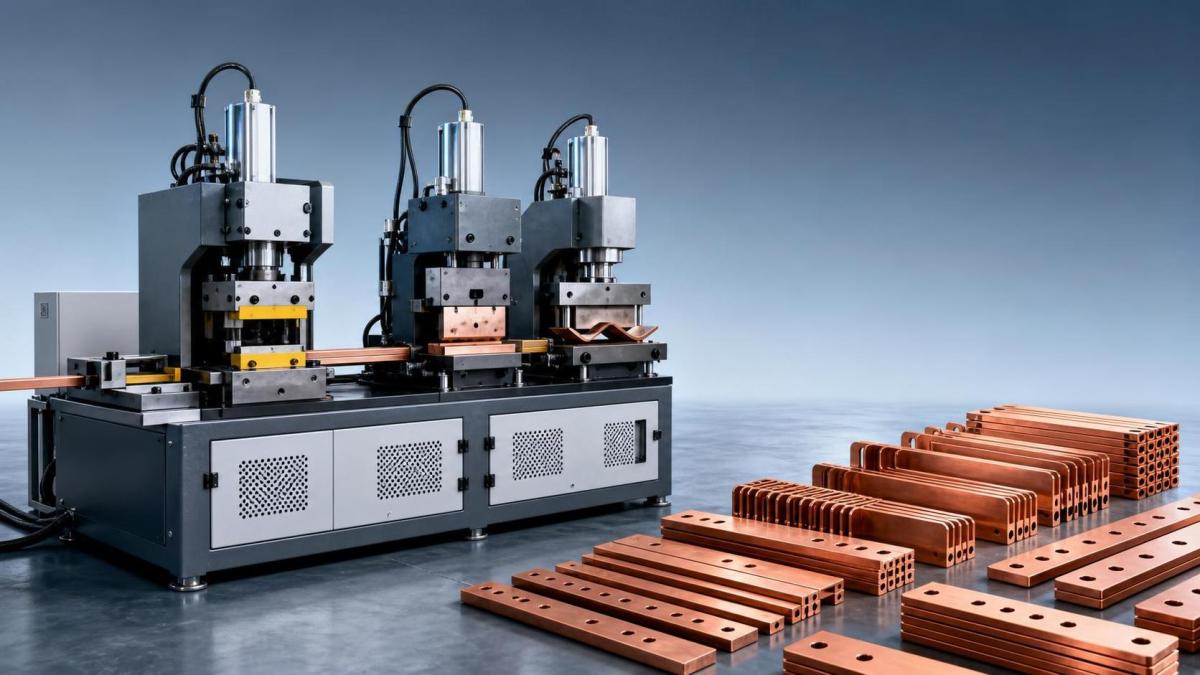
A 3-in-1 busbar machine makes sense when floor space is limited and operators need one station for cutting, punching, and bending. A dedicated CNC bending machine or portable hydraulic equipment can be a better fit when the process is unbalanced, for example when bending accuracy matters more than punching speed, or when field work is part of the job.
This is where supplier positioning matters. Manufacturers focused on busbar processing, such as DXJ, usually offer standard and customized configurations across fixed and portable equipment, which is useful when your process does not fit a single standard layout. Still, do not buy the category first. Buy the process fit.
Judge cutting quality by edge condition and repeatability
Cutting force alone tells you very little. What matters is whether the section stays square, burr remains controlled, and repeated cuts hold length consistently. On copper bars, poor blade alignment or weak frame rigidity usually shows up as rough edges, deformation near the cut, or inconsistent final dimensions.
Ask for sample cuts on material close to your own size range. Look at the edge, not just the cut speed. If operators need frequent rework after cutting, that “fast” machine is already costing you more than it saves.
Treat punching accuracy as a tooling and alignment question
Punching quality depends on more than tonnage. Die precision, guide stability, and positioning method all affect hole accuracy. For technical review, check how the machine locates the bar, how easy it is to change dies, and whether the punch station remains stable during repeated work.
A common mistake is approving a machine based on a single clean hole sample. The better test is a short repeated run. If hole spacing begins to drift or burr changes from part to part, the problem is usually in the guiding, tooling fit, or structural stiffness.
For bending, watch springback control and setup logic
Bending is usually where evaluators separate a usable machine from a frustrating one. Copper bar bending has to stay consistent over repeated angles, especially when downstream assembly allows little tolerance. Review the mold quality, bending force stability, and adjustment process for different bar sizes.
Do not focus only on whether the machine can reach the target angle. Check whether it can reach it again without trial-and-error correction. A machine that needs constant operator compensation will produce acceptable first pieces and unstable batch output.
Look closely at the drive system and build quality
Motor quality, frame rigidity, hydraulic stability, and mold machining all affect long-term performance more than sales claims do. DXJ emphasizes high-quality materials, precision molds, and pure copper motors in its busbar equipment, and that is the right area to inspect because these details influence noise, service life, and output stability.
Ask practical questions during evaluation:
- How does the machine behave during continuous operation, not just a short demo?
- Which wear parts are expected to be replaced most often?
- How are molds manufactured and matched to the machine?
- What maintenance points must operators handle weekly?
The answers will tell you more than a specification sheet.
Review controls from the operator’s side
Technical evaluators sometimes underestimate usability because they assume operators will adapt. They do, but at a cost. If controls are awkward, measurement references are unclear, or setup takes too many steps, output drops and mistakes climb.
Even when reviewing equipment outside the core busbar line, the same principle applies. For example, DXJ-RX1T Horizontal Coil Winding Machine (1 Ton) uses a touch-screen counting method, stepless speed regulation, and automatic stop by preset turns. That is not a busbar machine, but it shows a useful design mindset: the better the control logic, the less the process depends on operator correction. Bring that same standard to busbar cutting, punching, and bending equipment.
Do not skip certification and document checks
Certification does not replace technical evaluation, but it does matter for compliance and purchasing risk. If the supplier states ISO, 3A, CE, or EAC coverage, review which documents apply to the exact machine model you are buying and whether the nameplate, manual, and supplied paperwork match. This matters more for export projects, customer audits, and internal approval workflows than many buyers expect.
What you are checking here is simple: model consistency, document completeness, and whether the supplied machine configuration matches the quoted one.
After-sales support is part of machine capacity
When a busbar line stops, the issue is rarely philosophical. It is usually a worn die, a control fault, a hydraulic issue, or a setup question that needs a fast answer. So service response, spare parts availability, training, and technical support should be part of your selection checklist, not an item left for procurement at the end.
Dexinjia positions itself around standard models, customized busbar processing solutions, technical support, and global after-sales service. That is useful if your production mix is likely to change, but you still need specifics: which parts are stocked, what training is included, and how remote troubleshooting is handled.
A practical decision sequence
If you need a clean way to close the evaluation, use this order. Define your copper bar range and key tolerances. Test cutting quality on representative material. Run repeated punching samples, not one-off pieces. Verify bending consistency on your difficult sizes. Review the drive system, tooling, and maintenance points. Then confirm documents, spare parts, and service response.
That sequence keeps the decision anchored in production reality. A good Busbar Machine is not the one that looks strongest on paper. It is the one that holds accuracy through repeated cutting, punching, and bending, fits your actual workflow, and can be supported properly after installation.
Send Us A Message
Get in Touch
*We respect your confidentiality and all information are protected.
First class quality service and professional after-sales team.